
Dine Brands in Late 2026: Franchise Economics, Governance Moves, and the Stakes of Liquidity in Casual Dining
The company’s recent rejection of a takeover bid and adoption of a stockholder rights plan underscore both its perceived value and the risks of misalignment between management and shareholders.
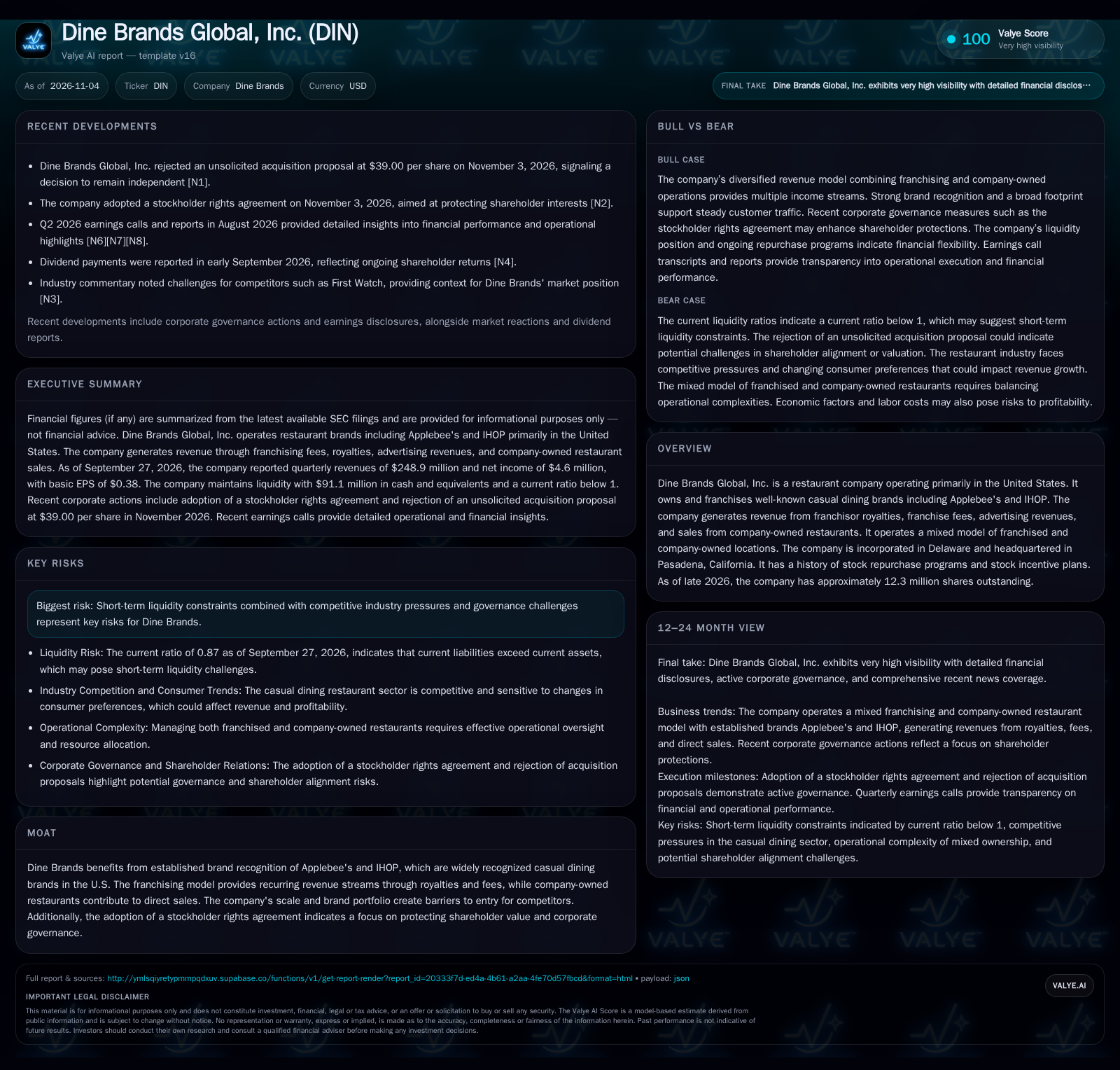
Dine Brands Global combines high-recognition brands and a franchise-centric model with mixed company/franchise operations. As of late 2026, it reported quarterly revenue of $248.9 million, net income of $4.6 million, and cash of $91.1 million, but current liabilities exceed current assets. Recent moves include rejecting a $39/share acquisition offer and adopting a stockholder rights agreement. [S2] [N1] [N2]
Dine Brands Global, the operator and franchisor behind Applebee’s and IHOP, stands at a crossroads in late 2026. The company’s decision to reject a $39 per share acquisition proposal and to adopt a stockholder rights agreement signals both confidence in its long-term value and a desire to chart its own course amid a rapidly evolving casual dining landscape. The question is whether Dine Brands can capitalize on its franchise-driven model while navigating operational, financial, and governance complexities that define the sector today. [S2] [N1] [N2]
Recent Moves: Liquidity, Governance, and Strategic Independence
As of September 27, 2026, Dine Brands reported quarterly revenues of $248.9 million and net income of $4.6 million, with cash and equivalents totaling $91.1 million. However, its current liabilities of $330 million exceed current assets of $287.4 million, resulting in a current ratio of 0.87 and a cash ratio of 0.28. This points to short-term liquidity pressure, even as operations remain profitable. [S2]
On November 3, 2026, Dine Brands rejected an unsolicited acquisition offer at $39.00 per share and simultaneously adopted a stockholder rights agreement. These actions suggest management’s intent to defend strategic autonomy and protect shareholder interests, but also highlight the risk of misalignment between management and some shareholders who might have favored the offer. [N1] [N2]
The cited source reports dividend-related activity; that disclosure alone does not establish dividend-policy continuity, management confidence, or a material constraint on capital flexibility. [N4]
How the Franchise Model Drives Cash Flow—And Where It Can Break
Dine Brands’ core economic engine is its franchise model, which generates recurring revenue through royalties, franchise fees, and advertising contributions from franchisees. These royalty streams are typically based on a percentage of gross sales and are less capital-intensive than direct restaurant operations, allowing for higher margins and lower capital requirements per dollar of system sales than a fully company-owned model.
The company-owned restaurant segment, while providing direct sales and operational flexibility, exposes Dine Brands to labor, food, and occupancy cost volatility. This segment tends to have lower margins and requires more working capital, especially in inflationary or volatile demand environments.
Operating leverage is a double-edged sword in this model. When same-store sales are rising, incremental royalties and advertising fees flow through with limited incremental cost, boosting margins. However, if franchisee health deteriorates—due to sales declines, rising costs, or unit closures—royalty streams can quickly come under pressure. Franchisee financial stress can also increase the risk of bad debt, deferred payments, or the need for franchisor support.
Capital allocation remains a central question: repurchase programs, dividends, and capital expenditures must be balanced against liquidity needs and long-term reinvestment in the brands.
Brand Power, Franchise Scale, and the Realities of Casual Dining Competition
Applebee’s and IHOP remain among the most recognized brands in U.S. casual dining, providing Dine Brands with significant consumer mindshare and a large, established footprint. This scale supports national advertising, menu innovation, and purchasing leverage with suppliers.
The franchise model provides some insulation from regional downturns and operational execution risks, as franchisees bear direct operating responsibility. However, the sector is intensely competitive—rival chains, fast-casual entrants, and even quick-service brands compete aggressively for consumer traffic, especially as off-premise and digital ordering reshape the landscape.
Brand strength and network breadth create some switching frictions for franchisees and diners, but not insurmountable ones. Franchisees may have long-term contracts, but if unit economics deteriorate, terminations or conversions to other concepts become plausible over time.
Technology adoption, menu adaptation, and value-for-money perceptions will be critical to maintaining traffic and share. The company’s ability to support franchisees through digital investments and operational innovations may determine its long-term competitive resilience.
If Franchise Health Holds, Margin Expansion and Strategic Optionality Follow
Corporate governance moves—such as the stockholder rights agreement—could provide the time and flexibility needed to pursue organic or inorganic growth, repositioning, or even a higher-value strategic transaction in the future.
Evidence that would confirm this scenario includes: sustained or improving same-store sales growth across both brands, stable franchisee unit counts, continued positive cash flow after dividends, and no material increase in franchisee support costs or bad debt. Announcements of new franchise agreements, digital platform enhancements, or successful menu innovation would further support the upside case.
Franchise Stability Offsets Margin Pressure, But Liquidity Remains Tight
The most plausible outcome is that Dine Brands continues to generate stable, if unspectacular, cash flow from its franchise base, but faces ongoing margin pressure from labor and commodity costs, as well as soft traffic trends in casual dining. Franchisee closures may be limited but not eliminated, and company-owned locations could see fluctuating performance.
Liquidity remains a constraint: the company must carefully manage working capital and capital allocation, possibly moderating share repurchases or dividend growth to preserve flexibility. The stockholder rights plan may protect against opportunistic takeovers, but could also be a source of tension with some investors if performance lags.
This scenario would be confirmed by relatively flat systemwide sales, stable unit counts, continued but modest profitability, and no sharp deterioration in liquidity ratios. Evidence to the contrary would include rising franchisee delinquencies, accelerating closures, or the need to suspend dividends or repurchases.
Liquidity Squeeze and Franchisee Stress Could Trigger a Strategic Reset
In an adverse scenario, persistent cost inflation, weak consumer spending, or brand fatigue drive same-store sales declines. Franchisees, facing margin compression, may close units or seek concessions, causing royalty streams to shrink and bad debts to rise. Company-owned locations could swing to losses, putting further strain on cash flow.
With a current ratio below 1, Dine Brands could be forced to curtail dividends, suspend repurchases, or seek external financing under less favorable terms. If liquidity tightens further, the company may need to sell company-owned units, monetize assets, or reconsider strategic alternatives—including a potential sale under pressure.
Warning signs would include a spike in franchisee assistance, a sharp drop in system sales, negative cash flows, credit rating downgrades, or any move to restructure debt or renegotiate covenants. Significant management or board turnover could also signal distress.
Benchmarks That Will Shape Dine Brands’ Trajectory Through 2027
Quarterly same-store sales growth for both Applebee’s and IHOP—reported systemwide and by segment—would help test the resilience of customer demand.
Franchisee unit counts and net openings/closings by brand, if disclosed, provide an early signal of system health and future royalty streams.
Levels of franchisee assistance, bad debt expense, or deferred royalty payments—if reported—would indicate underlying stress in the franchise base.
Free cash flow after dividends and repurchases, if disclosed, is critical for assessing true potential financial flexibility.
Any new franchise agreements, refranchising transactions, or digital platform investments would reveal management’s growth and modernization priorities.
Evidence of increased promotional activity, menu changes, or customer traffic initiatives would show responsiveness to competitive and consumer trends.
Disclosure of debt covenant headroom or any new financing arrangements would provide visibility into the company’s ability to weather external shocks.
Disclaimer: This is research-only, informational analysis and not investment advice. It may include AI-generated interpretation and general industry context. Always verify important details using primary sources.

Comments