
Twin Disc in 2026: Backlog Strength, End-Market Cyclicality, and the Stakes of Product Diversification
Twin Disc’s robust backlog and recent product-line expansion anchor its near-term visibility, but the company’s exposure to cyclical marine and energy markets, commodity costs, and global supply-chain complexity pose ongoing challenges. The question is whether engineering investment and strategic acquisitions can build resilience against macro volatility and competitive pressure.
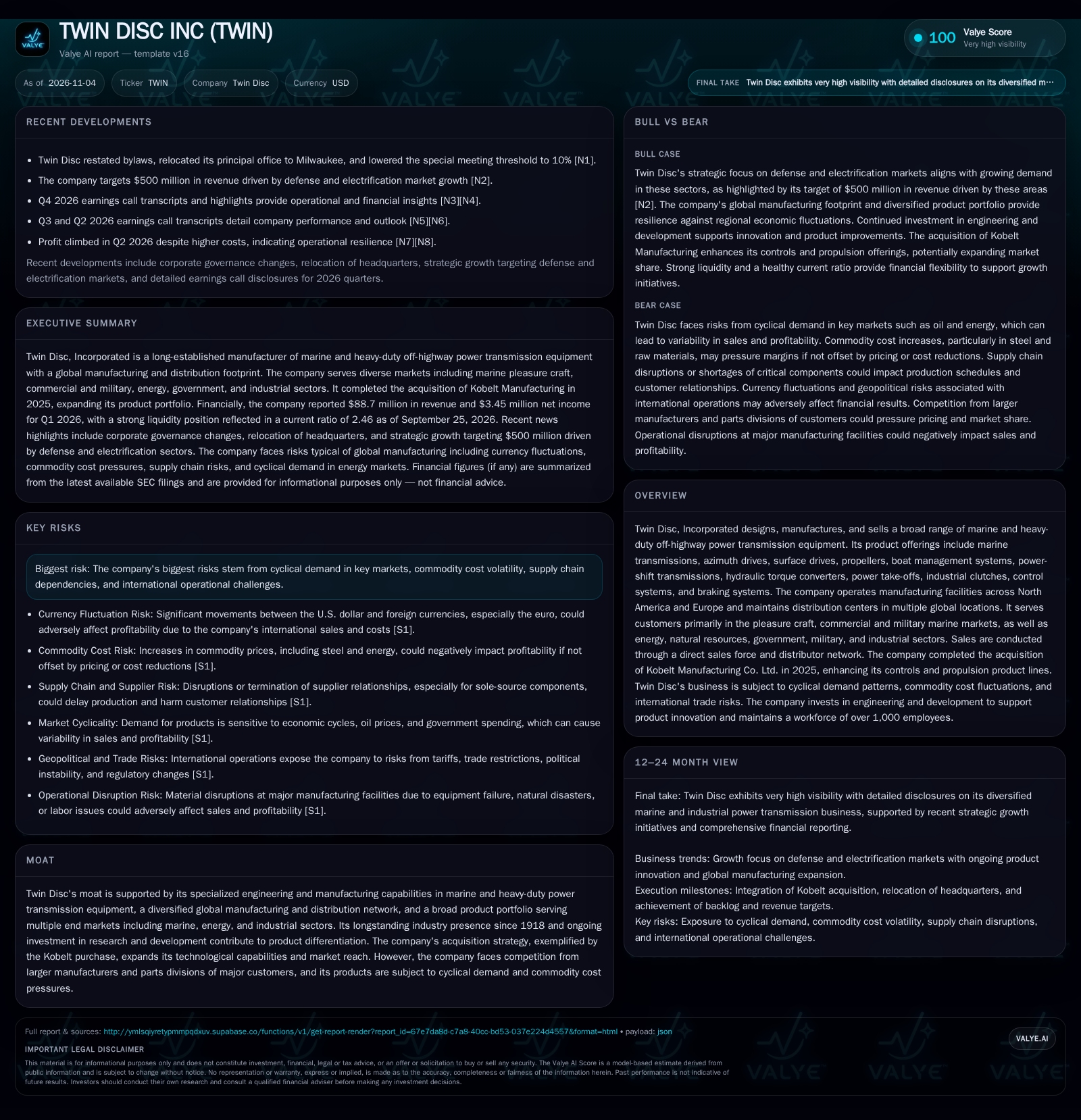
Twin Disc enters late 2026 with $178.3M in open orders, positive earnings momentum, and an expanded controls and propulsion portfolio via the Kobelt acquisition. While its diversified product offering and global footprint provide some insulation, the company remains exposed to demand swings in marine and energy sectors, commodity cost volatility, and execution risks tied to supply chain and international operations. The next phase hinges on converting backlog, sustaining margin discipline, and capturing growth from electrification and defense initiatives. [S1] [S2] [N1] [N7] [N8]
Twin Disc, a century-old manufacturer of marine and heavy-duty power transmission equipment, faces a familiar industrial paradox in 2026: a substantial backlog and global reach create near-term stability, while its fate remains tightly linked to volatile end-markets and cost inputs. Recent profit growth, an expanded product suite through the Kobelt acquisition, and ongoing engineering investment point to operational progress. Yet, the company’s ability to sustain growth and margin discipline will be tested by cyclical demand shifts, supply chain complexity, and mounting competitive pressures in both traditional and emerging segments like electrification and defense. The next chapter for Twin Disc hinges on execution, innovation, and navigating macroeconomic crosscurrents.
Backlog, Earnings Momentum, and Portfolio Expansion Define Twin Disc’s 2026 Position
Twin Disc reported $178.3 million in unfilled open orders as of June 30, 2026, signaling strong demand visibility into the coming quarters and providing a buffer against short-term market fluctuations. [S1] Profit climbed in Q2 2026 despite increased costs, and Q4 continued this trend, suggesting operational resilience and some success in passing through or offsetting cost pressures. [N7] [N8] The company completed the acquisition of Kobelt Manufacturing in February 2025, expanding its controls, propulsion, steering, and braking systems product lines—an important step toward broadening its market reach and deepening its offering in both marine and industrial segments. [S1] These developments underpin the company’s current narrative: healthy order flow, margin improvement, and strategic expansion, but still with substantial exposure to the cyclical nature of its end markets.
How Twin Disc’s Product Mix and Cost Structure Shape Its Economic Leverage
Twin Disc generates revenue by designing, manufacturing, and selling power transmission equipment—marine transmissions, drives, clutches, and control systems—primarily to OEMs and large integrators in marine, energy, and industrial sectors. The company’s economics are shaped by a mix of engineered-to-order and catalog products, with pricing power generally dependent on technical differentiation, switching costs for bespoke applications, and the capital intensity of customer fleets. High engineering and development costs ($13.4 million in fiscal 2026) reflect the need for ongoing product innovation, especially as customers demand more integrated and digitalized control solutions. [S1]
Fixed costs are significant, given Twin Disc’s global manufacturing and distribution footprint, but the company’s ability to leverage this base depends on throughput and order visibility—hence the importance of backlog. Variable costs are dominated by materials (notably steel and electronics), labor, and logistics, all of which are subject to global commodity price swings and supply chain disruptions. Gross margins can be pressured by rising input costs unless offset by price increases or operational efficiencies. The company reported cash and liquidity metrics for the period; these figures do not by themselves establish operating runway, investment capacity, financial flexibility, or financing capacity. [S2]
Capital requirements are moderate for a heavy industrial: investment in plant, tooling, and R&D is essential, but product cycles and customer relationships can be long, supporting multi-year sales opportunities if execution is strong. The economics of the Kobelt acquisition will hinge on integration efficiency and the ability to cross-sell into Twin Disc’s existing channels.
Differentiation, Distribution, and the Challenge from Larger Players
Twin Disc’s competitive position is anchored by specialized engineering capabilities, a broad range of power transmission products, and a global network of manufacturing and distribution sites. This enables the company to serve both niche and mainstream applications across pleasure craft, commercial marine, military, and energy sectors. The acquisition of Kobelt enhanced its value proposition in integrated controls and propulsion, potentially increasing switching costs for customers who value single-vendor solutions.
However, the company faces competition from both large diversified industrials and OEM in-house divisions, which can exert price pressure and offer bundled solutions. In marine and off-highway, barriers to entry are moderate: certification requirements, reliability track records, and integration complexity matter, but scale players may have cost advantages and greater R&D resources. Substitution risk is rising as electrification, digital controls, and alternative propulsion technologies evolve; Twin Disc’s response—ongoing engineering investment and portfolio expansion—could mitigate this but requires successful execution.
Distribution is a double-edged sword: a direct sales force and global distributors provide reach, but also introduce channel conflict and margin dilution risks if end-market demand weakens. Customer concentration is notable, with the top 10 customers representing 36% of sales, making relationship management and retention critical in a competitive landscape. [S1]
How Electrification, Defense, and Integration Could Drive Outperformance
An upside scenario for Twin Disc would see sustained conversion of its $178.3 million backlog into profitable sales, supported by continued order inflows from defense, electrification, and high-performance marine segments. If the company successfully leverages the Kobelt acquisition to offer more integrated, high-value systems, it could capture greater wallet share from existing customers and win new programs, especially as OEMs seek to simplify their supply chains.
Margin expansion would be plausible if Twin Disc can pass through commodity cost increases, benefit from operational efficiencies, and achieve higher utilization across its manufacturing base. Evidence of this scenario would include rising gross margins despite input volatility, new multi-year contracts or platform wins in electrification or defense, and above-trend order growth from new product lines. Falsification would be signaled by stagnating order intake, inability to sustain gross margins, or integration difficulties with acquired businesses.
Mixed End-Markets and Cost Headwinds Sustain a Balanced Outlook
The most plausible path for Twin Disc is continued revenue and earnings growth at a moderate pace, supported by backlog conversion and incremental share gains in core marine and industrial segments. The company is likely to face ongoing margin pressure from commodity costs and labor inflation, offset in part by pricing actions and manufacturing efficiencies. Backlog provides near-term visibility, but the cyclical nature of its end markets—especially oil & gas, commercial marine, and industrial—suggests periodic volatility in order intake and sales.
Engineering investment will likely support product refreshes and incremental innovation, but breakthrough growth depends on successful integration of acquired capabilities and capturing new applications in defense and electrification. Confirmation of this scenario would include stable or slowly rising revenues, steady gross margins, and continued investment in R&D. Falsification would come from a sharp drop in orders, persistent margin erosion, or evidence of market share loss to larger competitors or technological substitutes.
Order Slippage, Supply Chain Disruptions, and Margin Squeeze as Threats
A downside scenario could materialize if cyclical downturns in marine, energy, or industrial end-markets trigger order cancellations or delayed deliveries, eroding backlog and reducing factory utilization. Concurrent commodity price spikes or extended supply chain disruptions—for example, shortages in steel or electronic components—could compress gross margins if Twin Disc is unable to pass through costs or find alternative suppliers.
Customer concentration risk could also materialize if a major OEM or fleet operator insources production or switches to a competitor, amplifying revenue and margin volatility. Integration missteps with Kobelt, or failure to deliver on promised synergies and cross-selling opportunities, could further drag on profitability. Confirmation would be visible in falling order book, declining revenues, negative operating leverage, or significant one-off charges tied to restructuring or supply chain issues.
Metrics and Milestones That Will Test Twin Disc’s Resilience and Growth Ambitions
Order intake and backlog progression quarter-over-quarter, especially in new product lines and geographies, will show whether momentum is building or stalling.
Gross margin trends relative to commodity cost indices and pricing actions—sustained improvement would signal successful cost management and pricing power.
Revenue mix by end market (marine, energy, defense, industrial) if disclosed, helping to gauge diversification and exposure to cyclical sectors.
Integration progress and revenue contribution from the Kobelt acquisition, including cross-selling evidence and product development milestones.
R&D spending as a percentage of revenue, and whether new product launches are translating into incremental orders.
Customer concentration metrics and retention rates—significant changes would indicate shifting competitive dynamics.
Supply chain lead times, inventory turns, and any reported disruptions or mitigation actions, as these directly impact execution and margins.
Developments in electrification or defense-related contracts, as wins here could validate the strategic growth narrative.
Disclaimer: This is research-only, informational analysis and not investment advice. It may include AI-generated interpretation and general industry context. Always verify important details using primary sources.

Comments