
Vishay Precision Group in Late 2026: Margin Pressures, Strategic Shifts, and the Stakes of Industrial Sensing Expansion
VPG’s latest quarter underscores the tension between expanding demand for precision sensing—particularly in AI and automation—and persistent margin constraints. As the company pursues operational improvements and targets new applications, the core questions hinge on its ability to convert innovation and acquisitions into durable earnings growth.
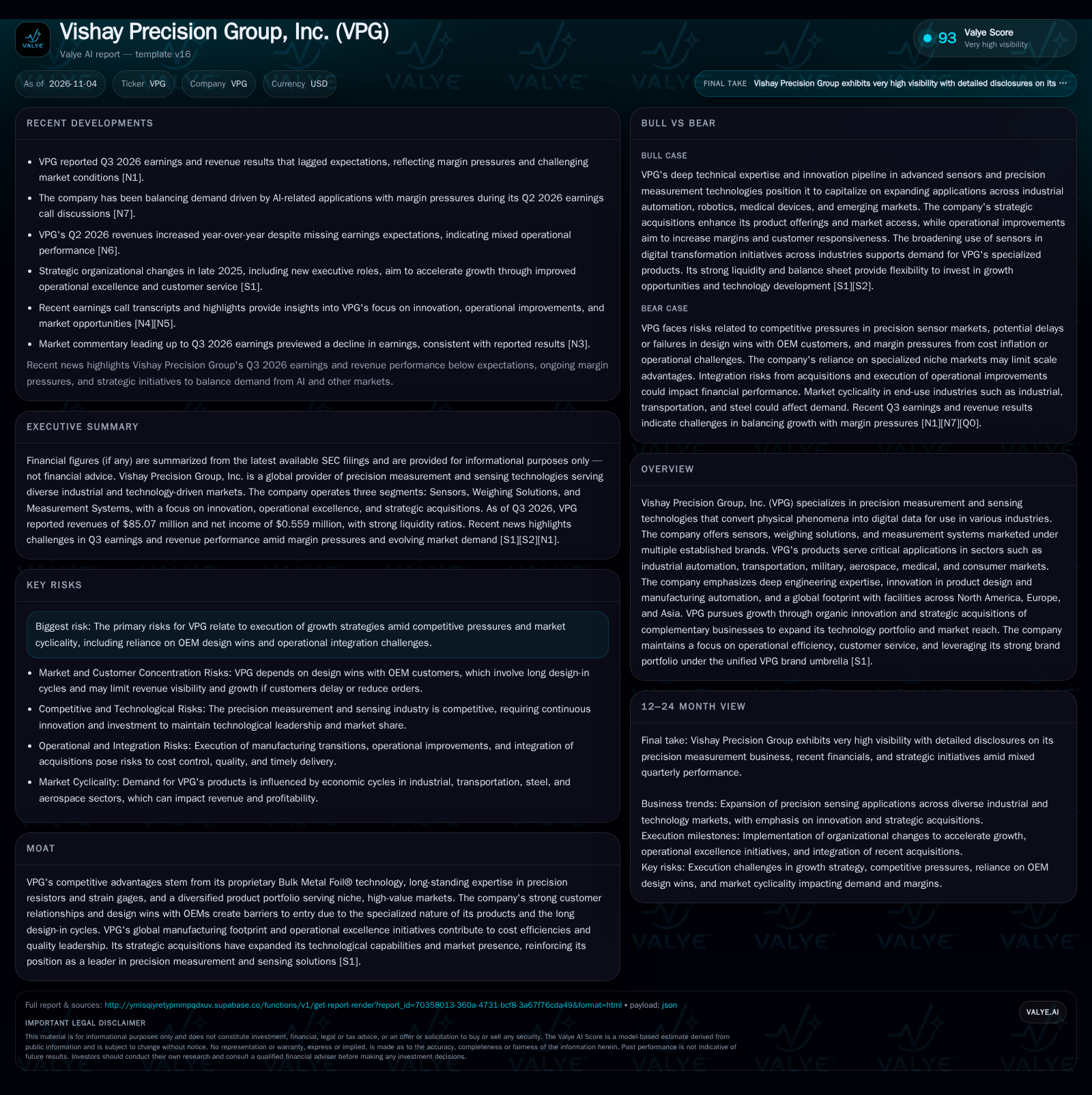
VPG’s Q3 2026 results highlight revenue growth but continued margin pressure, driven by a changing mix of industrial and technology markets. The company is leaning on innovation, operational changes, and recent acquisitions to improve performance. The critical test is whether these moves can overcome competitive and cyclical headwinds to deliver sustainable profitability gains. [S1] [S2] [N1] [N7]
Vishay Precision Group’s most recent financials and strategic pivots encapsulate the realities of operating in the high-mix, high-stakes world of precision measurement technology. While demand for sensors and measurement systems continues to broaden—driven by trends in automation, AI, and digital transformation—VPG’s Q3 2026 results illustrate the persistent challenge of translating top-line momentum into sustainable margin improvement. The company’s response—a blend of innovation, acquisitions, and operational restructuring—sets the stage for a pivotal period in which execution, not just opportunity, will likely determine the trajectory of earnings and shareholder value.
Recent Financials Highlight Margin Strain Despite Revenue Growth
VPG reported Q3 2026 revenue of $85.07 million, with net income of $0.559 million and earnings per share of $0.04, falling short of expectations and reflecting ongoing margin challenges. The company’s cash and equivalents stood at $80.85 million, with a current ratio of 3.59 as of October 3, 2026. Management commentary and news coverage point to continued pressure from rising costs and a changing sales mix, particularly as demand from AI-related and industrial automation sectors increases. These results follow a pattern of revenue growth not translating into proportional earnings gains, sharpening focus on the effectiveness of VPG’s operational improvements and cost controls. [S2] [N1] [N7]
How Product Mix and Innovation Shape Earnings Potential
VPG’s business model is rooted in selling high-precision sensors, weighing solutions, and measurement systems into a wide range of industrial, technology, and specialty markets. Pricing power in these markets typically hinges on the degree of product customization, performance differentiation, and integration into customer systems—particularly for applications with stringent reliability or regulatory requirements. The company’s segment structure (Sensors, Weighing Solutions, Measurement Systems) allows for a blend of recurring and project-based revenue, but the economics can vary: sensors and resistors sold into OEMs often involve long design-in cycles and potentially sticky relationships, while weighing and measurement systems may be more exposed to cyclical capital spending.
VPG’s focus on innovation—such as advanced sensors with smaller form factors and lower power consumption—could enable premium pricing and access to new markets like medical and industrial robotics. However, margin expansion will depend on the company’s ability to scale these products, manage input costs, and sustain manufacturing automation gains. Acquisitions add technology breadth and customer reach, but integration costs and the need to harmonize product portfolios can dilute near-term profitability. Fixed-cost leverage is available through global manufacturing, but high engineering and SG&A intensity, along with exposure to variable demand, can limit operating leverage if volumes do not accelerate.
Defending Niche Leadership in a Fragmented, Innovation-Driven Landscape
VPG’s competitive strengths derive from proprietary technologies (such as Bulk Metal Foil® resistors), deep engineering expertise, and strong OEM relationships—particularly in applications where precision, reliability, and long qualification cycles could increase switching costs. The company’s multi-brand strategy and global manufacturing footprint allow it to serve diverse geographies and end markets, from avionics and military to industrial automation and medical devices.
However, the competitive landscape is fragmented and dynamic, with specialized sensor and measurement companies, diversified industrial conglomerates, and emerging technology players all vying for share. Price-based competition is acute in commoditized segments, while technological obsolescence risks loom as customers look for smaller, smarter, and more integrated solutions. VPG’s reliance on design wins with OEMs creates both defensibility (due to long product lifecycles) and vulnerability (if competitors leapfrog in innovation or if key customers change suppliers). The company’s strategy to grow through acquisitions can strengthen its competitive moat, but successful integration and retention of acquired talent and IP are critical for sustaining differentiation.
Margin Recovery Through Innovation and Integration: What Would Shift the Narrative
The favorable scenario hinges on VPG translating its innovation pipeline and recent acquisitions into higher-margin, higher-growth segments—particularly as demand for advanced sensors in AI, automation, and robotics accelerates. If the company’s new product introductions gain traction in medical and industrial robotics, and if manufacturing automation and process improvements deliver cost savings, VPG could see both gross and operating margin expansion.
Confirmation would come from sequential improvement in gross margin percentage, evidence of premium pricing on new sensor lines, and a more favorable revenue mix from proprietary, less commoditized products. Additional signals would include successful integration of acquired businesses, with synergies reflected in SG&A leverage and expanded addressable markets. Tangible design wins with blue-chip OEMs in growth sectors, coupled with stable or rising backlog (if disclosed), would further validate the upside case.
Operational Progress Tempered by Industry Cyclicality and Execution Risks
The most plausible path forward is one of incremental improvement: VPG leverages its global footprint and operational refinements to defend share in core industrial, transportation, and specialty markets, while gradually expanding into emerging applications. Revenue growth continues, but margin recovery is slow, reflecting persistent input cost pressures, integration expenses from acquisitions, and the lag between R&D investment and commercial payoff.
Evidence supporting this scenario would include stable to modestly improving operating margins, continued investment in product development, and periodic announcements of design wins or new customer relationships in targeted verticals. However, if margin gains remain elusive and earnings growth is inconsistent, it would suggest that competitive intensity, cost inflation, or integration complexity are offsetting the benefits of innovation and scale.
If Margin Pressures Deepen and Integration Falters
The most adverse scenario would see VPG unable to offset rising costs and competitive pricing pressure, with margin erosion outpacing revenue growth. This could result from failed or delayed integration of recent acquisitions, stalled uptake of new products, or a downturn in cyclical end markets such as industrial, steel, or transportation. The company’s exposure to OEM design cycles could amplify volatility if major customers delay projects or switch to alternative suppliers.
Confirmation of this scenario would come from declining gross and operating margins, negative earnings surprises, or a spike in restructuring or integration costs. Additional warning signs would include lower R&D productivity (as measured by new product revenue contribution, if disclosed), customer concentration risk materializing in lost contracts, or heightened inventory write-downs linked to obsolete or unsold products.
Milestones and Metrics That Will Determine Whether VPG Converts Opportunity Into Profitable Growth
Quarterly gross and operating margin trends—improvement would support the margin recovery thesis, while compression would reinforce downside risk.
Revenue mix by segment and product line, especially the share from new sensor technologies and higher-value measurement systems, if disclosed, to assess the transition toward less commoditized offerings.
Pace and success of integration for recent acquisitions, including cost synergies and retention of key talent and customers.
Design win announcements with major OEMs in growth sectors such as robotics, medical devices, and AI-enabled industrial automation.
R&D efficiency metrics—such as the percentage of revenue from products launched in the last three years, if disclosed—to gauge innovation payoff.
Trends in input costs and supply chain stability, given ongoing margin pressures cited in recent quarters.
Evidence of operational excellence gains from organizational restructuring and process standardization, as reflected in SG&A as a percentage of revenue.
External demand signals from core end markets (industrial, transportation, steel) that could indicate cyclical upturns or downturns affecting order momentum.
Disclaimer: This is research-only, informational analysis and not investment advice. It may include AI-generated interpretation and general industry context. Always verify important details using primary sources.

Comments