
Royalty Pharma in 2026: Income Volatility and the Impact of Portfolio Concentration on Biopharma Funding
Royalty Pharma’s Q3 2026 results highlight the company’s unique position as the leading aggregator of pharmaceutical royalty streams, but also expose structural earnings volatility and concentration risk tied to blockbuster drug franchises. The next phase hinges on portfolio diversification, policy navigation, and innovation sourcing as the biopharma landscape evolves.
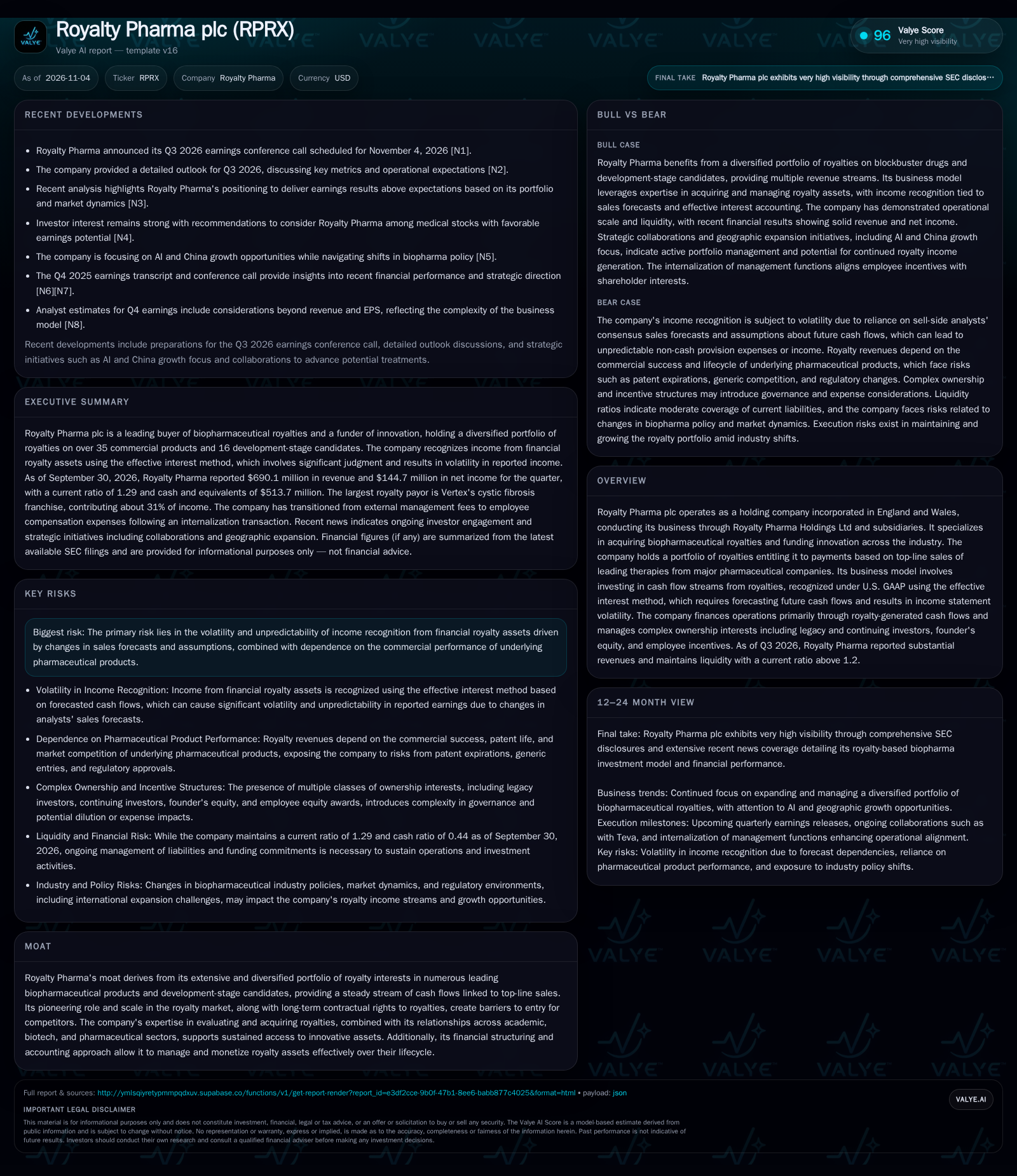
Royalty Pharma reported $690.1 million in Q3 2026 revenue and remains the largest buyer of biopharma royalties, with a portfolio spanning over 35 commercial assets. Its income is heavily influenced by Vertex’s cystic fibrosis franchise, which contributed 31% of Q3 income, and by the volatility inherent in royalty accounting. Execution on geographic and thematic growth, especially in AI and China, could reshape future earnings resilience. [S2] [N5]
Royalty Pharma’s business model—acquiring royalty interests in blockbuster and emerging biopharma products—offers investors exposure to top-line pharmaceutical sales without direct R&D or commercialization risk. Yet, its Q3 2026 results underscore the double-edged sword of this approach: robust cash generation and scale, but also income volatility and concentration in a handful of franchises, notably Vertex’s cystic fibrosis therapies. As the company targets new royalty streams and navigates shifting industry policy, investors must weigh the sustainability of current cash flows against the risks of product, policy, and market shocks.
Q3 2026 Overview: Spotlight on Concentration and Earnings Variability
Royalty Pharma reported $690.1 million in revenue and $144.7 million in net income for Q3 2026, supported by a portfolio of royalties on more than 35 commercial drugs and 16 development-stage candidates [S2]. The company’s largest single contributor is Vertex’s cystic fibrosis franchise, which accounted for approximately 31% of total income in the quarter—a level of concentration that heightens exposure to franchise-specific events and patent cycles [S2].
The company’s income recognition methodology, based on the effective interest method and sell-side consensus forecasts, introduces significant non-cash volatility: adjustments to expected cash flows can drive swings in reported results independent of underlying royalty receipts [S2].
The company reported cash and liquidity metrics for the period; these figures do not by themselves establish operating runway, investment capacity, financial flexibility, or financing capacity.
Linking Royalty Income to Earnings Strength and Fluctuations
Royalty Pharma’s economics hinge on acquiring rights to a portion of top-line drug sales, typically through upfront payments or structured deals with biotech, pharma, or academic licensors. The company’s income is derived from these royalty streams, which are recognized under the effective interest method—requiring forecasts of future drug sales trajectories and periodic remeasurement against actual and projected performance. This structure provides high gross margins and limited direct operating costs, but exposes reported earnings to swings based on consensus sales outlooks and non-cash accounting adjustments.
Operating leverage is achieved through portfolio scale: as fixed costs—including employee compensation and share-based awards post-internalization—are spread over a larger royalty base, incremental royalties can drive disproportionate bottom-line growth. However, the company’s funding needs are episodic and tied to the timing and scale of new royalty acquisitions; large deals may require external financing or redeployment of cash flows.
The economics are inherently variable: royalty income rises and falls with the success, patent protection, and competitive dynamics of underlying therapies. Loss of exclusivity or generic competition can sharply reduce cash flows, while successful new launches or label expansions can create stepwise gains. Royalty Pharma’s challenge is to balance near-term income with investments in development-stage royalties that may not contribute meaningfully for years.
Evaluating Royalty Pharma’s Competitive Edge: Scale Versus Imitation
Royalty Pharma’s primary competitive edge is its scale and expertise in sourcing, evaluating, and structuring royalty transactions. Its portfolio diversity—spanning dozens of commercial assets and multiple therapeutic areas—creates a partial buffer against individual product shocks and provides deal flow visibility that smaller entrants may struggle to match.
However, the royalty aggregation model is not immune to competition. Alternative capital providers—including private equity, pension funds, and dedicated royalty funds—have increasingly targeted the same assets, driving up acquisition prices and compressing returns. The company’s long-term relationships with academia and industry, and its ability to conduct complex due diligence, remain differentiators; yet, as the market matures, barriers to entry may erode if capital becomes commoditized.
Substitution risk is also present: biopharma companies may choose to retain royalty streams, pursue alternative financing (such as structured debt or milestone payments), or sell to direct competitors. The sustainability of Royalty Pharma’s moat depends on maintaining origination advantages, underwriting discipline, and access to proprietary deal flow.
Potential Catalysts for Significant Growth in Royalty Pharma’s Cash Flow
A favorable scenario would see Royalty Pharma successfully diversify away from its reliance on Vertex’s cystic fibrosis royalties, adding new commercial and late-stage development assets across multiple therapeutic areas. Execution in AI-enabled analytics could improve the company’s ability to underwrite and price complex royalty deals, potentially unlocking higher returns or identifying overlooked assets [N5].
Geographic expansion—especially deeper participation in China and other high-growth markets—could open new pipelines of royalty opportunities, particularly as local innovation ecosystems mature and require non-dilutive funding partners [N5].
Confirmation of this scenario would come from a declining share of income from the top royalty payors, increased deal activity in non-U.S. markets, and evidence of successful AI-driven sourcing or risk management. Sustained EPS growth above consensus despite patent expiries in legacy assets would further validate the thesis.
Managing the Portfolio Through Patent Challenges and Policy Shifts
The most plausible trajectory is for Royalty Pharma to maintain mid-single-digit revenue growth as legacy royalties mature and new assets are added at a measured pace. Portfolio concentration—especially exposure to Vertex’s cystic fibrosis franchise—remains a structural feature, with gradual dilution as additional royalties are acquired. Ongoing income volatility is likely due to the accounting model and periodic resets of sales expectations.
Policy risks—including drug pricing reform and shifts in biopharma reimbursement—are actively managed but not fully escapable. The company’s efforts to source royalties in AI, China, and innovative therapeutic areas may offset some headwinds, but underlying industry cyclicality and patent cliffs are enduring realities.
Evidence supporting this base case would include stable or slightly rising revenues, periodic non-cash income adjustments, and a portfolio mix that evolves gradually without dramatic shifts in risk profile.
Risks from Concentrated Holdings and Regulatory Changes That Could Undermine Performance
A negative outcome could materialize if Vertex’s cystic fibrosis franchise—currently 31% of income—faces an unexpected competitive threat, patent challenge, or regulatory setback, sharply reducing royalty inflows. Simultaneous delays or failures in advancing development-stage assets to commercialization would exacerbate the earnings decline.
Broader policy changes, such as aggressive drug price controls or unfavorable reimbursement shifts in key markets, could further pressure top-line royalties and reduce the attractiveness of new deals. Competitive dynamics might intensify, with rivals overpaying for assets or biopharma companies opting for alternative funding models, limiting Royalty Pharma’s ability to redeploy capital at attractive returns.
This scenario would be confirmed by a sharp drop in reported revenues, increased non-cash provision expenses, or a spike in the share of income from a shrinking set of payors. A rising current-liabilities burden or evidence of forced asset sales to meet funding commitments would also signal stress.
Developments Poised to Shape Royalty Pharma’s Upcoming Growth Trajectory
Quarterly and annual changes in the share of income from the top five royalty assets—particularly Vertex’s cystic fibrosis franchise—would help assess concentration risk and diversification progress.
Volume and value of new royalty acquisitions, especially in non-U.S. markets or innovative therapeutic categories, would indicate success in sourcing future growth.
Disclosure of AI-enabled underwriting or portfolio management initiatives—if provided—would help test the thesis around technology-driven competitive advantage.
Trends in non-cash provision expenses or income related to changes in expected cash flows, as reported in financial statements, would flag earnings volatility and underlying sales forecast shifts.
Management commentary on policy risk mitigation—especially regarding U.S. drug pricing and international expansion—would provide insight into adaptability and strategic focus.
Progress in advancing development-stage assets into the commercial phase (if disclosed) would be a leading indicator of future royalty income resilience.
Disclaimer: This is research-only, informational analysis and not investment advice. It may include AI-generated interpretation and general industry context. Always verify important details using primary sources.

Comments