
First Financial Corp. in 2026: Profit Consistency, Acquisition Stakes, and Dividend Discipline
First Financial Corp. navigates 2026 with robust quarterly profits, an acquisition-driven growth strategy, and a clear dividend focus. The real test will be how well it integrates new assets and sustains returns amid evolving market and operational risks.
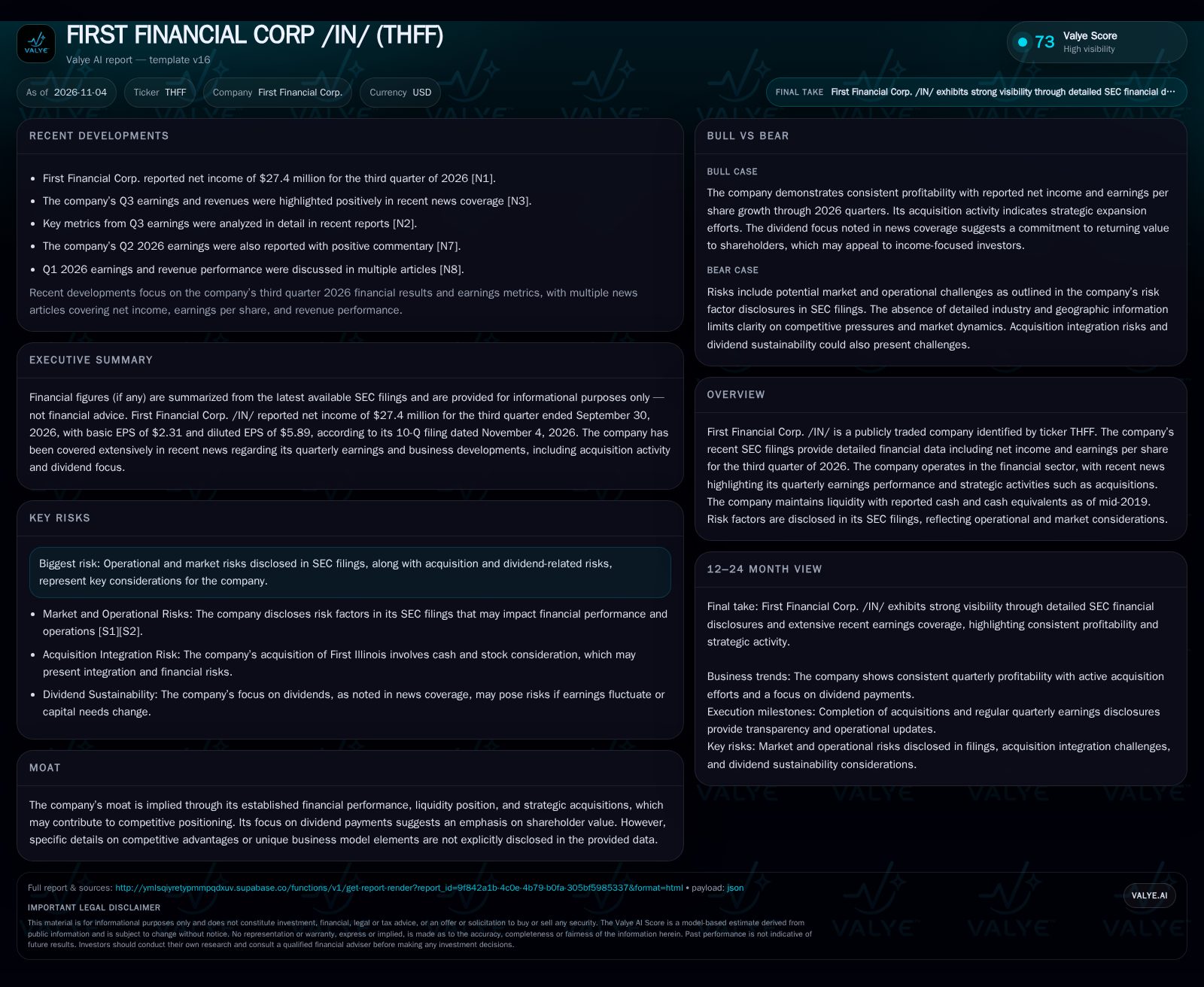
First Financial Corp. delivered $27.4 million in Q3 2026 net income and has maintained a steady earnings trajectory across 2026. The company is pursuing growth via acquisitions—most notably a $111.3 million deal for First Illinois—and continues to emphasize dividends. The central challenge is balancing integration and capital allocation while navigating disclosed market and operational risks. [S2] [N1] [N2] [N3] [N7] [N8]
First Financial Corp. enters late 2026 as a regional banking player demonstrating consistent earnings power and an appetite for inorganic growth. With net income of $27.4 million in Q3 and a prominent acquisition of First Illinois, the company is signaling both stability and ambition. Yet, the dual priorities of integrating new assets and maintaining reliable dividends bring execution risks into focus. The company’s challenge now is to translate recent financial momentum into enduring value, especially as competitive and operational headwinds persist.
Earnings Strength, Strategic Acquisition, and Dividend Emphasis Define 2026
First Financial Corp. reported net income of $27.4 million for the third quarter of 2026, with basic EPS of $2.31 and diluted EPS of $5.89, confirming solid profitability for the period.[S2] [N1] This performance is consistent with earlier quarters in 2026, as noted in news coverage highlighting positive earnings and revenue beats.[N2] [N3] [N7] [N8] The company’s acquisition of First Illinois—valued at $111.3 million in cash and stock—signals a strategic push for scale and market reach, though detailed integration plans are not disclosed in the available evidence. The cited source reports dividend-related activity; that disclosure alone does not establish dividend-policy continuity, management confidence, or a material constraint on capital flexibility. The latest SEC filings include risk factor disclosures, pointing to explicit acknowledgment of operational and market uncertainties.[S1] [S2]
How First Financial Corp. Drives Profits: Spread Income, Efficiency, and Capital Allocation
As a regional bank, First Financial Corp. likely generates its core earnings through net interest income—the spread between loan yields and deposit/funding costs—supplemented by fee-based services. The Q3 2026 net income and strong EPS figures suggest the company is managing its interest margin and cost structure effectively in the current rate environment.[S2] [N1] [N2] Operating leverage can be realized if the company is able to grow assets (loans, deposits) faster than non-interest expenses, particularly if recent acquisitions deliver synergies.
Acquisitions such as the First Illinois deal typically require upfront capital but can expand the loan and deposit base, offering scale benefits and potential cross-selling opportunities. However, integration costs, credit risk from acquired portfolios, and retention of local market share can influence realized returns. The company’s persistent focus on dividends indicates a discipline in capital allocation, balancing reinvestment needs with shareholder distributions. Future profitability will hinge on maintaining asset quality, managing funding costs, and extracting efficiency gains from new assets.
The sustainability of First Financial Corp.'s profit model also depends on its ability to adapt to interest rate cycles. Given that net interest income is sensitive to the interest rate environment, the company must effectively manage the duration mismatch between assets and liabilities. For example, if loan yields do not reprice as quickly as funding costs rise, net interest margins could compress, pressuring earnings. Conversely, a well-managed asset-liability strategy that anticipates rate shifts can protect margins and support stable profitability. Additionally, the company's fee income streams, while typically less volatile, may be influenced by competitive pressures and changes in customer behavior, necessitating ongoing innovation in service offerings to maintain revenue diversity.
Capital allocation decisions beyond dividends and acquisitions also play a critical role in driving long-term profitability. If the company prioritizes investments in technology and digital platforms, it may enhance operational efficiency and customer engagement, potentially reducing costs and increasing fee income. However, such investments require upfront expenditure and may pressure near-term earnings. The balance between reinvesting in growth capabilities and returning capital to shareholders through dividends or share repurchases reflects management's strategic priorities and risk tolerance. Monitoring the company's leverage ratios and regulatory capital buffers will be important to assess whether capital deployment aligns with maintaining potential financial flexibility and regulatory compliance.
Regional Banking Dynamics: Scale, Relationships, and the Race for Efficiency
First Financial Corp. operates in a highly competitive regional banking sector, where advantages often stem from scale, local market relationships, and operational efficiency. Larger national and super-regional banks compete aggressively on rates, digital banking capabilities, and breadth of services. Community banks, meanwhile, may offer more personalized service but can lack resource depth.
First Financial’s acquisition strategy could be a response to competitive pressures—seeking to build scale, diversify its loan book, and increase its deposit base. However, such moves also expose the company to integration risk and potential cultural or operational mismatches. The company’s focus on dividends may appeal to income-oriented investors but could constrain retained earnings for organic investment or future acquisitions. The question is whether First Financial can carve out a durable niche via local expertise, efficient operations, and prudent risk management, or whether it risks being squeezed by both larger and nimbler competitors.
In the context of regional banking competition, First Financial Corp.'s ability to leverage technology could be a differentiator. Digital banking adoption is reshaping customer expectations, with convenience and seamless online experiences becoming critical. If the company can integrate digital solutions effectively, it may improve customer retention and attract younger demographics, offsetting some competitive disadvantages related to scale. However, digital transformation requires investment and cultural shifts, which may be challenging during periods of acquisition integration. Furthermore, competitive pressures from fintech entrants and non-bank lenders could compress margins in traditional lending segments, requiring strategic adjustments to product mix and pricing.
Another competitive dimension involves regulatory compliance and risk management capabilities. As the company expands through acquisitions, it must ensure that compliance frameworks scale appropriately to avoid operational risks and regulatory penalties. The cited source reports dividend-related activity; that disclosure alone does not establish dividend-policy continuity, management confidence, or a material constraint on capital flexibility. Conversely, failure to manage these aspects could lead to increased costs or reputational damage, undermining competitive positioning. The interplay between growth ambitions and the capacity to maintain disciplined risk management will be a key determinant of the company's medium-term success.
Acquisition Integration Unlocks Scale and Sustained Earnings Growth
A favorable scenario would see the First Illinois acquisition integrated smoothly—expanding the company’s geographic reach, customer base, and revenue streams without material credit or operational disruptions. If cost synergies are realized and the combined entity retains core customer relationships, First Financial could see improved operating leverage and higher return on equity. The company reported profitability for the period.
Evidence confirming this scenario would include rising net interest income and efficiency ratios post-acquisition, stable or improving asset quality metrics, and management commentary highlighting successful integration milestones.
Incremental Growth with Measured Acquisition Impact and Dividend Stability
The most plausible outcome is that First Financial delivers steady, incremental growth as it absorbs the First Illinois acquisition. Earnings remain positive, but integration benefits accrue gradually and are partially offset by higher near-term expenses or modest credit normalization.
Any notable deterioration in asset quality or a spike in non-interest expenses would challenge this middle path.
Integration Missteps or Credit Deterioration Erode Earnings and Threaten Dividends
A negative scenario could unfold if the First Illinois acquisition proves more difficult to integrate than expected—leading to higher-than-anticipated costs, customer attrition, or credit losses from the acquired loan book. If market or operational risks disclosed in SEC filings were to materialize, net interest margins could compress, and non-performing assets could rise, weighing on profitability.
Confirmation would come from a decline in net income, a dividend cut or suspension, or negative trends in asset quality metrics such as rising non-performing loans.
What Could Shift the Thesis for First Financial Corp. in 2027
Progress on integration milestones and cost synergies from the First Illinois acquisition—if disclosed—would help test whether the deal is value accretive.
Quarterly trends in net interest margin and net interest income will reveal how well the company is managing funding costs and loan pricing in a changing rate environment.
Asset quality indicators such as non-performing loan ratios and net charge-offs—if disclosed—would signal credit risk trends and potential future earnings volatility.
Efficiency ratio movements post-acquisition would indicate whether operating leverage is improving or costs are outpacing revenue gains.
Any new acquisition announcements or strategy updates could change the company’s risk/reward profile and capital allocation priorities.
Management commentary on competitive dynamics, digital banking initiatives, or regional economic trends would help assess long-term positioning.
Disclaimer: This is research-only, informational analysis and not investment advice. It may include AI-generated interpretation and general industry context. Always verify important details using primary sources.

Comments