
Innospec Inc. in Late 2026: Diversification, Innovation, and the Stakes of Chemical Value Chains
Innospec’s latest results highlight broad-based growth across its diversified specialty chemicals portfolio, but raw material sourcing, regulatory costs, and shifting end-market dynamics pose structural challenges. The company’s ability to convert R&D and acquisitions into durable margin expansion will define its next phase.
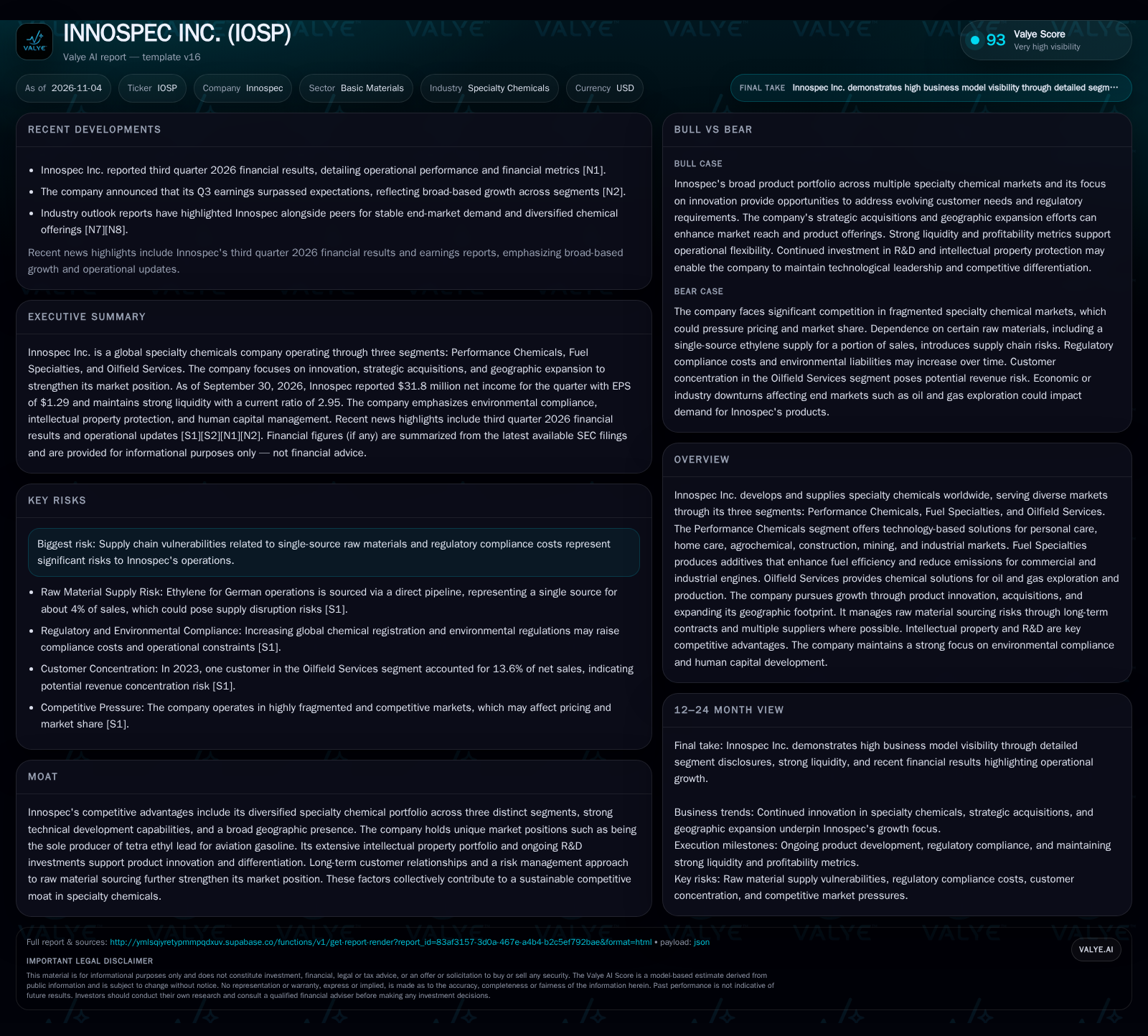
Innospec continues to demonstrate operational momentum across its three segments, reporting $31.8 million in Q3 2026 net income as broad-based demand supports top-line growth. However, single-source raw material exposure, rising regulatory burdens, and intense competition in fragmented markets remain persistent risks. The company’s future hinges on translating innovation and acquisitions into sustainable margin and market share gains while managing supply chain and compliance pressures. [S1] [S2]
Innospec Inc. enters late 2026 with a solid operational track record and a diversified specialty chemicals portfolio spanning Performance Chemicals, Fuel Specialties, and Oilfield Services. Recent quarterly earnings surpassed expectations, driven by broad-based demand and a disciplined approach to innovation and acquisitions. Yet, the company’s next chapter will be shaped by its ability to manage raw material vulnerabilities, regulatory cost inflation, and the competitive realities of global chemical markets. The question for investors is whether Innospec can consistently convert its R&D investments and strategic moves into durable margin and market share gains amid a shifting industry landscape.
Recent Performance and Structural Exposures Shape Innospec’s Position
In Q3 2026, Innospec reported net income of $31.8 million, with basic and diluted EPS of $1.29, reflecting broad-based growth across its three operating segments: Performance Chemicals, Fuel Specialties, and Oilfield Services [S2] [N1] [N2]. reported liquidity position, with $251.9 million in cash and a current ratio of 2.95 as of September 30, 2026 [S2]. However, the company’s German operations source ethylene via a single direct pipeline, representing a supply chain exposure for approximately 4% of total sales [S1]. No single customer accounted for more than 10% of net sales in 2024 and 2025, though a customer in Oilfield Services represented 13.6% in 2023, highlighting a prior concentration risk [S1]. Ongoing R&D investment—$51 million in 2025—continues to support product development and segment-level innovation [S1].
How Innospec Monetizes Specialty Chemistry: Segments, Mix, and Margin Leverage
Innospec’s revenue model is built on differentiated specialty chemical solutions, with each segment operating under distinct demand and pricing dynamics. Performance Chemicals offers technology-driven products for diverse end markets, including personal care, home care, agrochemicals, and construction—sectors that generally exhibit steady, less cyclical demand and allow for product customization, supporting premium pricing if innovation and formulation advantages are sustained. Fuel Specialties generates sales from additives that improve performance and emissions, serving commercial, marine, and aviation customers. This segment benefits from regulatory-driven demand (e.g., emissions standards), but pricing is sensitive to oil price cycles and customer bargaining power.
Oilfield Services is more cyclical and exposed to energy sector volatility, with margins and volumes tied to drilling activity, production trends, and E&P spending. The capital intensity of specialty chemicals is moderate, with significant fixed costs in manufacturing and R&D, but variable costs are closely linked to raw material inputs. As a result, gross margin expansion depends on product mix (favoring higher-value, lower-commodity solutions), operating leverage from scale, and the company’s ability to pass through input cost inflation.
Strategic acquisitions and ongoing R&D provide levers for expanding the addressable market and introducing higher-margin products, but integrating acquisitions and realizing synergies are execution-dependent. Intellectual property protection and proprietary formulations can provide temporary pricing power, but competitive imitation is a persistent risk. The company’s broad customer base reduces reliance on any single end market, but supply chain shocks—such as a disruption to ethylene supply—could have outsized effects on profitability and production continuity.
Competitive Landscape: Differentiation, Substitution, and the Value of Scale
Innospec competes in fragmented global specialty chemical markets, where differentiation is achieved through technology, application expertise, and customer relationships. Performance Chemicals faces competition from both multinational conglomerates and niche specialty producers, requiring continuous innovation and rapid response to evolving customer needs. Fuel Specialties is more concentrated, with Innospec holding a unique position as the only producer of tetra ethyl lead for aviation gasoline—a legacy product with limited but defensible demand [S1].
In Oilfield Services, competition is intense and includes large diversified chemical suppliers as well as regional players; price competition and contract cycles are common, and customer loyalty can be limited when switching costs are low. The company’s competitive advantages stem from its intellectual property portfolio, R&D pipeline, and ability to offer tailored solutions. However, barriers to entry in specialty chemicals are moderate—while technical expertise and regulatory compliance are nontrivial, scale and capital requirements are not prohibitive for well-funded entrants.
Substitution risk is present if customers shift to alternative technologies or formulations, especially in fuel additives as electrification and alternative propulsion gain share. The ability to anticipate regulatory changes, adapt product lines, and form strategic partnerships will be key to sustaining share and margin.
Innovation and Strategic Expansion Drive Durable Margin Gains
A favorable scenario for Innospec would see its sustained investment in R&D and targeted acquisitions translating into a pipeline of proprietary, higher-margin specialty products that win share in both established and emerging markets. If the company continues to expand into higher-growth end markets such as personal care, advanced materials, and next-generation fuel additives, and successfully integrates acquisitions that provide new technologies or geographic reach, its revenue mix could shift toward segments with better pricing power and less cyclicality.
Evidence confirming this scenario would include above-peer revenue growth in Performance Chemicals, margin expansion despite input cost pressures, an increasing share of sales from newly launched or acquired products, and successful entry into new geographies or end-markets. Additional confirmation would come from disclosure of multi-year customer agreements, high renewal rates, or visible backlog in core segments. Falsification would be evident if R&D spend fails to yield new commercial products, if margin trends stagnate or reverse, or if integration of acquisitions results in operational or financial drag.
Incremental Innovation Offsets Pressures, but Structural Risks Persist
The most plausible trajectory is that Innospec maintains moderate growth and profitability by leveraging its diversified portfolio and ongoing product development, while managing through periodic raw material and regulatory headwinds. Performance Chemicals and Fuel Specialties are likely to provide stable, if not spectacular, growth, while Oilfield Services remains a swing factor tied to energy market conditions.
Margins could face intermittent pressure from input cost volatility (notably ethylene and other raw materials), but a balanced customer mix and the ability to selectively pass through costs may provide partial insulation. The company’s capital allocation remains focused on incremental innovation and selective acquisitions, with no outsized bets. Confirmation of this base case would include continued broad-based segment growth, maintenance of current gross and operating margin levels, and manageable working capital swings. Falsification would be seen if raw material disruptions, regulatory shocks, or customer losses lead to sharp revenue or margin declines.
Supply Chain Shocks and Regulatory Costs Erode Profitability
A negative scenario would materialize if Innospec faces a significant disruption in its single-source ethylene pipeline for German operations, leading to production halts, elevated procurement costs, or customer contract penalties. Simultaneously, a tightening regulatory environment could sharply raise compliance costs or force product reformulations, particularly in fuel additives and Oilfield Services. If energy sector demand contracts or key customers are lost (as seen with prior concentration in Oilfield Services), top-line and margin compression could follow.
This scenario would be confirmed by declining segment revenues, sustained margin erosion, increased disclosure of contingency planning or alternative sourcing costs, and possibly the need for capital raises or restructuring. A lack of successful new product launches or failed integration of acquisitions would further amplify downside risks.
Milestones That Will Define Innospec’s Competitive Outcome
Track the proportion of revenue from newly launched or recently acquired products, as this would indicate the effectiveness of R&D and acquisition strategies (if disclosed).
Monitor gross and segment-level operating margins for signs of sustainable improvement or pressure, especially in the context of raw material cost volatility.
Watch for updates on ethylene sourcing for German operations, including any new supply contracts, diversification efforts, or disclosed contingency planning.
Observe the quarterly R&D spend and the pipeline of patent applications or new product announcements as a proxy for ongoing innovation.
Follow customer concentration trends in Oilfield Services, particularly whether any single customer again exceeds 10% of net sales.
Assess regulatory disclosures for new environmental or chemical registration requirements that could materially impact cost structure or product portfolio.
Look for evidence of successful geographic expansion, such as new facilities, partnerships, or market entries, that diversify revenue streams.
Evaluate working capital and inventory trends for signs of supply chain stress or overstocking, which may signal demand or operational issues.
Disclaimer: This is research-only, informational analysis and not investment advice. It may include AI-generated interpretation and general industry context. Always verify important details using primary sources.

Comments