
Westlake Corp in Late 2026: Restructuring, Integration, and the Stakes of a Vertically Integrated Chemical Platform
Westlake Corp’s 2026 profile reveals a company managing through industry cyclicality and margin pressure, with major restructuring, targeted acquisitions, and selective expansion shaping both risks and opportunities across its integrated housing, infrastructure, and performance materials value chain.
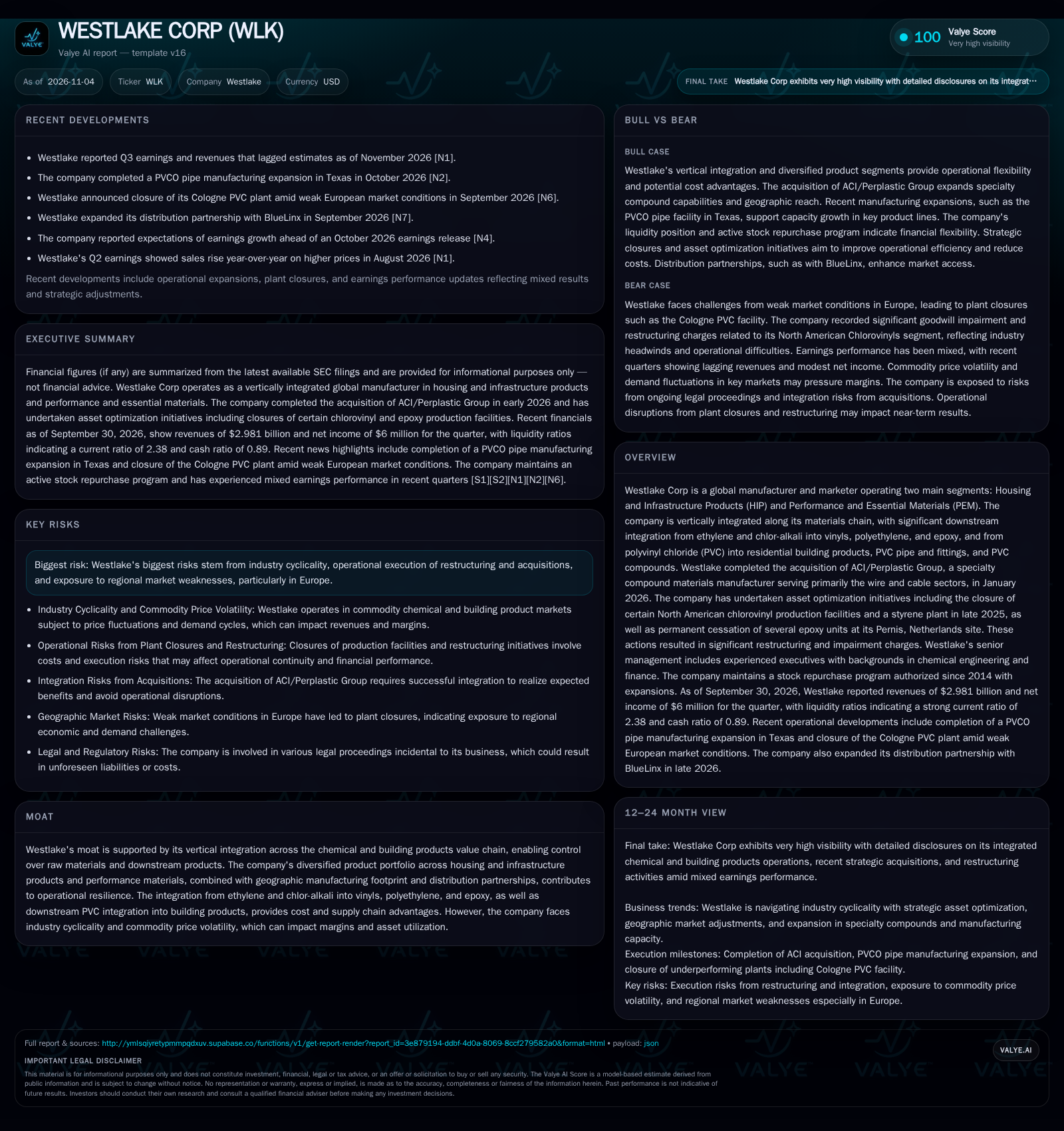
Westlake Corp is navigating a turbulent period marked by operational restructuring, the closure of underperforming assets, and a strategic acquisition to deepen specialty compounding capabilities. Despite a reported liquidity position, recent earnings have lagged expectations, reflecting weak market conditions—particularly in Europe—and ongoing margin pressures. The company’s vertical integration offers some resilience, but its future trajectory will hinge on successful integration of acquisitions, cost discipline, and demand recovery in core end markets. [S2] [N1] [N2] [N6]
In the closing months of 2026, Westlake Corp stands as a case study in the complexities of running a vertically integrated chemical and building products business through a downcycle. The company has made decisive moves—shuttering underperforming assets, absorbing major impairment charges, and acquiring specialty compounding capabilities—while also selectively expanding in growth markets like PVCO piping. Yet, despite its scale and integration, Westlake’s most recent financials reveal razor-thin margins and ongoing exposure to weak demand and commodity volatility. The next phase will test whether its operational resets and portfolio shifts can translate into sustainable earnings and resilience against continued market turbulence.
Recent Moves Reshape Westlake’s Strategic and Financial Landscape
Westlake’s recent period is defined by a blend of significant restructuring, asset optimization, and portfolio expansion. The January 2026 acquisition of ACI/Perplastic Group added global compounding capabilities, positioning Westlake to participate more deeply in specialty wire and cable materials. At the same time, Westlake closed certain North American chlorovinyl and European epoxy facilities, incurring $393 million in related costs and a $727 million goodwill impairment for the North American Chlorovinyls unit—reflecting operating losses and negative industry trends. Q3 2026 results underline the pressure: revenues of $2.981 billion yielded only $6 million in net income. The company also completed a PVCO pipe manufacturing expansion in Texas and shuttered its Cologne PVC plant amid weak European demand. As of September 30, 2026, Westlake reported $1.764 billion in cash and a current ratio of 2.38. These developments collectively illustrate a company in transition, aiming to streamline its cost structure while pivoting toward more specialized and resilient segments. [S2] [N1] [N2] [N6]
How Integration and Mix Shifts Drive Westlake’s Earnings Power
Westlake’s business model rests on vertical integration from basic chemicals (ethylene, chlor-alkali) to value-added downstream products like vinyls, epoxies, and a wide array of building and infrastructure goods. This structure has historically offered cost advantages, supply chain control, and cross-segment margin capture. However, much of the company’s portfolio remains exposed to commodity price cycles, especially in chlorovinyls and olefins, where margins can compress rapidly when supply outstrips demand.
Recent plant closures and impairment charges suggest that fixed costs in legacy commodity operations have become a drag during downturns. The shift toward specialty compounding (ACI/Perplastic) and expanded PVCO pipe capacity may incrementally improve the mix, with specialty materials typically commanding higher and more stable margins. Still, the company must absorb restructuring costs and realize integration benefits before these changes translate into improved bottom-line performance.
Operating leverage cuts both ways: high fixed costs can amplify profits in strong markets but exacerbate losses when volumes and prices fall. Westlake’s ability to flex its cost base—by shuttering inefficient assets and expanding resilient segments—will be critical to restoring profitability. Capital needs remain significant, both for ongoing maintenance of large-scale chemical plants and for targeted growth projects.
Competitive Advantages and Structural Vulnerabilities in a Cyclical Market
Westlake’s main competitive strengths lie in its integrated model, scale, and product breadth across housing, infrastructure, and essential materials. Vertical integration can provide cost advantages over standalone commodity producers and allow the company to capture value at multiple stages of the chain. The company’s downstream presence in building products and specialty compounds may offer some insulation from pure commodity swings, provided these segments maintain pricing power and demand.
However, the company operates in markets characterized by significant price competition, low switching costs for many customers, and frequent supply/demand imbalances. European market weakness, as seen in the Cologne PVC plant closure, exposes the company to geographic concentration risks, while competitors in both North America and Europe can quickly ramp or idle capacity in response to market signals.
Product substitution is another threat: alternative materials (e.g., composites, metals) can erode demand for PVC and other plastics in certain applications. Meanwhile, large global chemical peers, private-label building products manufacturers, and regional players all vie for share, with differentiation often limited to cost, reliability, and distribution reach rather than proprietary technology or brand loyalty.
If Restructuring, Integration, and Demand Recovery Align
A favorable scenario for Westlake depends on the successful integration of ACI/Perplastic, realization of restructuring-driven cost savings, and a cyclical rebound in demand for building, infrastructure, and specialty materials. If the company can reduce fixed costs by permanently shuttering underperforming assets while ramping up higher-margin specialty and downstream operations, operating leverage could swing positive as volumes recover.
Confirmation would come from a sustained improvement in segment margins, particularly in Housing and Infrastructure Products and specialty compounding, alongside evidence of higher capacity utilization rates at newly expanded facilities like the Texas PVCO pipe plant. Additional signs would include improved EPS and free cash flow, reduced impairment or restructuring charges, and growing contributions from new distribution partnerships (such as BlueLinx).
Falsification would be evident if the company continues to post low or negative margins despite restructuring, struggles to integrate acquisitions, or fails to capitalize on market recoveries due to lingering cost or operational issues.
A Mixed Recovery: Gradual Margin Repair Amid Persistent Cyclicality
The most plausible path is a gradual stabilization, with Westlake benefitting modestly from cost reductions and new specialty capacity but still facing margin headwinds from commodity volatility and uneven demand—especially in Europe. Incremental gains in specialty compounding and building products may offset some of the drag from legacy chlorovinyls and epoxy operations, but overall earnings growth could remain subdued until broader market conditions improve.
This scenario would be confirmed by sequential improvement in operating margins, but with continued volatility in quarterly results and the potential for further asset rationalization or impairment if certain geographies remain weak.
If Westlake is unable to generate margin improvement despite restructuring and mix shifts, or if further macro or operational shocks hit core segments, the company could see earnings stagnate or decline further.
Prolonged Margin Compression and Structural Headwinds
The adverse scenario is one where market weakness—especially in Europe and in commodity chemicals—persists or worsens, leading to continued underutilization of assets, further impairment charges, and erosion of cash flows. Integration of the ACI/Perplastic acquisition could prove more difficult than expected, either due to cultural misalignment, customer attrition, or failure to achieve targeted cost synergies.
Additional downside triggers could include a sharp decline in residential or infrastructure construction (dampening demand for building products), increased regulatory or environmental costs, or a spike in raw material prices that cannot be passed through to customers quickly. In such a scenario, Westlake may be forced to consider further divestitures, curtail capital spending, or even restructure its debt if cash flow deterioration is severe.
Confirmation would be seen in continued low or negative net income, rising net debt, and new announcements of plant closures or asset sales. Falsification would require clear evidence of margin turnaround, successful integration of recent acquisitions, and stabilization (or growth) in core end markets.
What Will Determine Whether Westlake’s Reset Delivers Lasting Value?
Sustained margin expansion in the Housing and Infrastructure Products and specialty compounding segments would indicate successful portfolio repositioning.
If disclosed, capacity utilization rates at newly expanded facilities (such as the Texas PVCO pipe plant) would help gauge demand recovery and operating leverage.
The pace and scale of impairment, restructuring, and integration-related costs in future quarters will reveal whether the company’s reset is complete or ongoing.
Evidence of revenue and margin stability or growth in Europe after the Cologne PVC closure will test whether regional risks are contained.
Updates on the integration progress of ACI/Perplastic, including realized synergies and customer retention, would confirm the acquisition’s strategic value.
If disclosed, product-level or customer-segment mix shifts (e.g., greater share from specialty materials versus commodity PVC) would clarify the effectiveness of the company’s strategic pivot.
Any further changes in the distribution network, such as expanded BlueLinx volumes or new channel partnerships, would indicate commercial traction in targeted growth areas.
Disclaimer: This is research-only, informational analysis and not investment advice. It may include AI-generated interpretation and general industry context. Always verify important details using primary sources.

Comments