
Plumas Bancorp’s Expansion, Credit Dynamics, and the Stakes of Regional Community Banking
Plumas Bancorp’s record Q3 2026 earnings, Cornerstone acquisition, and evolving deposit/loan mix highlight the leverage and vulnerabilities of its community banking model. The interplay between commercial real estate exposure, regional concentration, and technology-driven service improvements will define both its resilience and risk as local economies and interest rates shift.
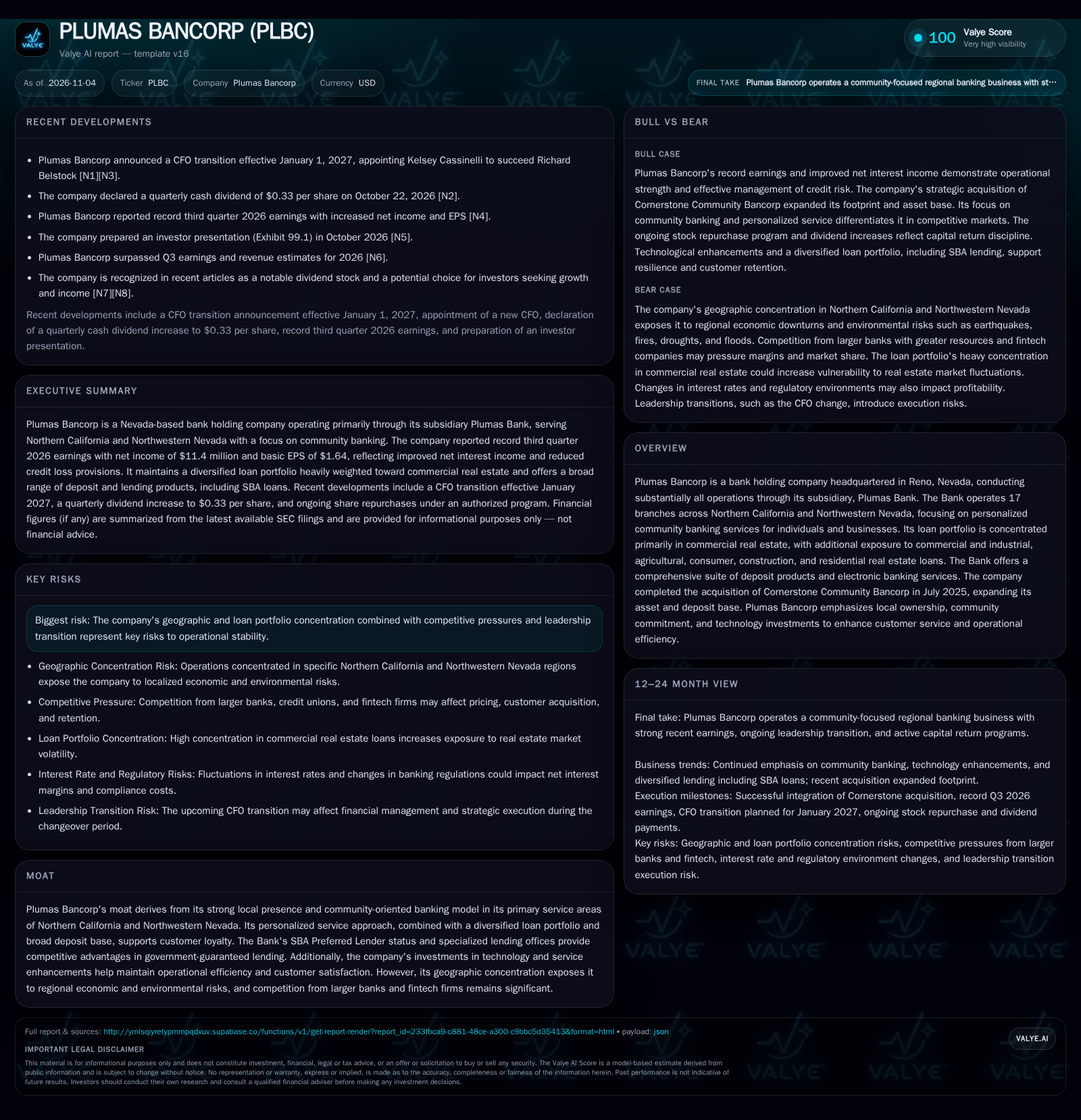
Plumas Bancorp delivered record Q3 2026 earnings, with net income more than doubling year-over-year, aided by the Cornerstone acquisition, improved net interest income, and sharply lower credit loss provisions. The bank’s loan book remains heavily weighted to commercial real estate, while deposit growth and technology upgrades support its local franchise. Geographic and sector concentration, however, heighten sensitivity to regional and real estate cycles, and the upcoming CFO transition adds operational risk. Sustained outperformance will depend on credit quality, margin stability, and successful integration of new assets and personnel.
Plumas Bancorp’s latest results underscore the power and limits of the community banking model as the company integrates its largest acquisition to date and posts record profitability. The addition of Cornerstone Community Bancorp has materially expanded its balance sheet and market reach, while improvements in net interest income and a one-time tax credit have driven headline earnings to new highs. Yet, the bank’s outsized exposure to commercial real estate, reliance on regional economies, and looming management transition mean that sustaining these gains will require deft credit management and continued operational discipline.
Record Earnings, Acquisition Integration, and Shifting Credit Dynamics
In Q3 2026, Plumas Bancorp reported net income of $11.4 million and basic EPS of $1.64—more than double the prior year’s quarterly result. Return on average assets reached 1.98% and return on average equity 16.7%, reflecting both higher loan balances and yields, as well as a dramatic reduction in the provision for credit losses to just $150,000, down from $5.4 million in Q3 2025 [S2]. This surge in profitability coincides with the integration of Cornerstone Community Bancorp, acquired in July 2025, which added $659 million in assets and $581 million in deposits, boosting Plumas Bancorp’s scale and market presence [S1].
The loan book remains heavily skewed toward commercial real estate (66.3% of loans), while the bank’s diversified deposit base grew to approximately $1.8 billion across 47,667 accounts [S1]. Meanwhile, a $14.5 million green energy tax credit reduced the effective tax rate to 18.9% in Q3 2026, providing a one-time boost to net income [S2].
A leadership transition is on the horizon, with the CFO role passing to Kelsey Cassinelli in January 2027 [N1] [N3]. This change comes at a critical time as the bank manages integration, loan book risks, and continued capital return programs.
How Community Banking Scale and Mix Shape Plumas Bancorp’s Earnings Power
Plumas Bancorp’s revenue is dominated by net interest income, which reached $26.5 million in Q3 2026, up from $25.2 million the prior year [S2]. This growth has been aided by higher loan balances post-acquisition and improved yields as rates have risen. The company’s core lending model—anchored by commercial real estate, C&I, and agricultural loans—creates predictable interest income but also exposes the bank to sector concentration risk.
The deposit franchise, with a broad base and an average account size of $38,000, provides relatively low-cost funding, supporting net interest margins. However, deposit mix and retention become critical if competition for funding intensifies, especially from fintechs and larger banks with more aggressive rates or digital capabilities.
Operating leverage is visible in recent results: the sharp drop in credit loss provisions and a lower tax rate have contributed disproportionately to bottom-line growth. Such factors may not persist, and a return to normalized credit costs or higher compliance expenses could compress margins. The integration of Cornerstone brings scale benefits but also increases complexity, especially in harmonizing risk management and technology platforms. Capital needs remain moderate for a bank of this size, but the high share of real estate loans may necessitate higher reserves or capital buffers if asset quality deteriorates.
Local Relationships, Niche Lending, and the Challenge from Larger and Digital Competitors
Plumas Bancorp’s edge lies in its commitment to community banking—personalized service, local decision-making, and deep relationships with small businesses and individuals in its Northern California and Nevada footprint. Its SBA Preferred Lender status and specialized lending centers enable it to serve small business customers with speed and flexibility not always matched by national players [S1].
However, the bank faces competition on several fronts: large regional and national banks with broader product suites and digital platforms, credit unions with tax advantages, and fintechs offering faster, often more convenient digital experiences. Larger banks may be able to offer lower lending rates or higher deposit yields, while fintechs can erode fee income and attract younger, tech-savvy customers.
The heavy concentration in commercial real estate lending could be a double-edged sword—while it supports customer relationships and local economic development, it also means Plumas is highly exposed to downturns in local property markets, a vulnerability not shared by more diversified or urban-focused lenders.
If Credit Quality Holds and Integration Succeeds, Earnings Momentum Could Outlast the Cycle
A favorable scenario for Plumas Bancorp features continued benign credit conditions, with non-performing assets and charge-offs remaining low, allowing the bank to sustain below-average credit loss provisions. Successful integration of Cornerstone’s operations could yield further scale benefits, especially if cost synergies are realized and customer retention is high.
Technology upgrades—such as improved online banking, ATM replacements, and fraud detection—could bolster customer satisfaction and reduce operating costs, making the bank more competitive even as digital adoption accelerates. If deposit growth keeps pace with loan demand and the bank maintains pricing discipline, net interest margins could remain robust.
Confirmation would come from sustained high returns on assets/equity, stable or improving asset quality metrics, and evidence that new markets and customers from the acquisition are being retained and cross-sold. A persistent premium to peer banks in efficiency ratio and customer satisfaction surveys (if disclosed) would further validate the upside scenario.
Maintaining Profitability Amid Normalizing Credit and Increased Competition
The most plausible trajectory is that Plumas Bancorp’s earnings normalize as credit costs revert to historical averages and the benefits from the green energy tax credit fade. Net interest income could continue to grow modestly as the Cornerstone integration matures, but margin pressures may appear if funding costs rise or if loan growth slows.
The bank is likely to hold its market share in core geographies due to its entrenched local relationships, but may lose ground at the margin to larger or more digital competitors. The commercial real estate loan book will drive overall performance; if local economies remain healthy and property values stable, losses should be manageable.
Operationally, the CFO transition and ongoing tech investments may create transitional costs, but are unlikely to disrupt core banking activities if managed well. Confirmation would come from steady, though not record, quarterly earnings, stable efficiency and asset quality ratios, and successful execution of the capital return program without compromising regulatory capital levels.
A Turn in Regional Real Estate or Deposit Competition Could Erode Franchise Value
A negative scenario unfolds if commercial real estate markets in Northern California or Northwestern Nevada deteriorate, leading to rising delinquencies and charge-offs. Given the bank’s 66% CRE loan concentration, even localized downturns could force higher provisions, compressing earnings and potentially requiring capital raises or dividend cuts.
Sharp competition for deposits—especially if larger banks or online entrants offer meaningfully higher rates—could drive up funding costs or result in outflows, squeezing net interest margins. If integration issues with Cornerstone arise (such as customer attrition, IT problems, or cultural clashes), cost overruns and lost revenue could further pressure results.
Other triggers could include a regulatory environment that raises compliance costs or restricts certain lending practices, or a failed CFO transition that disrupts financial oversight. Downside signals would include a spike in non-performing assets, a sudden increase in deposit outflows, negative operating leverage, or a reduction in the dividend or share repurchase activity.
Variables That Will Test Plumas Bancorp’s Community Banking Thesis
Quarterly trends in non-performing loans, charge-offs, and classified asset ratios—these will indicate whether credit quality is holding as the CRE cycle matures.
Net interest margin evolution, especially if disclosed by segment or geography, as an indicator of funding cost pressure or loan pricing discipline.
Deposit growth and retention rates post-acquisition, particularly in newly entered markets from Cornerstone.
Customer attrition or satisfaction metrics (if disclosed) to assess the impact of integration, technology investments, and competitive threats.
Efficiency ratio progression, which will reflect the bank’s ability to extract cost synergies and control expenses as it scales.
Capital ratios and dividend payout trends, to monitor the sustainability of capital return policies in the face of potential credit shocks.
Progress on technology deployment—such as adoption rates of digital banking features or reductions in fraud losses—as a measure of operational modernization.
Evidence of successful leadership transition, including continuity in financial reporting, risk management, and strategic execution through and beyond the CFO changeover.
Disclaimer: This is research-only, informational analysis and not investment advice. It may include AI-generated interpretation and general industry context. Always verify important details using primary sources.

Comments