
Ocugen’s Gene Therapy Ambitions: Licensing, Liquidity, and the Stakes of Clinical Execution
Ocugen is advancing gene therapy candidates for retinal diseases, notably OCU400 and OCU410, with regulatory designations and a $255 million MENA licensing deal.
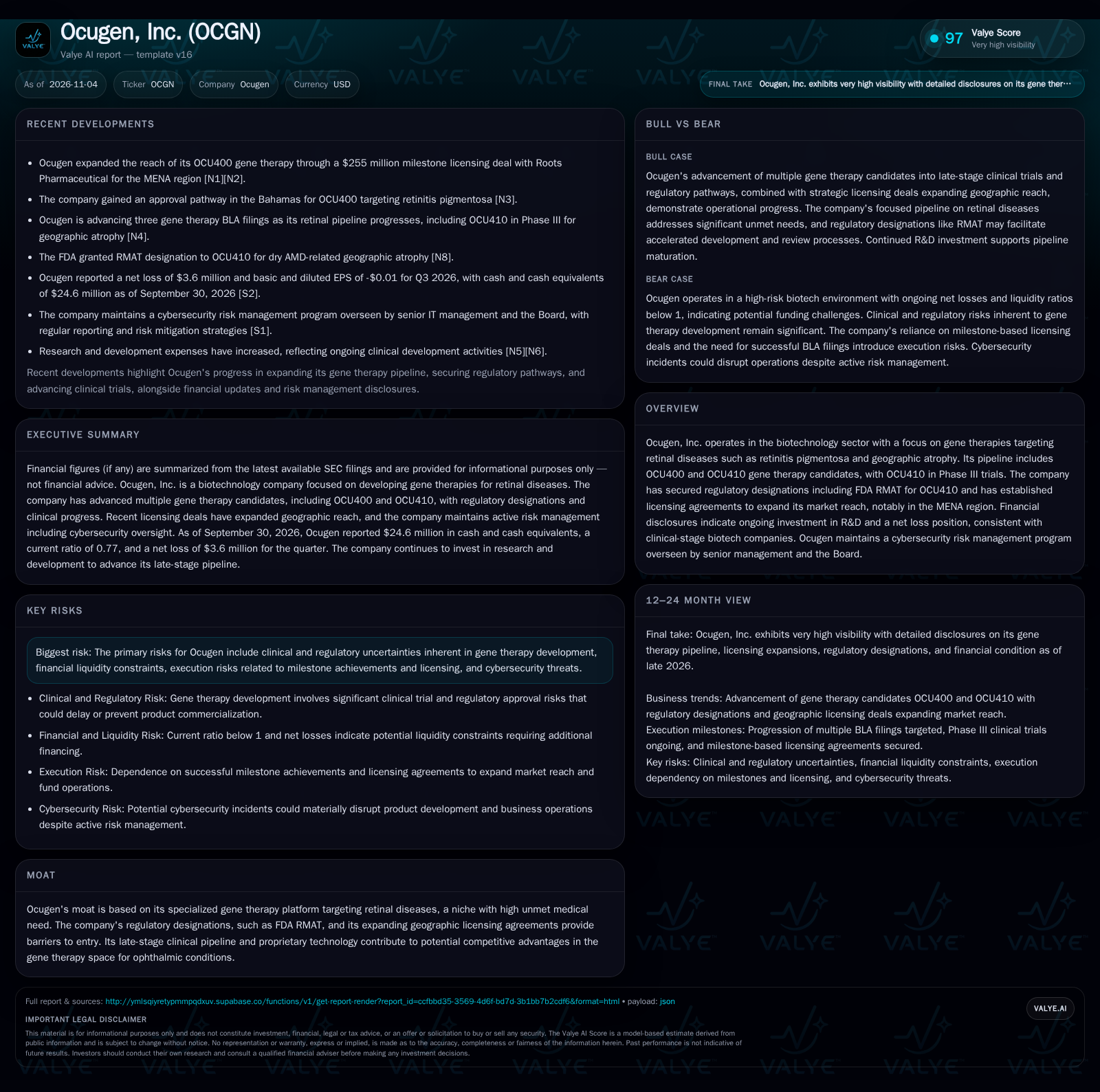
Ocugen is advancing gene therapy candidates for retinal diseases, notably OCU400 and OCU410, with regulatory designations and a $255 million MENA licensing deal. The next 12–24 months hinge on regulatory progress, clinical readouts, and the monetization of milestone agreements.[N1] [N2] [N3] [S2]
Ocugen, Inc. is at a pivotal juncture in its evolution as a gene therapy developer focused on retinal diseases. In late 2026, the company has notched important regulatory and commercial milestones, including a major MENA licensing deal for OCU400 and an FDA RMAT designation for OCU410. The coming year will test whether Ocugen can convert its scientific and partnership progress into sustainable value amid execution and funding pressures.
Recent Milestones and Financial Realities Define Ocugen’s Position
Ocugen’s most material developments in late 2026 include the $255 million milestone licensing agreement with Roots Pharmaceutical for OCU400 in the MENA region, an approval pathway for OCU400 in the Bahamas, and the FDA RMAT designation for OCU410 targeting geographic atrophy in dry AMD.[N1] [N2] [N3] These events broaden the potential commercial scope and regulatory momentum for Ocugen’s core assets. The company reported a current ratio of 0.77 for the period. [S2] [N5] [N6]
Gene Therapy Commercialization: High Fixed Costs, Uncertain Revenue Timing
Ocugen’s economics are typical of clinical-stage biotech: high upfront R&D and regulatory costs, with revenue dependent on future approval, launch, and milestone realization. The company’s $255 million licensing deal with Roots Pharmaceutical is milestone-based, meaning actual cash inflows will depend on achieving regulatory and commercial triggers rather than providing immediate liquidity.[N1] [N2] For OCU400 and OCU410, potential future revenues hinge on successful pivotal trials, regulatory approvals, and market uptake in specialized ophthalmology segments.
The business model could generate substantial operating leverage if therapies reach market, as gene therapies often command high prices per treatment and target chronic, high-need conditions. However, the pathway to that leverage is long, requiring sustained capital for clinical trials, regulatory submissions (including planned BLA filings), and eventual commercialization infrastructure. Without near-term product revenue, Ocugen remains dependent on financing events or upfront/milestone payments from partners to fund operations. The January 2026 $22.5 million equity offering exemplifies this cycle of dilution to bridge cash needs.
Variable costs post-approval may be modest relative to revenues, but manufacturing scale-up and post-market commitments (such as long-term safety studies) could introduce additional capital requirements. The economic model is thus a high-risk, high-reward proposition contingent on both scientific success and commercial execution.
The timing and structure of milestone payments in licensing agreements like the one with Roots Pharmaceutical are critical to Ocugen's financial planning. Since these payments are contingent on regulatory and commercial milestones, any delays in clinical development or approval processes can postpone expected cash inflows, increasing reliance on external financing. This dependency underscores the importance of maintaining flexible capital strategies and exploring diversified funding sources to mitigate liquidity risk. Additionally, the scalability of manufacturing processes for gene therapies often requires upfront investments in specialized facilities and quality control systems, which may not be fully captured in variable cost estimates but are essential for successful commercialization.
Ocugen’s Niche: Regulatory Designations and Geographic Expansion as Differentiators
Ocugen’s focus on gene therapies for rare retinal diseases positions it in a niche with high unmet medical need and relatively few direct competitors compared to broader ophthalmology or gene therapy categories. Regulatory designations, such as the FDA RMAT for OCU410, can provide expedited review and increased engagement with regulators—potentially conferring a speed-to-market advantage if clinical data are compelling.
The $255 million MENA licensing agreement and Bahamas approval pathway signal a strategy to expand geographic reach beyond the crowded US/EU markets, potentially accessing less competitive or more receptive regulatory environments.[N1] [N2] [N3] However, the gene therapy space attracts well-resourced biotech and pharma players, and the ultimate competitive threat will depend on the speed, efficacy, and durability of Ocugen’s clinical data relative to rival programs targeting similar indications.
Switching frictions for approved gene therapies may be high due to the one-time or infrequent dosing model and the lack of established alternatives for many inherited retinal diseases. However, the absence of current commercial products means Ocugen’s competitive position is still largely theoretical, pending successful late-stage development and launch.
Geographic expansion into regions like MENA and the Bahamas may offer regulatory advantages, but also introduces complexities related to market access, reimbursement frameworks, and healthcare infrastructure variability. The commercial success of gene therapies in these markets depends not only on regulatory approval but also on the ability to navigate local payer systems and physician adoption patterns. Moreover, Ocugen’s competitive positioning will hinge on demonstrating differentiated clinical benefits and long-term safety profiles compared to emerging therapies, which could influence formulary inclusion and patient preference in both established and emerging markets.
Accelerated Regulatory Success and Milestone Monetization Drive Value Creation
A favorable outcome for Ocugen would involve successful pivotal trials for OCU400 and OCU410, leading to timely BLA filings and regulatory approvals in multiple jurisdictions. Early commercialization in the Bahamas or MENA could unlock milestone payments from the Roots Pharmaceutical deal, providing non-dilutive funding and validation of the platform.[N1] [N2] [N3]
If clinical data demonstrate durable efficacy and safety, and regulatory agencies grant priority reviews (leveraging RMAT and similar designations), Ocugen could rapidly establish itself as a leader in retinal gene therapy. This could attract additional licensing partners, justify premium pricing, and potentially support further capital raises on favorable terms.
Confirmation of this scenario would come from positive late-stage clinical readouts, receipt of milestone payments, and regulatory approvals or conditional market authorizations. Additional geographic licensing or partnership deals would also reinforce this trajectory.
Clinical Progress Continues, But Funding Remains a Persistent Challenge
The most plausible near-term scenario is steady advancement of OCU400 and OCU410 through mid- to late-stage clinical development, with periodic regulatory updates and incremental progress on BLA filings. Milestone payments from the Roots Pharmaceutical deal may be deferred until key regulatory events are achieved, limiting their immediate impact on liquidity.[N1] [N2]
R&D expenses are likely to remain elevated as the pipeline matures, and any delays or negative clinical signals could exacerbate funding pressures.
Evidence confirming this middle path would include further clinical trial initiations or completions, additional regulatory designations, and timely but not transformative financing events. Failure to secure new capital or delays in milestone achievement would suggest increased risk to continuity.
Clinical Setbacks or Delayed Milestones Trigger Liquidity Crunch
A negative scenario would see Ocugen encounter clinical setbacks—such as adverse trial results, regulatory delays, or safety concerns—that stall progress on OCU400 or OCU410. In this case, milestone payments from the MENA licensing deal could be delayed or forfeited, exacerbating cash burn.[N1] [N2]
With a current ratio of 0.77 and only $24.6 million in cash as of September 2026, the company could face a liquidity crunch, forcing highly dilutive equity raises, asset sales, or a slowdown in R&D activity.[S2] A lack of near-term catalysts and continued net losses could also erode investor confidence and limit access to capital markets.
Confirmation of this downside would come from negative clinical or regulatory updates, missed or renegotiated licensing milestones, and emergency financing measures. Persistent negative operating cash flow without offsetting capital inflows would also signal mounting distress.
In the event of clinical setbacks, the fixed costs associated with ongoing trials and manufacturing readiness could exacerbate financial strain, as these expenditures are less flexible in the short term. Additionally, the gene therapy field’s inherent scientific uncertainties mean that negative trial outcomes could not only delay revenue but also impair investor sentiment, potentially limiting access to capital at reasonable terms. This scenario highlights the critical need for robust risk management practices, including contingency planning for operational scale-downs or strategic partnerships to preserve value amid adverse developments.
What Could Shift Ocugen’s Retinal Gene Therapy Trajectory in 2027
Timelines and outcomes of pivotal clinical trials for OCU400 and OCU410, including data readouts and BLA filing progress.
Receipt and timing of milestone payments from Roots Pharmaceutical and other potential licensing partners (if disclosed).
Additional regulatory designations or expedited review pathways in major markets (e.g., US, EU, MENA, Bahamas).
Updates on cash burn rate, R&D expense trends, and frequency/terms of new financing events.
Progress in establishing commercial infrastructure or distribution partnerships for early-launch geographies.
Any adverse clinical, safety, or regulatory developments that could delay or derail lead programs.
Board and management commentary on risk oversight, especially around cybersecurity and operational continuity (if disclosed).
Disclaimer: This is research-only, informational analysis and not investment advice. It may include AI-generated interpretation and general industry context. Always verify important details using primary sources.

Comments