
OPENLANE in Late 2026: Digital Transformation Stakes, Used Vehicle Supply Cyclicality, and the Contest for Remarketing Economics
OPENLANE, Inc. is navigating a complex automotive remarketing landscape by investing in digital marketplace technology and ERP modernization. With recent revenue and earnings strength, the company’s performance remains tightly linked to used vehicle supply, pricing, and its ability to outpace technology and operational risks in a fiercely competitive environment.
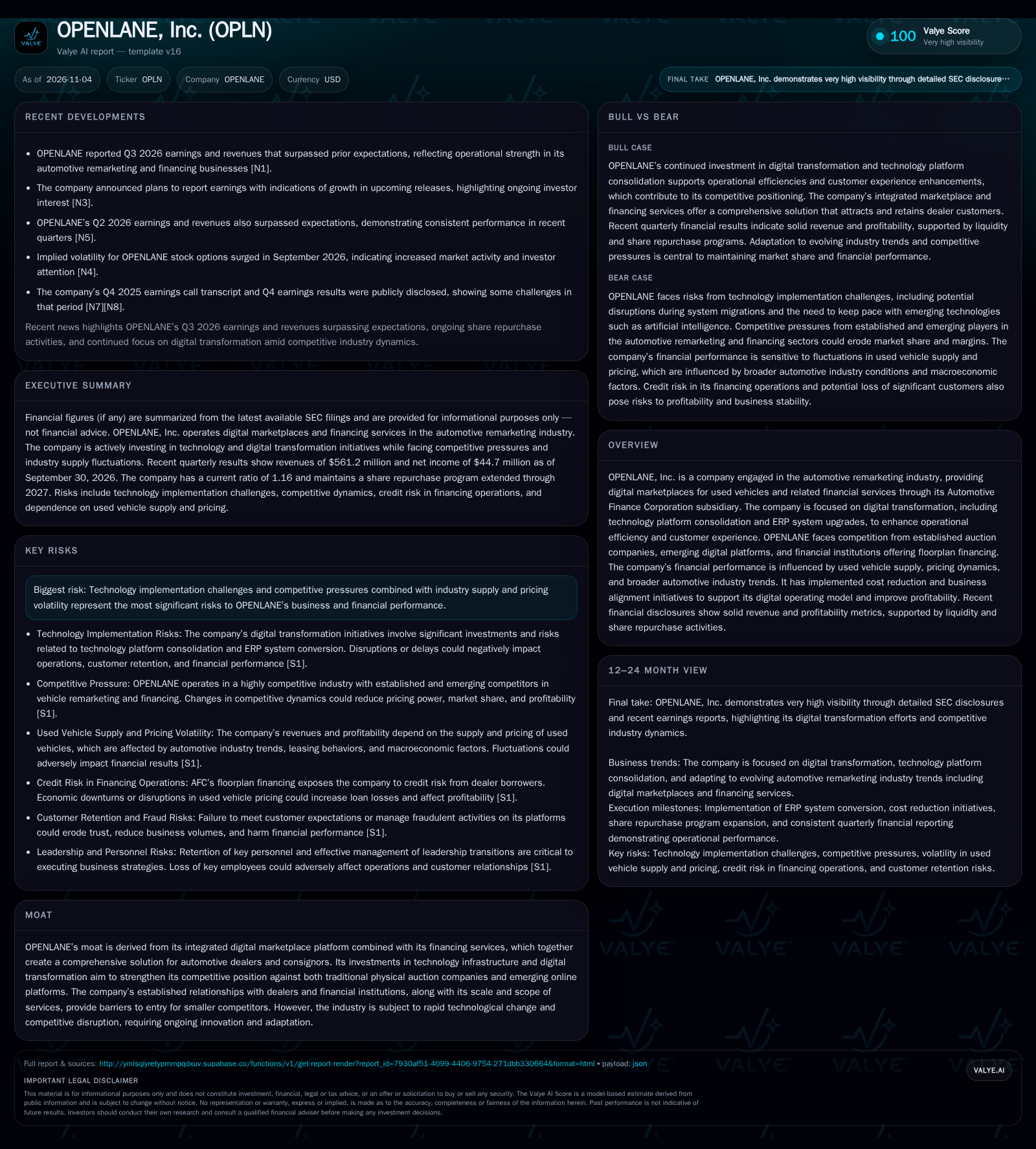
OPENLANE, Inc. reported Q3 2026 revenues of $561.2 million and net income of $44.7 million, supported by ongoing digital transformation and cost initiatives. The company’s fortunes remain tied to used vehicle supply and pricing, while it faces implementation risks from major technology upgrades and intensifying competition from both traditional and digital-first remarketers. Key watchpoints include execution of platform consolidation, customer retention, and the resilience of its floorplan financing business under shifting market conditions. [S2] [S1]
OPENLANE, Inc. stands at a crossroads in the automotive remarketing industry, where digital transformation is both an opportunity and a necessity. The company’s recent financials show robust revenue and earnings, but the underlying business remains tightly bound to the unpredictable dynamics of used vehicle supply and pricing. As OPENLANE invests in technology upgrades and cost alignment, its ability to maintain competitive relevance and operational resilience will be tested by market cyclicality, customer retention challenges, and the rapid evolution of digital platforms. The next phase for OPENLANE will hinge on whether its transformation efforts deliver not only efficiency, but also durable advantages in a crowded and changing landscape.
Recent Results and Transformation Efforts Define the Operating Backdrop
OPENLANE reported Q3 2026 revenue of $561.2 million and net income of $44.7 million, indicating continued profitability in a period marked by industry volatility [S2]. This performance follows multiple quarters of revenue exceeding expectations, amid ongoing cost reduction and business alignment initiatives [N5]. The company’s digital transformation is progressing, with investments in consolidating technology platforms and converting to a modern ERP system intended to streamline operations and improve customer experience [S1]. As of September 30, 2026, OPENLANE held $244.9 million in cash and equivalents, with a current ratio of 1.16 and a share repurchase program extended through 2027 [S2]. These facts set the stage for a company seeking to solidify its position through operational upgrades while managing exposure to credit, supply, and technology risks.
How OPENLANE’s Platform and Financing Model Shape Its Earnings Power
OPENLANE’s primary revenue streams are transaction fees from its digital used vehicle marketplaces and interest income from floorplan financing via its Automotive Finance Corporation (AFC) subsidiary. Transaction economics depend on vehicle volumes, pricing, and the take rate per transaction, which are influenced by wholesale supply, used vehicle price trends, and dealer demand. The move to a consolidated digital platform and ERP system is aimed at reducing fixed and variable operating costs, potentially boosting margins as volumes scale. However, the company’s economics are exposed to swings in used vehicle supply—tied to new car sales, lease returns, and macro cycles—making revenue inherently cyclical.
Floorplan financing adds a layer of interest income but also exposes OPENLANE to credit risk, especially if dealer customers face liquidity pressures or if used vehicle values decline rapidly. In downturns, credit losses can spike, compressing segment profitability. The capital intensity of the business is moderate: while the platform model is asset-light, the financing arm requires capital to support receivables and manage credit risk, especially as competition from banks and fintechs intensifies. Operating leverage could improve if technology investments yield cost savings and higher transaction throughput, but execution risks around system migrations remain material.
Digital Disruption, Established Rivals, and the Evolving Remarketing Arena
OPENLANE operates in a highly competitive value chain, facing pressure from large traditional auction houses, digital-native remarketing platforms, and specialty finance providers [S1]. Its scale, long-standing dealer relationships, and integrated financing services create some barriers to entry, but these are eroding as digital competitors streamline processes, lower transaction costs, and invest in AI-driven pricing and fraud detection. The company’s ongoing technology consolidation is designed to counter these threats, but the pace of innovation by new entrants and the ability of incumbents to digitize quickly remain critical counterforces.
Switching costs in this industry are moderate: while dealer relationships and integration with dealer management systems offer some stickiness, customers are increasingly willing to experiment with new platforms if they offer better economics or user experiences. The risk is that digital-first competitors could undercut transaction fees, offer more flexible financing, or provide superior analytics, eroding OPENLANE’s share. The company’s ability to leverage its existing customer base, data assets, and product breadth will be central to defending—and potentially expanding—its market position.
If Digital Transformation Unlocks Margin Expansion and Market Share Gains
The most favorable outcome for OPENLANE would see its technology investments drive both cost efficiencies and an improved digital customer experience, resulting in higher dealer retention and increased transaction volumes. Successful ERP migration and platform consolidation could lower operating expenses, improve scalability, and allow for rapid integration of new features such as AI-powered pricing or fraud prevention tools. If OPENLANE’s digital ecosystem becomes the preferred platform for dealers, it could capture incremental share from both traditional and emerging competitors.
Strong execution would be confirmed by sustained margin expansion, rising transaction volumes outpacing industry growth, and evidence of customer wins from digital-first rivals. Lower credit losses at AFC, even during periods of used vehicle price volatility, would further validate the upside case. Watch for disclosures on digital adoption rates, new product rollouts, and improved operating metrics tied to the new platform as leading indicators.
What a Stable Yet Cyclical Business Could Look Like Through 2027
The most plausible outcome is that OPENLANE’s digital transformation yields incremental efficiency gains and modest improvements in customer experience, but does not decisively outpace competitors. The company maintains its core dealer base and sees revenue and earnings track the underlying cycles of used vehicle supply and pricing. Technology implementation risks—such as ERP migration hiccups or slower-than-expected adoption—are managed but not eliminated, leading to periodic operational disruptions or cost overruns.
In this scenario, OPENLANE’s share repurchase program continues, but capital allocation remains conservative due to the need to support the AFC financing arm. Credit risk is contained but remains a swing factor depending on macro conditions. Confirmation would come from steady, if unspectacular, operating margins, stable transaction volumes in line with industry trends, and manageable credit losses. Falsification would involve either a significant loss of share to digital disruptors or major technology implementation failures impacting customer retention or platform uptime.
Technology Disruption, Credit Deterioration, and Loss of Relevance
The most adverse scenario would see OPENLANE’s technology upgrades falter—either through implementation delays, cost overruns, or system outages—leading to lost business and eroded customer trust. If digital competitors accelerate their innovation cycles and capture dealer relationships with lower fees, better user experiences, or superior financing products, OPENLANE could see meaningful share loss. A concurrent downturn in used vehicle supply or pricing, coupled with rising dealer bankruptcies, could spike credit losses at AFC and compress group profitability.
Downside confirmation would include sharp declines in transaction volumes, operating margin contraction, increased customer churn, and a surge in credit losses. Additional warning signs would be management turnover, negative customer satisfaction metrics, or an abrupt halt in share repurchases to preserve liquidity. If OPENLANE is slow to respond to shifting market dynamics, its position as a leading remarketing platform could rapidly erode.
Milestones That Will Clarify OPENLANE’s Transformation and Competitive Trajectory
Progress and measurable cost savings from the ERP system conversion and technology platform consolidation, especially as disclosed in future earnings reports.
Trends in transaction volumes and take rates on the digital marketplace platform—if disclosed, these would reveal customer engagement and pricing power.
Dealer customer retention rates and satisfaction scores, with particular focus on churn to digital-native competitors—would help test the strength of OPENLANE’s value proposition.
Credit loss rates and non-performing loan metrics within the AFC financing arm, especially during periods of used vehicle price volatility.
Incidence and mitigation of platform fraud or cybersecurity breaches, which could impact trust and operating results.
Evidence of new digital product rollouts, AI-driven features, or integrations that enhance customer experience and operational efficiency.
Management commentary on competitive dynamics, particularly regarding pricing pressure, customer wins/losses, and responses to new entrants.
Disclaimer: This is research-only, informational analysis and not investment advice. It may include AI-generated interpretation and general industry context. Always verify important details using primary sources.

Comments