
City Holding Company in 2026: Regional Banking Scale, Credit Risk Dynamics, and the Stakes of Community Banking Resilience
City Holding Company’s strong regional market share and diversified loan portfolio underpin its recent outperformance, but credit risk management, interest rate sensitivity, and evolving competitive threats remain central to its forward trajectory.
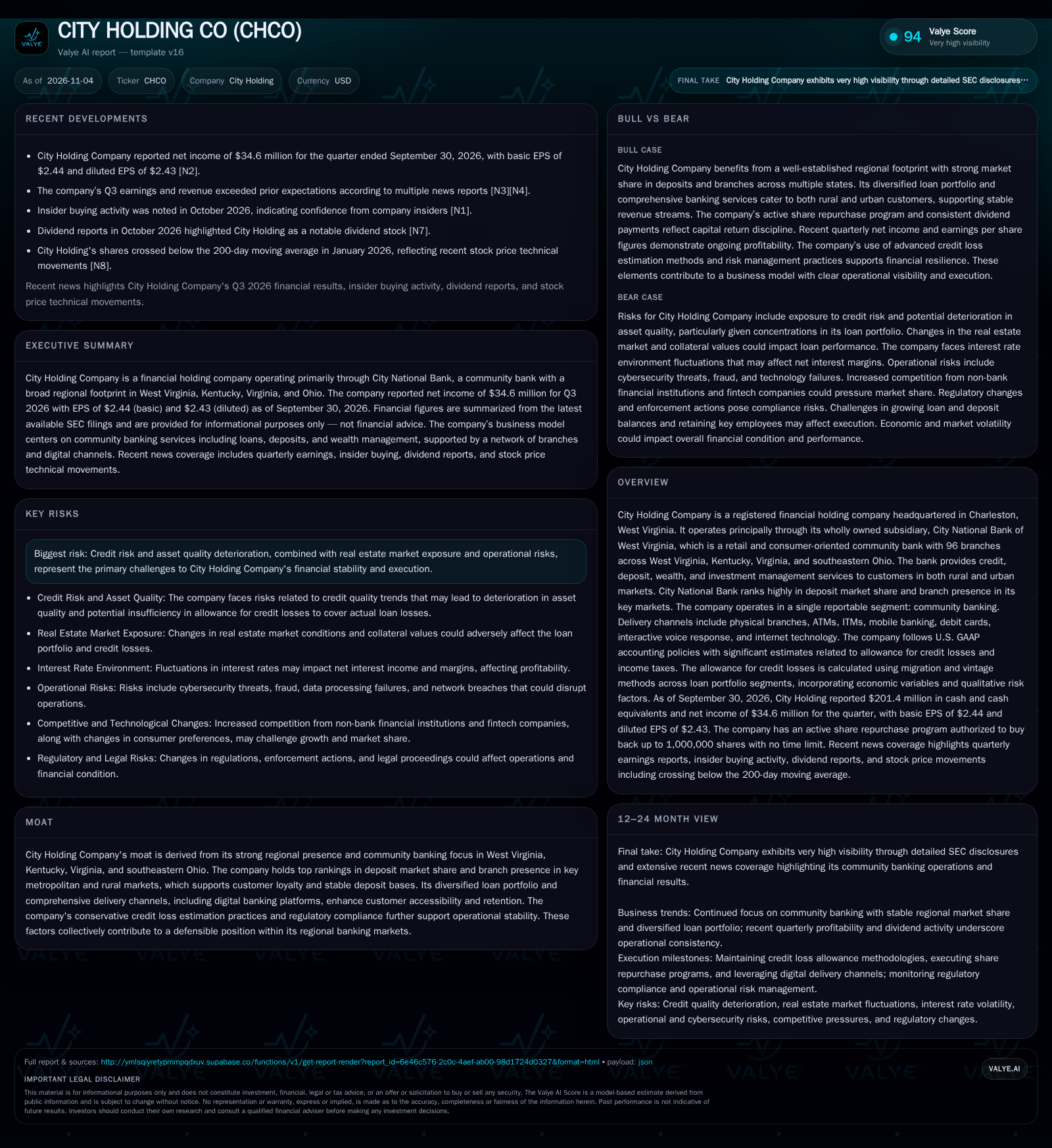
City Holding Company delivered Q3 results that topped expectations, driven by its high deposit share and broad branch network across several states. With $34.6 million in net income and $201.4 million in cash as of September 2026, the bank’s stable operating model is supported by a diversified loan book and active capital return policies. However, its exposure to credit risk, dependence on regional real estate conditions, and mounting competition from both banks and fintechs present ongoing challenges. The effectiveness of its credit loss allowance methodologies and ability to sustain deposit growth will be critical to its long-term resilience and earnings consistency. [S2] [N2] [N3] [N4]
City Holding Company, operating as a prominent community bank through its City National Bank subsidiary, continues to demonstrate the strengths and vulnerabilities inherent in regional banking. Its 96-branch footprint and top-tier deposit share across West Virginia, Kentucky, Virginia, and Ohio have fueled stable earnings and enabled consistent capital returns. The Q3 2026 earnings beat underscores operational resilience, but the bank’s fortunes remain closely tied to disciplined credit risk management and its ability to adapt to an evolving competitive and regulatory landscape. The next phase for City Holding will be defined by how well it navigates credit cycle pressures, interest rate volatility, and the digital transformation reshaping banking.
Q3 Outperformance and Market Position: What Recent Results Reveal
The company reported cash and liquidity metrics for the period; these figures do not by themselves establish operating runway, investment capacity, financial flexibility, or financing capacity. The company’s extensive footprint—96 branches spanning four states—underpins its status as a leading deposit and branch share holder in core markets. City Holding’s active share repurchase program and dividend payouts underscore a commitment to disciplined capital return. These factors collectively reinforce investor confidence in the bank’s business model, while also highlighting the importance of ongoing credit risk management and adaptability in a shifting regional and national banking environment. [S2] [N2] [N3] [N4] [N7]
How City Holding’s Community Banking Model Drives Earnings and Risk
City Holding generates revenue primarily through net interest income from a diversified loan portfolio—commercial real estate, residential mortgages, commercial and industrial loans, home equity, and consumer lending—funded by a stable base of low-cost core deposits. Non-interest income from wealth management, investment services, and transaction fees supplements this core. The spread between asset yields and funding costs is sensitive to interest rate movements, with profitability hinging on both loan quality and deposit retention.
The bank’s cost structure reflects a mix of fixed expenses (branch network, regulatory compliance, technology investment) and variable costs (credit losses, incentive compensation). Operating leverage is achieved as incremental growth in loans and deposits can improve margins if overhead is contained. However, credit risk is a structural variable: allowance for credit losses is calculated using migration and vintage methods, with forecasts for unemployment and other economic drivers factored in. This approach allows for dynamic provisioning but also introduces earnings volatility if economic conditions deteriorate or if portfolio concentrations become problematic. [S1]
Capital needs are typical for regional banks—supporting loan growth, absorbing credit losses, and funding dividends and buybacks. The active share repurchase program and consistent dividends suggest current surplus capital, but any spike in credit losses or regulatory changes could shift this balance quickly.
Defending Regional Scale Amid Intensifying Competitive Pressures
City Holding’s competitive moat is rooted in its strong regional presence, high deposit market share, and dense branch network in both rural and urban markets. This physical scale supports customer loyalty, local knowledge, and a stable funding base, particularly valuable in markets where relationship banking remains important.
However, the company faces mounting challenges from large national banks with superior technology budgets, as well as fintechs and non-bank lenders targeting high-value segments with digital-first offerings. These competitors can erode fee income, attract younger or more mobile customers, and compress margins through price competition. City Holding’s own delivery channels—spanning mobile, internet, ATM/ITM, and traditional branches—help mitigate some risk, but the pace of digital adoption and customer expectations continue to accelerate.
Switching costs in community banking are moderate: while business and older retail customers may value local service, consumer inertia is not absolute, and rising digital standards could lower barriers to defection. The question is whether City Holding can leverage its trusted brand and local relationships to maintain share while upgrading its technology stack and customer experience.
What Could Unlock Sustained Outperformance? The Causal Chain for Upside
City Holding could deliver sustained outperformance if several conditions align: continued growth in loans and deposits—especially in higher-yielding commercial and consumer segments—combined with stable or rising net interest margins as funding costs remain contained. Outperformance would also require credit quality to remain robust, with allowance for credit losses proving adequate even as economic conditions fluctuate.
The bank may also benefit from expanding digital offerings that attract younger customers or new markets without sacrificing cost discipline.
Evidence that would confirm this scenario includes ongoing beats of earnings and revenue estimates, positive trends in loan and deposit growth, stable or improving asset quality metrics (such as non-performing loans and charge-offs, if disclosed), and continued growth in non-interest income. A successful digital adoption initiative or new fee-generating partnerships would further support the upside case.
Earnings Consistency and Credit Discipline Define the Most Likely Trajectory
The most plausible path for City Holding is continued steady profitability, anchored by its entrenched regional position and diversified loan book. Modest loan and deposit growth, coupled with prudent risk management and disciplined expense control, would support predictable earnings and ongoing capital returns, even if net interest margins experience mild compression due to competitive and rate pressures.
Credit losses may rise incrementally in line with broader economic cycles, but the bank’s allowance methodology—incorporating migration and vintage analysis and forward-looking economic variables—should help buffer shocks, provided local real estate and employment conditions remain stable.
Confirmation of this scenario would be visible in quarterly results that remain in line with historical trends, stable dividend and buyback activity, and absence of material surprises in asset quality. Conversely, a sudden spike in non-performing loans, deposit outflows, or regulatory intervention would challenge the base case.
How Credit Deterioration or Market Disruption Could Derail the Model
City Holding’s business model could be significantly challenged if credit quality weakens—driven by rising unemployment, falling real estate values, or sector-specific downturns in its core geographies. A sharp increase in non-performing loans or charge-offs could force higher provisioning, eroding earnings and potentially constraining capital available for dividends or buybacks.
Interest rate volatility poses another risk: if funding costs rise faster than loan yields, net interest margins could compress, pressuring profitability. Meanwhile, accelerated customer migration to digital-first competitors—particularly if City Holding’s technology investment lags—could lead to deposit attrition and lower fee income.
Downside confirmation would include a material increase in loan loss provisions, negative trends in asset quality metrics (if disclosed), deposit outflows, or the suspension of capital return programs. Regulatory actions or adverse legal developments would further amplify risks.
Benchmarks That Will Reveal the Resilience of City Holding’s Model
Quarterly trends in loan growth and deposit balances: sustained expansion would support the upside, while stagnation or declines would signal emerging challenges.
Net interest margin evolution: compression would indicate mounting rate or competitive pressures, while stability or expansion would support the bull case.
Non-performing loan and charge-off rates (if disclosed): rising levels would signal credit deterioration and stress-test allowance adequacy.
Provision for credit losses: increases beyond historical norms would suggest rising risk or model conservatism; stable provisioning would support the base case.
Deposit market share in core regions: loss of share to competitors or fintechs would raise questions about customer loyalty and funding stability.
Progress on digital channel adoption and customer engagement: meaningful increases would demonstrate successful adaptation to changing preferences.
Regulatory or legal developments: any new compliance burdens, enforcement actions, or adverse rulings could materially affect operations or capital allocation.
Disclaimer: This is research-only, informational analysis and not investment advice. It may include AI-generated interpretation and general industry context. Always verify important details using primary sources.

Comments