
Avis Budget Group in 2026: Fleet Economics, Competitive Pressures, and the Stakes of Mobility Industry Evolution
Avis Budget Group’s Q3 2026 results highlight the mounting challenge of balancing fleet costs, competitive pricing, and evolving travel demand. As the vehicle rental market faces disruption from new mobility models and electrification, Avis’s ability to manage utilization, adapt its fleet, and maintain profitability is under scrutiny.
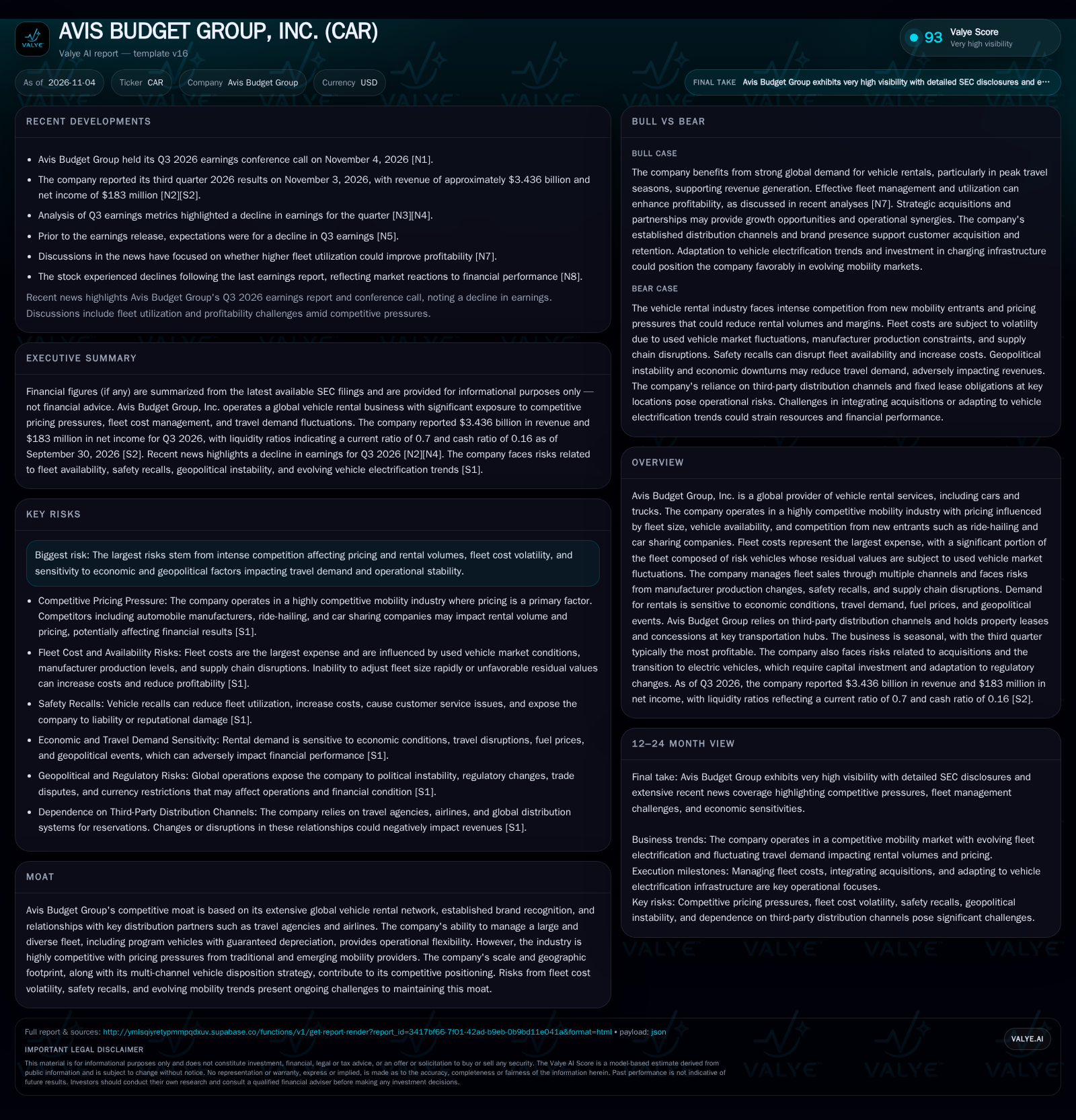
In Q3 2026, Avis Budget Group reported $3.436 billion in revenue and $183 million in net income, but earnings missed expectations and the stock declined. The company’s operating model faces heightened pressures from fleet cost volatility, increased competition—including ride-hailing and car sharing—and the capital requirements of electrification. Future performance hinges on effective fleet management, adapting to new mobility trends, and navigating economic sensitivities as the core rental business model is tested by industry shifts. [S2] [N2] [N4] [N8]
Avis Budget Group’s latest results underscore a vehicle rental business at an inflection point. Despite delivering $3.436 billion in Q3 2026 revenue, earnings fell short of expectations and the stock declined, reflecting market anxiety over intensified competition, rising fleet costs, and the looming capital commitments of electrification. As travel demand fluctuates and the mobility sector rapidly evolves, Avis’s core challenge is to optimize fleet economics and adapt to disruptive forces without sacrificing profitability or operational flexibility. The next phase for Avis will be defined by its ability to execute on fleet management, respond to new mobility models, and invest wisely in the face of industry transformation. [S2] [N2] [N4] [N8]
Recent Results and Financial Pressures Define a Transitional Moment
Avis Budget Group reported Q3 2026 revenue of approximately $3.436 billion and net income of $183 million. However, both earnings and profitability metrics missed market expectations, leading to a decline in the company’s stock price following the results. This underperformance comes amid heightened scrutiny of fleet utilization and profitability in recent news analysis. The company’s liquidity snapshot—$561 million in cash and cash equivalents, a current ratio of 0.7, and a cash ratio of 0.16 as of September 30, 2026—depicts a business operating with a narrow margin between short-term assets and liabilities, but not signaling immediate liquidity distress. These facts matter because they set the stage for Avis's operational priorities: navigating cost pressures, defending market share, and maintaining potential financial flexibility in an environment of increasing mobility disruption. [S2] [N2] [N4] [N8]
Fleet Cost Dynamics, Pricing Power, and the Economics of Vehicle Turnover
Avis Budget Group’s business model is fundamentally shaped by the interplay between fleet costs, rental pricing, and utilization rates. Fleet costs—by far the largest expense—are driven by the acquisition, depreciation, and disposal of vehicles. The company operates a mix of program vehicles (with manufacturer-guaranteed depreciation) and risk vehicles (about 84% of the fleet in 2025), the latter exposing Avis to the volatility of used vehicle market values. When used vehicle prices fall or manufacturer production tightens, residual values decline and fleet costs can rise sharply, compressing margins.
Revenue is generated by renting vehicles across daily, weekly, and monthly contracts, with pricing power constrained by competition and customer price sensitivity. Seasonality is a defining feature, with the third quarter historically the most profitable due to leisure travel. Fixed costs, including property leases and airport concessions, add operating leverage—boosting profits when volumes are strong but amplifying losses in downturns.
Variable costs include fleet maintenance, logistics, and insurance. The capital intensity of the business is increasing as electrification trends require investment in new vehicle types and charging infrastructure. Cash flow is thus highly sensitive to fleet utilization, resale values, and the ability to adjust fleet size to match demand. If the company can optimize fleet mix, improve utilization, and manage vehicle disposal channels effectively, there is potential for margin recovery, but the economics remain exposed to industry and macro shocks.
Competitive Pressures from Mobility Disruptors and Traditional Rivals
Avis Budget Group faces a highly competitive landscape, with traditional rental peers, automobile manufacturers (offering direct rentals), and, increasingly, ride-hailing and car-sharing platforms encroaching on its core business. These new entrants typically leverage technology, flexible pricing, and asset-light models to appeal to urban and younger travelers, threatening both pricing and volume for legacy rental operators.
Brand recognition, a global footprint, and longstanding relationships with travel agencies and airlines provide some insulation against disintermediation. However, reliance on third-party distribution channels also introduces risk if partners pivot to alternative mobility providers or renegotiate terms. The company’s ability to secure and manage key airport and train station concessions confers a logistical advantage, but these assets come with high fixed costs and exposure to competitive bidding.
The shift toward vehicle electrification and autonomous vehicles is a double-edged sword: while it could provide differentiation if managed proactively, it also requires significant capital and operational adaptation. The question is whether Avis can leverage its scale and multi-channel vehicle disposition strategy to offset competitive pressures, or whether new mobility models will erode its traditional moat over time.
Profitability Recovers Through Fleet Optimization and Electrification Execution
A favorable outcome for Avis Budget Group would hinge on several interlocking factors: strong travel demand, successful fleet cost management, and effective adaptation to industry shifts. If used vehicle markets stabilize or improve, residual values for risk vehicles would support lower fleet costs. Simultaneously, if Avis can boost fleet utilization—maximizing rental days per vehicle—while maintaining discipline in fleet size, operating leverage could lift margins even in a competitive pricing environment.
Strategic investments in electrification, if executed ahead of regulatory mandates and in response to emerging customer demand, could differentiate the offering and secure premium pricing or partnership opportunities. Expansion of direct-to-consumer sales channels for retired fleet vehicles may also capture higher resale values, further supporting profitability.
Evidence supporting this scenario would include sequential improvement in operating margins, positive commentary on fleet utilization trends, successful rollout of electrified fleet segments, and above-peer revenue growth during peak travel periods. Conversely, persistent underperformance on utilization or margin metrics would challenge the bullish case.
Stability Depends on Managing Fleet Volatility in a Disrupted Market
The most plausible path forward is one of incremental adaptation rather than rapid transformation. Avis Budget Group is likely to experience continued revenue and earnings volatility as fleet costs fluctuate with used vehicle markets and manufacturer supply conditions. Pricing will remain pressured by both traditional and non-traditional competitors, limiting the company’s ability to pass through higher costs.
The company should be able to maintain core operations and avoid acute liquidity stress, given its global footprint and established customer channels, but will need to prioritize cost control and tactical fleet management. Investments in electrification may proceed cautiously, paced by regulatory deadlines and customer adoption rates.
Confirmation of this scenario would come from relatively stable quarterly revenues, modest improvements in utilization, and the absence of major shocks from recalls or supply chain disruptions. Negative surprises in fleet costs, persistent pricing pressure, or evidence of market share loss to new mobility entrants would suggest downside risk.
Fleet Cost Surges and Mobility Disruption Erode Profitability
In a more adverse scenario, Avis Budget Group could face a convergence of negative forces: a sharp decline in used vehicle prices, persistent supply chain disruptions, and intensifying competition from ride-hailing and car-sharing platforms. If the company is unable to adjust fleet size or composition rapidly in response to demand shocks, excess inventory could drive up holding costs and force distressed vehicle sales at poor residual values.
A failure to adapt to electrification—whether through delayed investment, regulatory non-compliance, or misreading consumer demand—could result in stranded assets or loss of key transportation hub concessions. Operational disruptions, such as widespread safety recalls or loss of major travel agency partnerships, would further weaken the business model.
Confirmation of this scenario would include negative operating cash flow, declining fleet utilization, margin compression, and the need to raise capital under unfavorable terms. A useful falsification would be evidence of sustained or improved profitability despite industry headwinds.
Signals That Will Test Avis Budget Group’s Mobility Thesis
Quarterly trends in fleet utilization rates and the proportion of risk vehicles, if disclosed, will be essential for assessing operational efficiency and exposure to used vehicle market swings.
Operating margin progression and cost-per-rental-day metrics would clarify the company’s ability to manage fleet and operating expenses relative to pricing power.
Updates on electrified fleet deployment, charging infrastructure investment, and related capital expenditures will indicate readiness for regulatory and market shifts.
Retention and expansion of key property leases and airport/train station concessions, as disclosed, will reveal the company’s ability to defend its core distribution footprint.
Progress in direct-to-consumer vehicle sales channels, including volumes and realized resale values, would help gauge the effectiveness of fleet disposition strategies.
Changes in third-party distribution relationships—especially with travel agencies, airlines, and global reservation systems—would signal shifts in customer acquisition dynamics.
Any material safety recalls or manufacturer-driven fleet disruptions, and the resulting impact on fleet availability and costs, should be monitored for operational risk.
Disclaimer: This is research-only, informational analysis and not investment advice. It may include AI-generated interpretation and general industry context. Always verify important details using primary sources.

Comments