
Charles River Laboratories in 2026: Scaling CRO Operations, Margin Opportunities, and Leadership Transition Implications
Charles River Laboratories’ recent outperformance in earnings and outlook upgrades underscores the enduring demand for outsourced drug development, but the company’s ability to capitalize on sector strength will hinge on effective risk management, integration of new leadership, and maintaining its operational edge in a consolidating CRO landscape.
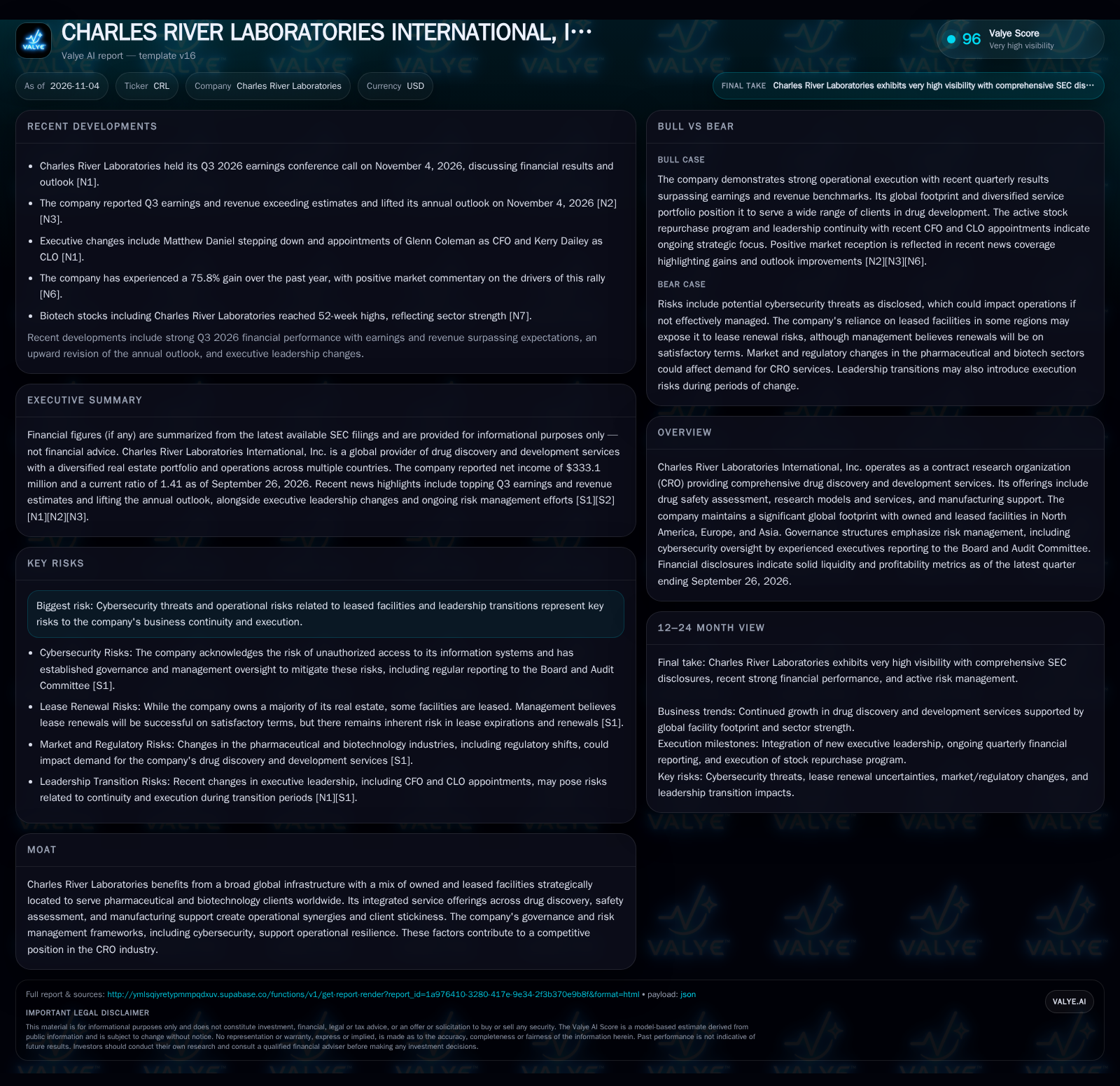
Charles River Laboratories (CRL) posted strong Q3 2026 results, beating estimates and raising its annual outlook amid a sector-wide biotech rally. The company’s global footprint and integrated service model remain strategic strengths, but the transition in financial and legal leadership introduces execution risk at a time when cybersecurity and facility management are critical operational watchpoints. The CRO’s ability to drive margin expansion and client retention will be tested by evolving pharma R&D needs and intensifying competition.
Charles River Laboratories International, Inc. stands at a pivotal moment in the CRO sector, reporting robust Q3 2026 earnings that outpaced market expectations and prompted an upward revision in its annual outlook. This performance, set against a backdrop of biotech sector strength and a 75%+ share price rally over the past year, highlights the company’s operational scale and the resilience of its integrated drug development services. Yet, leadership transitions at the CFO and CLO levels, coupled with persistent cybersecurity and facility management risks, mean that CRL’s ability to sustain profitable growth will be closely tied to execution and adaptability in an evolving life sciences landscape.
Earnings Outperformance, Revised Guidance, and Leadership Shifts Define Short-Term Outlook
Charles River Laboratories reported Q3 2026 net income of $333.1 million, with basic earnings per share of $6.97 and diluted EPS of $6.86, exceeding analyst expectations and prompting an upward revision to full-year guidance [S2] [N2] [N3]. The company’s stock has gained 75.8% over the past year, reflecting broad market optimism toward biotech and CRO peers [N6] [N7]. Recent executive changes—most notably the appointment of Glenn Coleman as CFO and Kerry Dailey as CLO following Matthew Daniel’s departure—add a layer of uncertainty as the company enters a critical phase of growth and operational execution [N1] [S1]. The company reported cash and liquidity metrics for the period; these figures do not by themselves establish operating runway, investment capacity, financial flexibility, or financing capacity. [S2]
Revenue Streams, Margin Trends, and Capital Deployment in the Integrated CRO Framework
Charles River’s business model is built around providing a full spectrum of drug discovery and development services to pharmaceutical and biotechnology clients. Revenue is generally driven by a combination of project-based and ongoing service relationships, with offerings spanning preclinical safety assessment, research models, and manufacturing support. Industry-wide, client stickiness is often supported by regulatory complexity and high switching costs, though the specific mechanics of Charles River’s client retention or contract structures are not detailed in public filings. Pricing power in the CRO industry is typically linked to specialized expertise, compliance track record, and global reach; Charles River’s ownership of 65% of its real estate (including all facilities over 200,000 square feet) suggests a commitment to operational control and cost leverage, though leased facilities still introduce renewal risks [S1].
Operating leverage is a critical mechanism in this model: as facility utilization increases, fixed costs are spread across a larger revenue base, potentially driving margin expansion. However, capital intensity remains significant, with ongoing investments in facility maintenance, compliance, and technology infrastructure—especially cybersecurity, given sector threat levels [S1]. The $1.0 billion stock repurchase program, with $700 million still available, signals a willingness to return capital to shareholders, although the absence of buybacks this quarter may reflect a preference for strategic flexibility or a response to market conditions [S2].
Competitive Strengths from Global Reach and Service Diversity Amid Industry Challenges
Charles River’s global infrastructure—spanning North America, Europe, and Asia—enables the company to serve multinational clients and tap into diverse regulatory and scientific ecosystems. Its integrated offerings across drug discovery, safety assessment, and manufacturing support create cross-selling opportunities and deepen client relationships, which can reduce churn and increase client lifetime value. The company’s focus on both owned and leased facilities provides a blend of cost control and geographic agility, though lease exposure in certain regions introduces operational risk [S1].
The CRO market remains highly competitive, with pressure from both large integrated players and specialized niche firms. Substitution risk exists as large pharma companies periodically consider insourcing or multi-vendor strategies to manage cost and control. Meanwhile, technological advances in AI-driven drug discovery and automation can alter the economics of preclinical research, potentially compressing margins for commoditized services. Charles River’s governance and risk management structures—particularly around cybersecurity and compliance—may serve as differentiators if well-executed, but these are fast-moving targets in a sector marked by regulatory scrutiny and data sensitivity.
Strong Execution Could Unlock Margin Gains and Enhance Client Loyalty
A favorable scenario for Charles River would see continued robust sector demand, with the company leveraging its global footprint and integrated service model to win larger, multi-phase contracts. Margin expansion could result from higher facility utilization and disciplined cost management, especially if the new executive team quickly demonstrates operational continuity and strategic alignment. Upside would be confirmed by sustained outperformance versus guidance, new client wins or contract expansions, and visible progress on cybersecurity and compliance initiatives.
Indicators supporting this scenario would include rising orders or awards (if disclosed), improved operating margins, and evidence of strong client retention or cross-selling. Confirmation would also come from above-peer revenue growth and positive commentary from large pharma or biotech clients about the value of Charles River’s integrated approach. Successful execution of the buyback program, without compromising investment in core operations, would further validate capital allocation discipline.
Growth Prospects Remain Stable Despite Leadership Changes and Industry Pressures
The most plausible outcome is that Charles River maintains mid-single-digit revenue growth, with margins stable or modestly improving as facility utilization remains high and sector demand for CRO services continues. The integration of new CFO and CLO leadership proceeds without major disruption, but execution risk remains elevated in the short term as organizational processes adjust. Lease renewal and cybersecurity issues are managed but not eliminated, resulting in occasional operational frictions.
Evidence confirming this scenario would include earnings in line with updated guidance, stable or slightly improved margin profiles, and no major negative surprises related to facility renewals or cyber incidents. Falsification would come from unexpected leadership turnover, significant contract losses, or regulatory setbacks that impact revenue visibility.
Client Trust Risks from Operational Issues and Leadership Challenges
In a less favorable scenario, the leadership transition proves disruptive, leading to delays in decision-making or misalignment on strategy. This could be compounded by a significant cyber incident or failure to renew key leases, resulting in operational interruptions and potential client losses. If sector demand weakens or large clients shift to competitors or insource more work, pricing pressure and margin contraction could follow.
Downside would be confirmed by missed earnings targets, declining orders or awards (if reported), negative client commentary, or elevated costs due to remediation efforts. Additional warning signs would include further senior management turnover, regulatory actions, or material adverse events disclosed in SEC filings.
Key Developments Influencing Charles River’s CRO Growth Path
Quarterly orders or awards disclosures, if provided, would clarify the sustainability of demand and revenue visibility.
Operating margin trends, especially relative to prior quarters and peers, will help gauge the effectiveness of cost management and facility utilization.
Updates on facility lease renewals or expansions, including any disclosed terms or regional exposure, would help assess operational risk.
Reported incidents or enhancements in cybersecurity posture—such as disclosures of breaches, technology upgrades, or audit outcomes—would test the company’s risk management claims.
Evidence of successful integration and continuity from the new CFO and CLO, possibly reflected in financial reporting cadence or strategic commentary.
Utilization rates of major facilities, if disclosed, would provide insight into fixed-cost leverage and capacity planning.
Pace and timing of stock buybacks, or commentary on capital allocation priorities, would indicate management’s confidence and flexibility.
Any disclosed changes in client concentration or retention rates, or qualitative disclosures about large contract renewals or losses, would help test the stickiness of the business model.
Disclaimer: This is research-only, informational analysis and not investment advice. It may include AI-generated interpretation and general industry context. Always verify important details using primary sources.

Comments