
Seres Therapeutics at a Crossroads: Clinical Promise, Financing Pressure, and the Stakes of Advancing SER-155
Seres Therapeutics is refocusing on its live biotherapeutics pipeline after divesting its only approved product, now relying on promising SER-155 data and regulatory momentum to attract urgently needed funding. With a limited cash runway, execution risk is acute—progress will hinge on clinical results, partnership formation, and the company’s ability to bridge capital gaps before late 2026.
Seres Therapeutics, now pipeline-focused after selling VOWST, is betting on SER-155’s clinical promise and positive FDA engagement to secure new funding and partnerships. However, with cash dwindling and ongoing losses, the company faces substantial going concern risk beyond late 2026. Execution will depend on advancing trials, demonstrating clear clinical value, and convincing partners or investors to back the next phase.
Seres Therapeutics, Inc. has reached a pivotal moment after divesting its only commercialized asset, VOWST, to focus exclusively on its pipeline of live biotherapeutic candidates—most notably SER-155. The next year will be defined by Seres’ ability to translate clinical promise into tangible financing or partnership deals, as ongoing losses and rising expenses threaten to outpace its resources.
Clinical Progress and Financial Strain Define Seres Therapeutics’ Current Reality
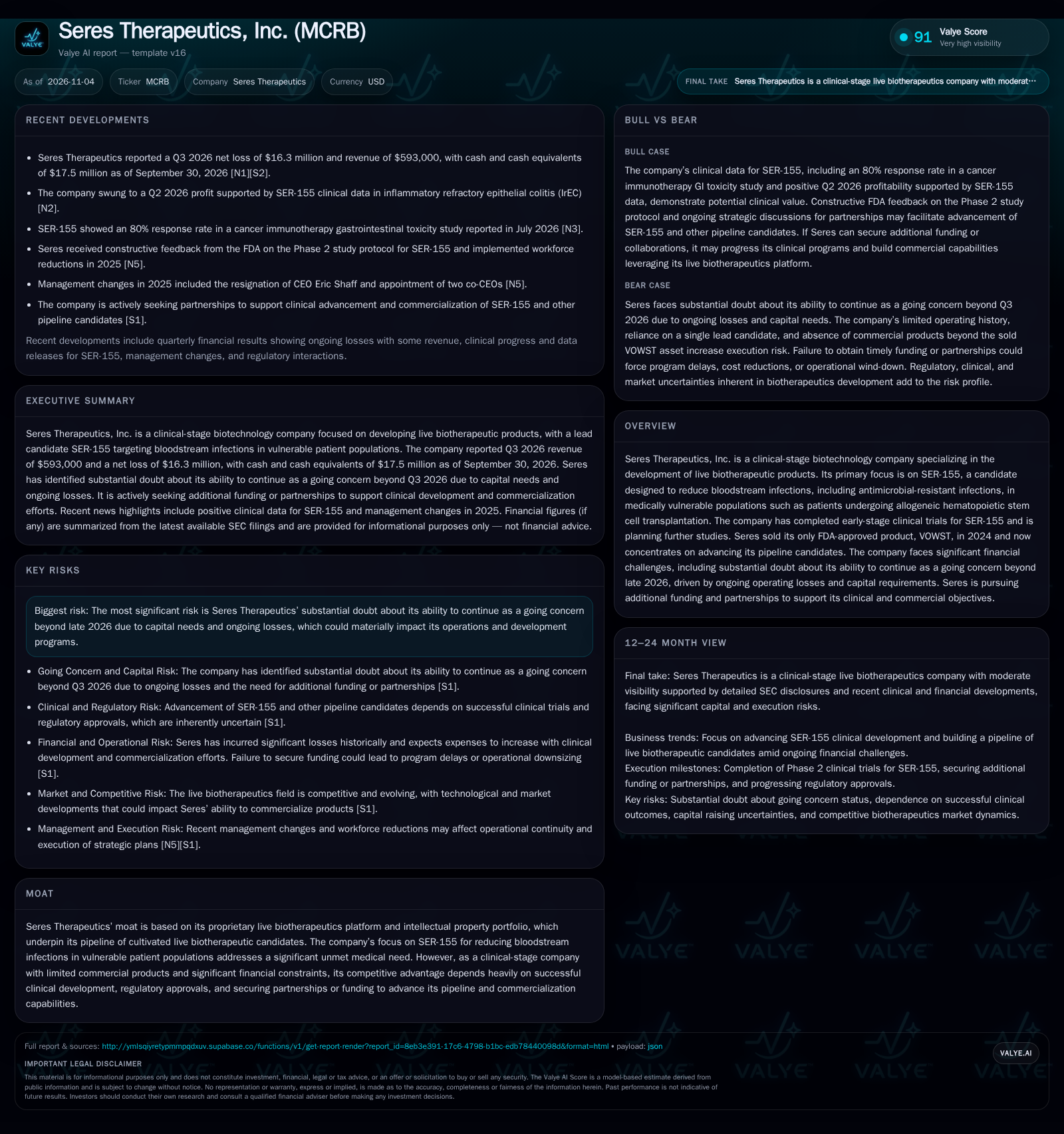
Seres Therapeutics is now a pure-play clinical-stage biotech after selling VOWST, its only FDA-approved product, in 2024. The company’s lead asset, SER-155, targets reduction of serious bloodstream infections in highly vulnerable populations and has recently reported an 80% response rate in a cancer immunotherapy GI toxicity study [N3]. The company ended Q3 2026 with $17.5 million in cash and equivalents, a net loss of $16.3 million, and revenue of $593,000—underscoring that it is not generating meaningful commercial income [N1] [S2]. Importantly, Seres has formally identified substantial doubt about its ability to continue as a going concern beyond Q3 2026 unless new funding or partnerships are secured [S2]. Expenses are expected to rise with clinical trial progression, manufacturing, and regulatory activities.
How Seres’ Biotherapeutics Model Could Create Value—And Where the Cost Pressures Lie
The business model for Seres Therapeutics is typical of clinical-stage biotech: heavy upfront investment in R&D, clinical trials, and regulatory preparation, with the hope of future high-margin product revenue or milestone/royalty streams from out-licensing or partnerships. The economics hinge on successful advancement of SER-155 and potentially other candidates like SER-603. At this stage, revenue is negligible; most cash outflows are for research, clinical operations, and regulatory engagement. Fixed costs are significant, especially around maintaining scientific, regulatory, and manufacturing infrastructure. Variable costs will rise with trial enrollment and potential manufacturing scale-up.
Seres’ capital needs are acute. With just $17.5 million in cash and a history of $16.3 million net quarterly losses, the company will need to either raise capital, strike partnership deals, or cut expenses sharply to avoid operational shutdown [S2]. If clinical results for SER-155 continue to be positive, Seres could potentially negotiate upfront payments or cost-sharing agreements with larger pharmaceutical partners, which is a common pathway for pipeline-stage biotechs facing cash constraints. However, the timing and magnitude of such deals are highly uncertain and often dilutive to existing shareholders.
The scalability of Seres’ live biotherapeutics manufacturing processes represents a significant economic lever but also a potential bottleneck. Manufacturing live microbial products at clinical and commercial scale involves complex quality control, reproducibility, and supply chain challenges that can materially impact cost structure and timelines. If Seres can optimize manufacturing efficiencies and reduce per-unit costs through process innovation or strategic partnerships, it would enhance gross margins and improve attractiveness to partners. Conversely, failure to control manufacturing costs or delays could exacerbate cash burn and undermine investor confidence.
Navigating the Crowded Microbiome Therapeutics Landscape
Seres’ competitive edge rests on its proprietary live biotherapeutics platform and intellectual property, with a focus on high-need indications like bloodstream infection prevention in immunocompromised populations [S1]. The live biotherapeutics field is increasingly crowded, with numerous startups and established pharmaceutical companies pursuing similar approaches for infectious disease, immunology, and gastrointestinal disorders. The strength and breadth of Seres’ IP and clinical data could support future differentiation, especially if SER-155 secures regulatory approval in a high-value, difficult-to-treat patient segment.
However, Seres now lacks a commercial product, which diminishes its leverage and negotiating position compared to peers with ongoing revenue streams. The field’s rapid pace means that other companies could leapfrog Seres if their candidates progress faster or demonstrate clearer commercial viability. Switching costs for prescribers and hospitals in this domain are likely to be moderate, with adoption dependent on clinical efficacy, safety, and payer support rather than platform loyalty.
In a crowded microbiome therapeutics field, differentiation hinges not only on clinical efficacy but also on intellectual property breadth, regulatory strategy, and go-to-market execution. The absence of a current commercial product limits Seres’ ability to leverage real-world evidence or payer relationships, which are increasingly important for market access in live biotherapeutics. Moreover, given the nascent state of microbiome therapies, payer reimbursement frameworks remain uncertain, potentially constraining adoption. Seres’ ability to demonstrate clear clinical and economic value will be essential to overcoming these barriers and establishing a sustainable competitive position.
If Pipeline Momentum Unlocks Funding: How Seres Could Defy the Odds
The favorable scenario for Seres hinges on a virtuous cycle: ongoing positive clinical data for SER-155 (e.g., high response rates, favorable safety profile) attracts significant partnership interest or equity investment, which in turn funds continued development and regulatory milestones. Constructive recent FDA feedback on the Phase 2 protocol and the 80% response rate in GI toxicity studies are early signals that could catalyze this cycle [N3] [N5]. If Seres secures a strategic partnership—potentially with upfront payments or milestone-based funding—it could stabilize operations, accelerate pipeline progress, and regain market confidence.
Confirmation of this scenario would include announcements of major partnership deals, non-dilutive funding, or successful completion of Phase 2 trials with compelling data. Falsification would come from failed fundraising rounds, inability to attract partners, or negative clinical/regulatory outcomes that stall momentum.
Managing Through Uncertainty: Likely Outcomes if Funding Remains Challenging
The most plausible near-term trajectory is a period of sustained financial stress: Seres continues to advance SER-155 into later-stage trials, but is forced to operate under severe budget constraints, possibly delaying other pipeline programs and reducing headcount further. Small-scale partnership or grant funding may provide incremental runway, but not enough to fully fund pivotal trials or launch preparations. Clinical and regulatory progress for SER-155 proceeds, but at a measured pace dictated by available resources.
Evidence supporting this scenario would be incremental fundraising (e.g., small equity offerings, grants), continued but slow trial enrollment, and ongoing cost controls. It would be falsified by either a major deal that alleviates financial pressure or a negative development that forces a sharp pivot or operational wind-down.
When Capital Runs Out: The Risk of Forced Retrenchment or Wind-Down
The adverse scenario materializes if Seres cannot secure sufficient funding or a strategic partnership before late 2026. In this case, the company may be forced to halt or delay clinical trials, lay off additional staff, and potentially seek a sale of assets or pursue bankruptcy protection. The absence of commercial products and reliance on a single advanced candidate would leave little margin for error; even minor clinical or regulatory setbacks could accelerate this outcome.
Evidence of this scenario would include public disclosures of failed funding efforts, major workforce reductions, asset sales, or a formal announcement of strategic alternatives. If Seres is unable to maintain compliance with its obligations or continues to report going concern warnings without progress on the funding front, investors should assume heightened risk of operational wind-down.
Signals That Will Determine Whether Seres Survives and Advances
Completion and publication of Phase 2 clinical trial data for SER-155, especially in new indications or larger patient cohorts.
Announcements of partnership deals, licensing agreements, or non-dilutive funding that materially extend the cash runway.
Updates on the pace of trial enrollment and manufacturing scale-up activities, which would indicate operational momentum or constraint.
Quarterly cash burn rates and updated financial disclosures—particularly any changes to the company’s stated going concern risk.
Any regulatory milestones or feedback from the FDA or other agencies that advance (or stall) SER-155 or other pipeline assets.
Management turnover, workforce changes, or cost-cutting initiatives that could impact execution capacity.
If disclosed, updates on out-licensing activity or interest in earlier-stage pipeline candidates such as SER-603.
Disclaimer: This is research-only, informational analysis and not investment advice. It may include AI-generated interpretation and general industry context. Always verify important details using primary sources.

Comments