
FTC Solar in 2026: Backlog Leverage, Liquidity Strain, and the Stakes of Solar Tracker Execution
FTC Solar’s Q3 2026 results highlight a paradox: a robust $640 million backlog and positive basic EPS contrast with a working capital deficit, recent covenant breaches, and ongoing doubts about going-concern viability.
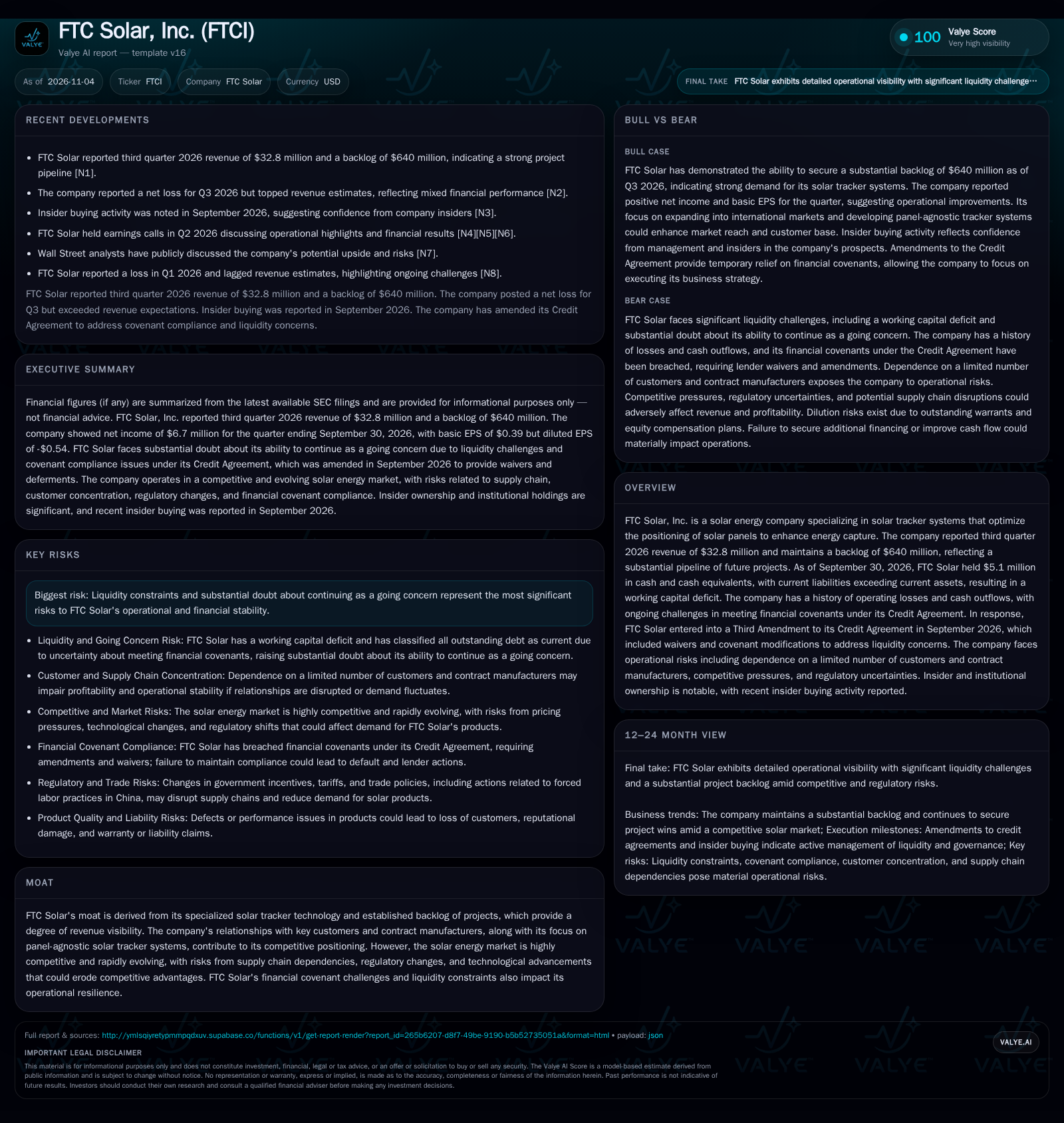
FTC Solar’s Q3 2026 results highlight a paradox: a robust $640 million backlog and positive basic EPS contrast with a working capital deficit, recent covenant breaches, and ongoing doubts about going-concern viability. [S2] [N1] [N2]
FTC Solar, Inc. stands at a crossroads in late 2026. Its $640 million backlog showcases clear demand for its solar tracker systems and supporting software, and a positive net income quarter hints at operational improvement. Whether FTC Solar can convert its pipeline into sustainable profitability—or becomes another casualty of solar sector volatility—depends on its ability to execute projects efficiently, manage concentrated relationships, and access additional capital before potential financial flexibility evaporates.
A Strong Backlog, Positive Quarter, and Severe Liquidity Headwinds
FTC Solar reported third quarter 2026 revenue of $32.8 million and maintains a substantial project backlog of $640 million, indicating robust demand and potential future revenue streams. Despite these positives, the company’s liquidity position is precarious: as of September 30, 2026, FTC Solar held just $5.1 million in cash and cash equivalents, with current liabilities of approximately $120.5 million surpassing current assets of $103.6 million—a current ratio of 0.86 and a working capital deficit. Notably, the company posted net income of $6.7 million and basic EPS of $0.39 for Q3, but diluted EPS was negative at -$0.54. Substantial doubt remains about FTC Solar’s ability to continue as a going concern, underscored by a stockholders’ deficit of $17.4 million and recent breaches of Credit Agreement covenants, which required lender waivers and amendments in Q3 2026. [S2] [N1] [N2]
How FTC Solar’s Tracker Model Translates Project Wins to Cash Flow
FTC Solar generates revenue through the sale of solar tracker systems—hardware that optimizes panel positioning for utility-scale and distributed solar projects—alongside proprietary software offerings (SUNPATH, SUNOPS) and engineering services. The company’s economics are driven by project-based contracts, with revenue recognized as systems are delivered and installed. Margins depend on hardware component costs, project complexity, and the ability to manage warranty and remediation expenses, which are typically provisioned for five to ten years post-sale. Fixed costs include R&D, engineering, and SG&A, while variable costs are dominated by hardware procurement and logistics.
A central challenge is the time lag between backlog conversion and cash inflow, especially given the company’s history of operating losses and negative cash flow from operations ($33.4 million used in 2025). With a reported cash balance, any delay in project delivery or customer payment can quickly escalate liquidity risk. FTC Solar’s dependence on contract manufacturers may offer cost flexibility but introduces supply chain risk and limits direct control of gross margins. Equity compensation and potential future dilution further complicate capital structure and per-share economics. The company reported cash and liquidity metrics for the period; these figures do not by themselves establish operating runway, investment capacity, financial flexibility, or financing capacity. [S2]
Solar Tracker Technology in a Crowded, Fast-Shifting Market
FTC Solar’s market position is anchored in its proprietary solar tracker systems (Pioneer and Voyager brands) and software platforms, targeting utility-scale solar EPCs, developers, and owners. The competitive landscape is crowded with both established tracker manufacturers and vertically integrated solar equipment providers. Competitive pressures are acute: rivals compete on cost, system reliability, ease of installation, and integration with diverse panel types. FTC Solar’s panel-agnostic design and value-added engineering services are intended to address a broad customer base and mitigate single-vendor lock-in.
However, the company’s reliance on a limited number of large customers and contract manufacturers increases vulnerability to demand fluctuations and supply chain disruptions. Regulatory shifts—such as changes in tariffs, incentives, or labor practices—can rapidly alter cost structures or supply availability. Product quality is critical: warranty claims or performance issues can erode reputation and margins. While the $640 million backlog suggests commercial traction, the real test is sustained execution in a market where price competition, technological innovation, and global supply dynamics can quickly reshape the playing field. [S2] [N1]
Backlog Conversion and International Expansion Unlock Margin Recovery
The favorable scenario for FTC Solar hinges on rapid and efficient conversion of its $640 million backlog into recognized revenue and operating cash flow, allowing the company to overcome its working capital deficit and regain covenant compliance. If the company can execute project delivery without significant cost overruns, maintain tight control of warranty expenses, and accelerate customer payments, it could stabilize liquidity and demonstrate sustainable profitability. Expansion into international markets—if successful—could diversify the customer base and reduce concentration risk, while panel-agnostic tracker innovation might capture incremental market share as solar adoption grows.
Confirmation of this scenario would include consecutive quarters of positive net income and operating cash flow, backlog burn translating to rising revenue and gross margins, and a restored current ratio above 1.0. Additional long-term contracts with new international customers, or evidence of improved pricing power, would signal traction. If FTC Solar secures non-dilutive financing or refinancing on favorable terms, it could further extend its runway and support growth initiatives. [S2] [N1]
Execution Strain: Backlog Monetization Meets Funding and Cost Pressures
The most plausible outcome is that FTC Solar continues to monetize its backlog at a moderate pace, with periodic project wins offset by ongoing liquidity constraints and operational challenges. Project delivery proceeds, but cash conversion is uneven; the company remains reliant on covenant waivers or short-term financing to bridge working capital gaps. Gross margins fluctuate with supply chain costs and competitive pricing pressure. Customer and contract manufacturer concentration persist as structural risks, and the company’s ability to diversify remains limited by resource constraints.
Evidence supporting this scenario would be continued backlog stability or gradual drawdown, revenue in line with recent quarters, and sporadic profitability—potentially positive basic EPS but negative diluted EPS, as seen in Q3 2026. Persistent working capital deficits and further covenant amendments would indicate that liquidity remains a chronic concern. Any progress on international expansion is likely incremental, not transformative, unless accompanied by visible new contracts or strategic partnerships. [S2] [N2]
Liquidity Crisis Triggers Restructuring or Strategic Alternatives
In the adverse scenario, delays in project execution, customer payment slippage, or cost overruns prevent FTC Solar from converting its backlog into sufficient cash flow. The company fails to secure additional financing or waivers, resulting in a breach of covenant terms that lenders are unwilling to further amend. This could trigger demands for immediate repayment, forcing the company into restructuring, distressed asset sales, or even bankruptcy proceedings. Customer or supplier concentration risks could be realized if a major contract is lost or a key manufacturer relationship breaks down, further accelerating revenue and cash flow declines.
Confirmation of this scenario would include a sharp drop in backlog, missed debt payments, auditor going-concern qualifications, and the announcement of formal restructuring processes or pursuit of strategic alternatives. A rapid increase in share count from dilutive financings, or management departures, would further signal distress. [S2]
Signals That Will Determine FTC Solar’s Next Chapter
Quarterly operating cash flow: sustained positive cash flow from operations would be a crucial sign of backlog-to-cash conversion and business stabilization, if disclosed.
Backlog drawdown and replenishment: tracking the pace at which the $640 million backlog converts to revenue, and whether new orders offset completed projects.
Covenant compliance status: any new waivers, amendments, or breaches under the Credit Agreement would signal ongoing or worsening liquidity risk.
Customer concentration metrics: disclosure of revenue share from top customers would help gauge dependency and diversification progress.
Gross margin trends: rising or stable gross margin would suggest improved project execution and cost control.
Announcements of non-dilutive financing, equity raises, or strategic partnerships: these would affect dilution risk and the company’s ability to fund operations.
Evidence of product quality issues, warranty claims, or supply chain disruptions: negative developments here could impact both near-term cash flow and long-term reputation.
Disclaimer: This is research-only, informational analysis and not investment advice. It may include AI-generated interpretation and general industry context. Always verify important details using primary sources.

Comments