
SuRo Capital in Late 2026: Externalization, Incentive Structures, and the Stakes of Adviser-Driven BDC Investing
SuRo Capital’s transformation into an externally managed BDC introduces new fee incentives, sharper adviser dependence, and a strategic focus on private equity and fintech investments. The company’s recent net loss, pending regulatory relief, and potential dilution risk highlight the delicate balance between growth ambitions and structural vulnerabilities.
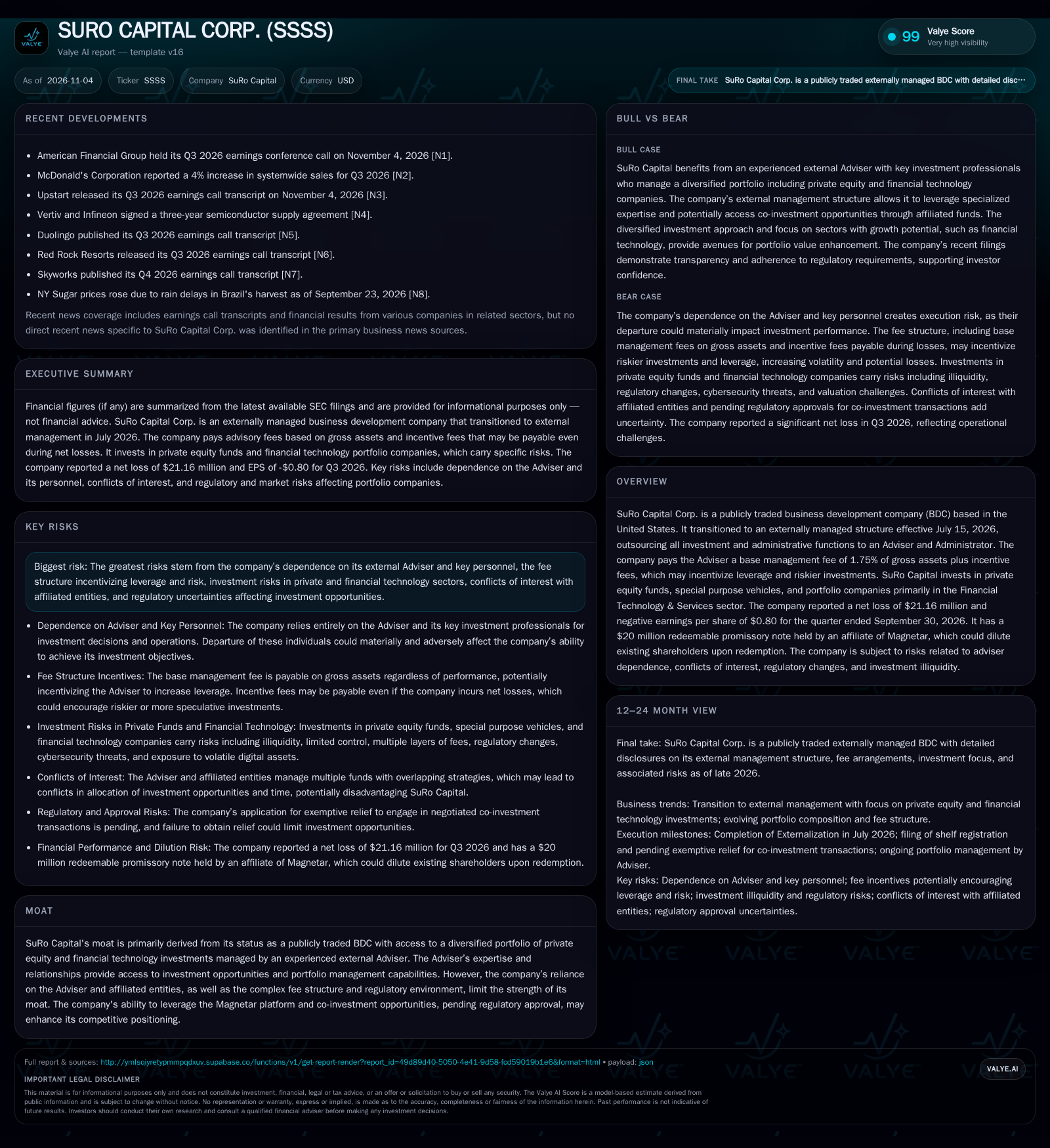
SuRo Capital is now an externally managed BDC, paying its Adviser fees based on gross assets—regardless of performance. The company focuses on private equity and financial technology investments, but reported a net loss in Q3 2026. Adviser dependence, incentive-driven risk, portfolio illiquidity, and dilution risk from a $20 million redeemable note are key issues as the company awaits regulatory relief for co-investment transactions. [S2]
SuRo Capital Corp.’s shift to an externally managed business development company model in mid-2026 has fundamentally altered its incentive structure, cost base, and dependence on third-party investment professionals. While the company continues to target private equity and fintech investments, it now faces a complex interplay of adviser-driven incentives, potential dilution from outstanding notes, and a net loss that raises questions about the sustainability of its current approach. With regulatory relief for co-investments still pending, the next year will test whether SuRo can balance aggressive portfolio ambitions with the risks embedded in its new externalized structure. [S2]
Recent Externalization, Fee Structure, and Q3 Losses Set the Stage
In July 2026, SuRo Capital finalized its transition to an externally managed BDC, outsourcing all investment and administrative functions to an Adviser and Administrator. This shift means the company no longer employs its own personnel; instead, key investment decisions are made by the Adviser’s team, including Mark D. Klein and Allison Green. The Adviser is now compensated with a 1.75% annual base management fee on gross assets and a two-part incentive fee, both of which may be payable even in quarters with net losses. For the quarter ended September 30, 2026, SuRo reported a net loss of $21.16 million and an EPS of -$0.80, underlining the financial challenges facing the new structure. Additionally, a $20 million redeemable promissory note held by a Magnetar affiliate introduces the possibility of dilution for existing shareholders if redeemed. The company has also filed for exemptive relief to participate in negotiated co-investments with affiliated funds, but approval is still pending. [S2]
How Adviser Fees and Portfolio Mix Shape SuRo Capital’s Earnings Power
SuRo Capital generates returns primarily from capital appreciation and income on investments in private equity funds, SPVs, and fintech portfolio companies. As an externally managed BDC, the company’s operating expenses are now dominated by advisory and administrative fees, rather than payroll or direct operating costs. The base management fee is calculated on gross assets (including leveraged assets), which may incentivize asset growth and the use of leverage, regardless of underlying portfolio performance. The incentive fee comprises an income-based component and a capital gains component; notably, the income-based fee may still be earned by the Adviser even if SuRo posts an overall net loss in a quarter. This structure can create a misalignment between shareholder returns and Adviser compensation, especially during periods of weak portfolio performance.
The company’s focus on private equity and fintech investments exposes it to illiquidity, valuation uncertainty, and multiple layers of fees when investing via funds or SPVs. These structures can obscure underlying cash flows and reduce transparency for public shareholders. The reliance on portfolio company exits or mark-to-market gains means SuRo’s reported earnings can be volatile, especially in periods of market stress or sector-specific downturns. The $20 million redeemable note adds a layer of fixed interest expense and the risk of equity dilution upon redemption, potentially altering the economics for existing shareholders. [S2]
Adviser Relationships and Access Versus Fee Drag and Structural Constraints
SuRo Capital’s competitive positioning now rests on the Adviser’s ability to source, evaluate, and manage high-quality private equity and financial technology investments. The external management model theoretically grants the company access to broader deal flow, co-investment opportunities (pending regulatory approval), and specialized expertise that would be difficult to replicate in-house. However, these advantages are offset by the drag of management and incentive fees, which reduce net returns to shareholders and can compound in periods of poor performance.
The company’s investment focus overlaps with other BDCs, private equity funds, and fintech-focused investment vehicles, all of which compete for limited high-potential opportunities. SuRo’s ability to win allocations or secure attractive terms may be constrained if affiliated funds or other Adviser clients have overlapping mandates—raising conflicts of interest and potentially limiting SuRo’s share of the best deals. Moreover, the company’s structure means it must rely on the continued engagement of key Adviser personnel; the loss of top investment professionals could materially weaken its competitive edge. [S2]
If Adviser Outperformance and Regulatory Relief Unlock Portfolio Value
A favorable scenario for SuRo Capital would see the Adviser successfully sourcing and managing investments that outperform peer BDCs and private funds, especially in the fintech sector. If the company secures exemptive relief for negotiated co-investments, it could participate alongside affiliated funds in larger, more attractive deals—potentially improving portfolio diversification and return potential. Outperformance would also require the Adviser to manage leverage prudently, avoiding excessive risk-taking despite the fee incentives.
Confirmation of this scenario would come from a return to consistent net investment income, positive EPS trends, and realized capital gains on portfolio exits or mark-ups. Additional evidence would include regulatory approval for co-investment transactions, visible participation in high-profile deals, and retention of key Adviser personnel. If portfolio company liquidity events or IPOs occur, SuRo could crystallize gains and improve distributable income, further supporting the bull case. [S2]
External Management Delivers Mixed Results Amid Fee Drag and Market Cycles
The most plausible near-term scenario is that SuRo Capital’s performance will reflect a combination of moderate portfolio gains and the persistent drag of advisory and incentive fees. As an externally managed BDC, the company may achieve occasional outsized returns on select fintech or private equity investments, but these will be partially offset by fee structures that reward asset gathering and leverage rather than pure investment alpha. Periods of market volatility or sector-specific headwinds could result in further net losses, particularly given the illiquidity and opacity of private investments.
The likelihood of sustained outperformance is limited by potential conflicts of interest, the company’s dependence on key Adviser personnel, and the uncertain timeline for regulatory relief on co-investments. Evidence for this scenario would include continued volatility in quarterly earnings, intermittent portfolio write-ups and write-downs, and a lack of material improvement in net investment income or EPS. If the Adviser’s performance is average and regulatory approval for co-investments is delayed or denied, SuRo may struggle to differentiate itself from peers. [S2]
Fee Incentives, Adviser Turnover, and Portfolio Illiquidity Compound Losses
A negative outcome could result if the Adviser, incentivized by asset-based fees, increases leverage or pursues riskier investments that do not pay off, magnifying losses in the event of market downturns or fintech sector disruptions. If key personnel depart, the company could lose access to critical deal flow, diminishing investment quality and performance. Portfolio illiquidity could prevent timely exits, forcing SuRo to mark down asset values and report further losses.
Additional risk comes from the $20 million redeemable note: if redeemed, existing shareholders could experience dilution, further eroding value. If regulatory relief for co-investments is denied, SuRo’s access to attractive deals may be constrained relative to affiliated funds, worsening its competitive position. Confirmation of this scenario would include further net losses, negative EPS, portfolio markdowns, Adviser turnover, and dilution events. [S2]
Milestones and Metrics That Will Shape SuRo Capital’s Next Phase
Quarterly net investment income and EPS trends: Persistent losses would test the sustainability of the externalized model. [S2]
Status and outcome of the pending exemptive relief application: Approval would expand co-investment options, while denial could restrict deal access. [S2]
Changes in gross assets and leverage: Increases may indicate risk-taking to drive fee income, raising questions about portfolio quality. [S2]
Realized versus unrealized portfolio gains and losses: A useful metric would be the proportion of returns driven by actual exits versus mark-to-market adjustments.
Adviser and Administrator fee disclosures: Monitoring the ratio of fees to net returns would help assess fee drag and alignment.
Retention of key Adviser personnel: Departure of Mark D. Klein, Allison Green, or other senior staff would materially alter the investment outlook. [S2]
Events related to the $20 million Magnetar note: Redemption or conversion would signal dilution risk becoming realized. [S2]
Portfolio company liquidity events (IPOs, M&A, secondary sales): If disclosed, these would provide validation of portfolio value and ability to generate distributable income.
Disclaimer: This is research-only, informational analysis and not investment advice. It may include AI-generated interpretation and general industry context. Always verify important details using primary sources.

Comments