
Marriott Vacations Worldwide in Late 2026: Brand Leverage, Segmented Revenue Streams, and the Stakes of Credit Risk Management
Marriott Vacations Worldwide’s Q3 2026 outperformance highlights the strengths and challenges of its branded vacation ownership model, which blends hospitality licensing, consumer financing, and exchange network economics. As management tightens cost structures and retools Asia Pacific growth, the company’s ability to manage credit risk and sustain multi-channel revenue generation will define its resilience through the next cycle.
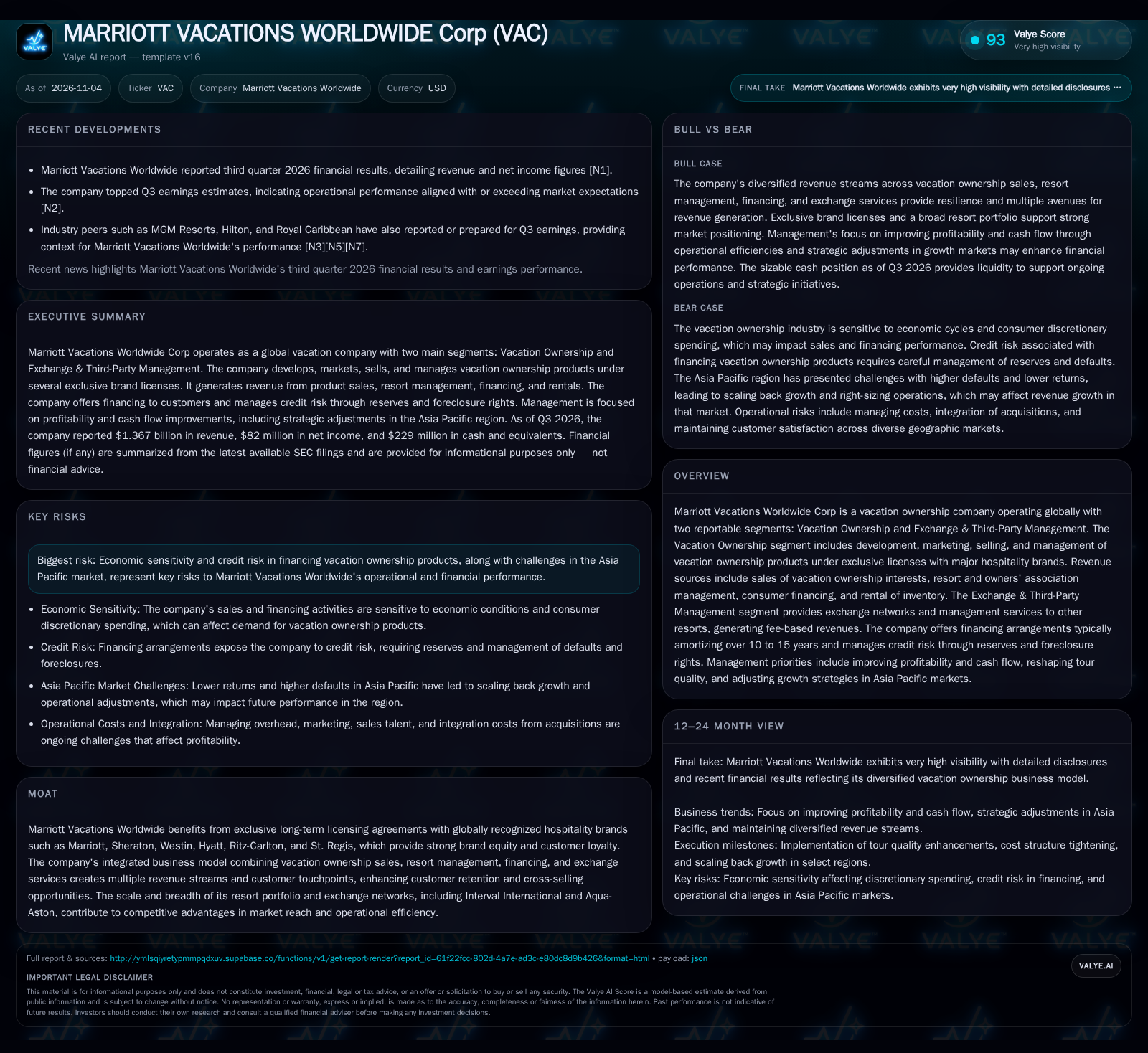
Marriott Vacations Worldwide topped Q3 2026 earnings estimates, reporting $1.367 billion in revenue and $82 million in net income. Its business model combines vacation ownership sales, resort management, consumer financing, and exchange services under exclusive hospitality brand licenses. Management is focused on profitability and cash flow, with targeted operational changes in Asia Pacific. The company’s future hinges on credit risk management, execution on cost controls, and retention of brand-driven customer loyalty. [S1] [S2] [N1] [N2]
Marriott Vacations Worldwide’s third quarter 2026 performance underscores the complex economics of a scaled, branded vacation ownership platform. By operating at the intersection of hospitality, real estate, and consumer finance, the company generates revenue from both the initial sale of vacation interests and a recurring mix of management, rental, and exchange fees. However, execution risk is rising as management shifts strategic focus toward profitability, reshapes cost structure, and reins in expansion in underperforming Asia Pacific markets. The company’s resilience will depend on its ability to manage credit risk, sustain customer demand, and adapt its capital-light exchange business amid evolving consumer travel preferences.
Q3 2026 Results Spotlight Brand-Driven Outperformance and Operational Reset
Marriott Vacations Worldwide reported $1.367 billion in revenue and $82 million in net income for the third quarter of 2026, topping consensus earnings estimates. This outperformance indicates that the company’s diversified revenue base—including vacation ownership sales, resort management fees, consumer financing, and exchange services—remains robust even amid a shifting macroeconomic environment. Management has publicly prioritized profitability and cash flow, with a sharpened focus on improving tour quality, tightening cost structure, and scaling back expansion in the Asia Pacific region after encountering higher defaults and lower returns there. The company reported cash and liquidity metrics for the period; these figures do not by themselves establish operating runway, investment capacity, financial flexibility, or financing capacity. [S2] [N1] [N2]
Revenue Model Mechanics: Where the Money Flows—and Where It Risks Stalling
Marriott Vacations Worldwide’s economics are built on a high-fixed-cost platform that monetizes real estate inventory through vacation ownership sales, with additional recurring revenues from resort management, consumer financing, and exchange services. The initial sale of vacation ownership interests is a capital-intensive process requiring significant upfront investment in property development and sales infrastructure. Revenue from these sales is recognized once the statutory rescission period has passed and collectibility is reasonably assured, introducing some timing lag and exposure to contract cancellations. [S1]
A distinctive element is the company’s in-house financing: qualified buyers can finance their ownership for 10 to 15 years, generating interest income but also exposing the company to consumer credit risk. While the company manages this risk through reserves and retains foreclosure rights—allowing defaulted interests to be returned to inventory—material increases in default rates can disrupt cash flow and reduce profitability. The rental of unsold or foreclosed inventory provides some carry-cost mitigation and customer flexibility but is not a guaranteed profit center if demand softens.
The Exchange & Third-Party Management segment, operating through Interval International and Aqua-Aston, generates fee-based revenue from memberships, exchanges, and resort management for third parties. This capital-light business offers higher margin potential and more predictable cash flows, but depends on maintaining a vibrant network and brand appeal. Operating leverage is significant in both segments: incremental sales and fee income can drive outsized profit gains, but downturns can quickly erode margins given the fixed cost structure.
Brand Licensing, Scale, and Network Effects: Defining the Moat in a Crowded Market
Marriott Vacations Worldwide’s principal competitive edge lies in its exclusive long-term licenses with powerful hospitality brands—Marriott, Sheraton, Westin, Hyatt, Ritz-Carlton, and St. Regis. These alliances confer brand trust, enable premium pricing, and drive customer acquisition through established loyalty programs like Marriott Bonvoy and World of Hyatt. The ability to cross-sell across brands and offer exchange flexibility via Interval International strengthens retention and lifetime value per owner.
However, the timeshare and vacation ownership sector is highly competitive, with peer groups including both branded rivals (such as other hospitality-backed vacation ownership platforms) and independent or regional players. Substitutes include traditional hotel stays, short-term vacation rentals, and newer models of flexible travel membership. The company’s scale—across inventory, resort locations, and exchange network depth—enables cost efficiencies and breadth of offering, but also creates complexity and exposure to regional economic cycles. Sustained differentiation will require ongoing investment in customer experience, digital integration, and partner network management.
If Credit Risk Stays Contained and Brand Equity Drives Tours, Operating Leverage Could Unlock Earnings Expansion
A favorable scenario would see consumer demand for vacation ownership remain strong, supported by resilient leisure travel trends and the enduring appeal of premium hospitality brands. If management’s initiatives to improve tour quality and cost discipline translate into higher close rates and better conversion, the company could realize operating leverage as incremental revenues outpace fixed cost growth. Credit risk would need to remain manageable—either through tighter underwriting, economic stability, or effective use of foreclosure rights—to prevent a drag on cash flow or a buildup of nonperforming assets.
Additional upside could come from revitalized growth in the Exchange & Third-Party Management segment, where fee-based models and network effects make incremental revenue highly accretive. Confirmation of this scenario would require disclosure of improving tour-to-sale conversion rates, stable or declining note receivable defaults, margin expansion in fee-based segments, and evidence of successful customer engagement and retention in loyalty programs.
Diversified Revenue and Disciplined Cost Controls Cushion Volatility—but Growth Is Uneven Across Regions
The most plausible forward trajectory for Marriott Vacations Worldwide is a period of stable, but modest, growth anchored by its diversified revenue streams and disciplined cost management. While North American and core European operations may sustain steady demand, the Asia Pacific region will likely continue to lag due to higher defaults and strategic scaling back. Management’s focus on tour quality, tighter cost control, and selective development should help preserve margins, but the business will remain exposed to macroeconomic headwinds and consumer discretionary spending cycles.
Evidence supporting this scenario would include relatively stable revenue and net income quarter-over-quarter, controlled expenses, and manageable credit loss provisions. Signs of recovery or successful repositioning in underperforming regions would enhance the outlook, while further deterioration in note receivable performance or a decline in tour flow would argue against it.
A Turn in the Credit Cycle or Brand Dilution Could Trigger Margin Compression and Inventory Overhang
In an adverse scenario, a cyclical downturn or exogenous shock could sharply reduce consumer appetite for vacation ownership, driving up contract cancellations and delinquencies on financed sales. If credit loss provisions rise materially and foreclosure activity accelerates, the company could face a growing inventory of unsold interests, increased carrying costs, and downward pressure on pricing. A parallel risk is brand dilution—if customer service, resort quality, or loyalty program value erodes, both sales and retention could suffer.
This scenario would be confirmed by a spike in note receivable write-offs, a build-up of inventory held for sale, negative trends in tour volume or close rates, and margin contraction despite cost-saving efforts. Broader economic weakness or a travel demand shock would amplify these pressures.
Testing the Marriott Vacations Thesis: What Will Confirm or Challenge Brand-Driven Resilience?
Tour flow and tour-to-sale conversion rates—if disclosed—are direct indicators of the effectiveness of sales and marketing initiatives and underlying demand elasticity.
Trends in vacation ownership note receivable delinquencies, credit loss provisions, and foreclosure rates will show whether credit risk is being successfully managed or deteriorating.
Segment-level margin performance, especially in the Exchange & Third-Party Management business, would clarify the sustainability of fee-based revenue and the scale of operating leverage.
Inventory levels of unsold or foreclosed interests—if available—would indicate whether carrying costs are rising and if inventory overhang risks are materializing.
Regional revenue and profitability breakdowns, particularly for Asia Pacific, would help gauge the impact of strategic right-sizing and ongoing operational challenges.
Customer retention, satisfaction, or loyalty program engagement statistics—if disclosed—would provide insight into the durability of brand-driven demand and cross-selling potential.
Cost structure changes and SG&A trends will test the effectiveness of management’s profitability and cash flow improvement initiatives.
Macroeconomic and travel sector data—such as consumer confidence, travel demand, and interest rate trends—will contextualize the company’s exposure to external shocks.
Disclaimer: This is research-only, informational analysis and not investment advice. It may include AI-generated interpretation and general industry context. Always verify important details using primary sources.

Comments