
Riot Platforms in Late 2026: Liquidity Strength, Earnings Volatility, and the Stakes of Capital Market Exposure
Riot Platforms enters Q4 2026 with positive net income, robust cash reserves, and heightened market attention—but its future earnings power and competitive durability hinge on sector cycles and evolving financial market dynamics.
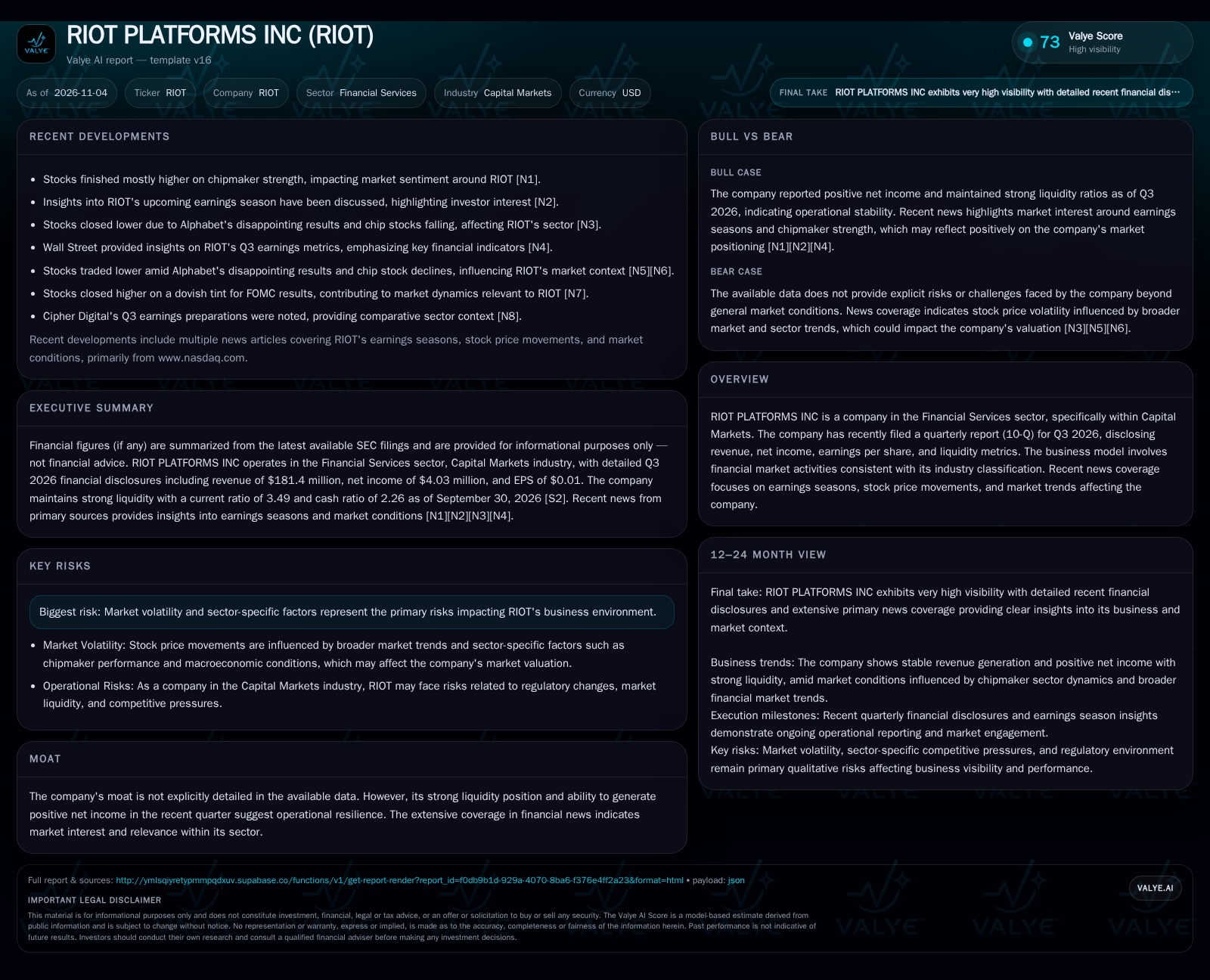
Market coverage centers on earnings and sector trends, highlighting both potential and uncertainty. The next phase will test whether Riot can convert liquidity into sustained profitability amid capital markets' cyclicality and competitive pressure. [S2] [N2] [N4]
Riot Platforms concludes Q3 2026 with a blend of financial stability and strategic ambiguity. Yet, Riot’s modest profit margin and reliance on sector trends reveal an underlying dependence on broader capital market cycles. As investor scrutiny intensifies around earnings and liquidity, the company faces a pivotal period: can it translate its financial resources into sustainable growth and competitive differentiation, or will volatility and industry headwinds cap its long-term potential?
Q3 2026 Financial Snapshot: Stability with Caveats
Riot Platforms reported Q3 2026 revenue of $181.4 million and net income of $4.03 million, yielding earnings per share of $0.01 [S2]. The company ended the quarter with $669.1 million in cash and cash equivalents, a current asset base of $1.04 billion, and current liabilities of $297.0 million—translating to a current ratio of 3.49 and a cash ratio of 2.26 [S2]. These figures reflect a business with reported liquidity position and operational continuity. However, the slim margin between revenue and net income suggests that profitability remains sensitive to underlying market and operational factors. Meanwhile, ongoing news coverage focuses on earnings and market reactions, indicating that investors are closely watching Riot’s performance and sector positioning [N2] [N4].
How Riot’s Capital Markets Model Drives—and Limits—Profitability
Riot Platforms operates within the capital markets segment of financial services, a sector often marked by high revenue variability and tight net margins. The company’s revenue model likely derives from activities such as trading, asset management, or facilitation of digital asset transactions, although the specific commercial mechanics are not detailed in the current report. The Q3 2026 results—$181.4 million in revenue translating to just over $4 million in net income—imply a cost structure where fixed and variable expenses absorb much of the top line, consistent with capital-intensive or transaction-driven models [S2].
Operating leverage in this context is double-edged: scaling transaction volumes can boost revenue, but margins remain under pressure if costs scale alongside or if fee compression occurs. The business must continually balance liquidity preservation with the need to generate sustainable, risk-adjusted returns, especially as capital markets cycles and sector volatility can rapidly erode profitability.
The interplay between fixed and variable costs in Riot’s model is critical to understanding its earnings sensitivity. If a significant portion of expenses is fixed—such as technology infrastructure, compliance, and personnel—then revenue downturns during capital market contractions can disproportionately impact net income. Conversely, a more variable cost base tied to transaction volumes or performance fees could offer some natural hedging against cyclical revenue swings. Therefore, the company’s cost structure flexibility and ability to scale expenses in line with market conditions are pivotal factors determining its resilience and profitability over time.
Furthermore, Riot’s exposure to capital markets cycles implies that timing and market conditions will heavily influence short-term earnings. During bullish phases, increased trading activity and asset appreciation can boost revenues and margins, while bearish or volatile periods may compress spreads and reduce transaction volumes.
Sector Cyclicality and the Challenge of Sustainable Advantage
Riot’s competitive environment is shaped by both traditional capital markets incumbents and technology-driven entrants, particularly in digital assets and trading infrastructure. However, such a reported cash balance is not unique and can be quickly neutralized if competitors deploy capital more aggressively or innovate faster.
Switching frictions in capital markets are often low—clients can migrate to platforms offering better pricing, technology, or execution. Furthermore, the sector is prone to technology substitution, regulatory disruption, and cyclical swings in transaction volumes. Without clear evidence of proprietary technology, exclusive customer relationships, or regulatory moats, Riot’s long-term differentiation may be vulnerable. The company’s future competitive position will likely depend on its ability to invest in platform features, cost efficiency, and emerging market segments, rather than relying solely on balance sheet strength.
From Liquidity to Leadership: What a Step-Change in Returns Would Require
If Riot can deploy capital into proprietary platforms, differentiated services, or exclusive market access, it could convert its liquidity into durable earnings power and margin expansion.
Confirmation would come from a sustained increase in net income relative to revenue, improved operating margins, or announcements of successful investments generating clear returns. Evidence of new customer wins, product launches that drive recurring revenue, or regulatory approvals enabling new lines of business would also support the upside case. Conversely, if cash reserves remain static or are deployed with little impact on earnings quality, the thesis would be undermined.
Achieving a step-change in returns would likely require Riot to identify and exploit niches within capital markets where it can establish differentiated service offerings or proprietary technology. For example, developing algorithmic trading platforms, leveraging data analytics for superior execution, or integrating blockchain-based settlement solutions could create barriers to entry and foster client stickiness. Such innovations could enable the company to command premium pricing or generate recurring revenue streams, thereby improving margins and reducing earnings volatility tied to broader market cycles.
Additionally, successful capital deployment would depend on disciplined investment selection and execution. Riot must balance the pursuit of growth opportunities with maintaining potential financial flexibility, avoiding overextension that could strain liquidity during adverse market conditions. Strategic partnerships or selective acquisitions in complementary segments might accelerate capability building, but only if these moves enhance the company’s competitive moat and contribute positively to return on invested capital. Ultimately, sustainable leadership will hinge on converting liquidity into scalable, differentiated assets that withstand sector cyclicality and technological disruption.
Sustained Liquidity, Episodic Profits: The Likely Near-Term Trajectory
Absent a major strategic pivot, Riot’s most plausible path is continued revenue generation with modest net income, supported by a reported liquidity position. The company is likely to remain sensitive to capital markets cycles, with earnings fluctuating in response to transaction volumes, asset volatility, and sector trends.
Confirmation would be ongoing reporting of positive, but low, net income and stable or slowly growing cash balances. If the company’s cost structure and revenue mix remain largely unchanged, and if news coverage continues to focus on earnings volatility and market swings rather than breakthrough developments, the base scenario is reinforced.
Sector Volatility and Erosion of Profitability
The downside risk for Riot is that sector headwinds—such as reduced transaction volumes, fee compression, adverse regulatory changes, or technological obsolescence—outpace its ability to adapt. In this scenario, fixed costs and operating expenses could erode the slim profit margin, potentially leading to quarters of net losses despite a large revenue base.
The company’s cash position may provide temporary relief, but persistent losses or ill-timed capital deployment could deplete reserves, eroding investor confidence. Confirmation would be sharp drops in net income or a swing to net loss, declining cash balances quarter over quarter, and news coverage focusing on layoffs, restructuring, or missed financial targets.
Milestones That Will Define Riot’s Competitive and Financial Trajectory
Quarterly changes in net income and operating margin: A useful metric would be the pace at which profitability improves or deteriorates, shedding light on cost control and revenue quality.
Capital deployment updates: Announcements of acquisitions, technology investments, or entry into higher-margin segments would help test whether Riot can convert liquidity into durable returns.
Revenue mix disclosure: If disclosed, a breakdown of revenue sources (e.g., trading, asset management, platform fees) would clarify business model resilience and margin potential.
Cash flow from operations: Monitoring whether operating cash flow is consistently positive would signal underlying business health beyond reported net income.
Cost structure evolution: Updates on fixed versus variable costs, if provided, would reveal operating leverage and risk exposure to revenue swings.
Competitive announcements: News of new entrants, pricing changes, or technology upgrades in the sector would indicate rising competitive pressure or potential market share shifts.
Regulatory developments: Changes in capital markets regulation or digital asset policy could materially affect Riot’s business model and future earnings power.
Market sentiment shifts: Major news coverage moving from earnings season volatility to structural business changes would suggest a transition in investor focus and company narrative.
Disclaimer: This is research-only, informational analysis and not investment advice. It may include AI-generated interpretation and general industry context. Always verify important details using primary sources.

Comments