
Caterpillar in 2026: Pricing Power, Dealer Dynamics, and the Stakes of Technology Integration
Caterpillar’s strong Q3 2026 results reflect robust pricing and volume gains across segments, but rising dealer inventories, supply chain variability, and a strategic push into AI-powered equipment create both opportunities and risks for future performance.
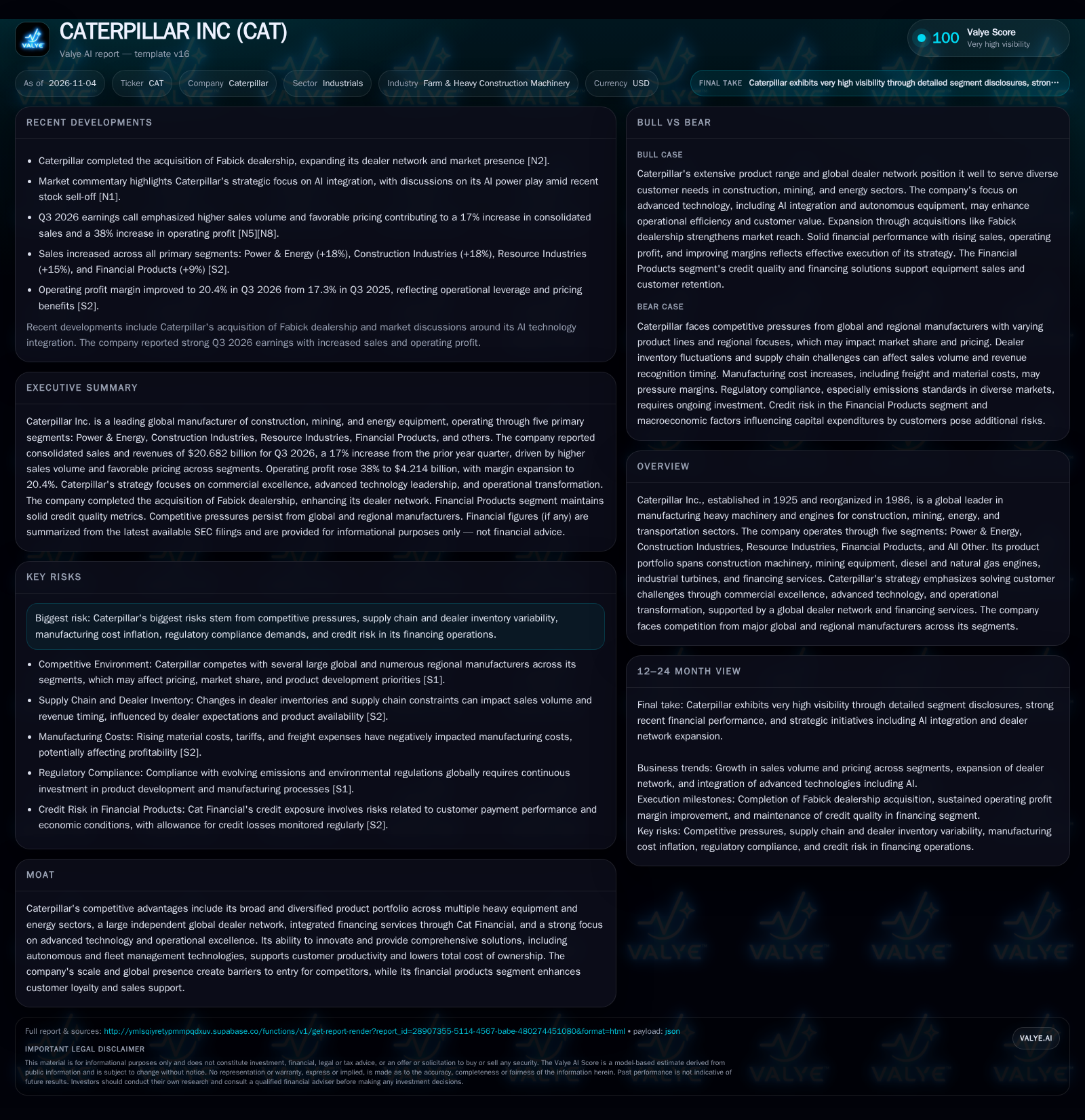
Caterpillar reported a 17% year-over-year sales increase and a 38% jump in operating profit for Q3 2026, led by broad-based strength in Power & Energy, Construction Industries, and Resource Industries. Operating margin rose to 20.4%. Dealer inventories swelled by $3.5 billion year-to-date, signaling both demand optimism and potential supply chain friction. The company’s strategy emphasizes advanced technology—including AI integration—and dealer network expansion, exemplified by the acquisition of Fabick dealership. However, competitive intensity, manufacturing cost inflation, and the impact of dealer stocking cycles remain central watchpoints. [S2] [N1] [N2]
Caterpillar’s Q3 2026 performance underscores its ability to drive growth through pricing and volume even in a complex global environment. The company’s operating margin expansion and double-digit segment growth demonstrate underlying demand and successful commercial execution. Yet, a sharp rise in dealer inventories and ongoing investments in advanced technology—including AI—signal a business at an inflection point, where the interplay of channel dynamics, innovation, and competitive response will shape the next phase of value creation. The challenge for Caterpillar is to convert these operational gains and strategic initiatives into sustainable performance, while navigating the risks of supply chain volatility, cost inflation, and shifting customer expectations.
Q3 2026: Robust Growth, Margin Expansion, and Dealer Inventory Surge
Caterpillar reported consolidated sales and revenues of $20.682 billion for Q3 2026, a 17% increase from the prior-year quarter, with all major segments—Power & Energy, Construction Industries, Resource Industries, and Financial Products—delivering strong double-digit growth. Operating profit climbed 38% to $4.214 billion, boosting operating margin to 20.4% from 17.3% a year earlier, a sign of both pricing power and operational leverage [S2].
Dealer inventories rose sharply, increasing by $3.5 billion over the first nine months of 2026. This reflects both dealer optimism about future demand and possible supply chain or delivery timing effects [S2].
Caterpillar completed the acquisition of the Fabick dealership, further strengthening its extensive global dealer network [N2].
AI integration has moved to the forefront of Caterpillar’s strategy, with market commentary highlighting the company’s potential to leverage AI for autonomous equipment and fleet management solutions [N1].
How Caterpillar Earns: Pricing, Volume, and Operating Leverage Dynamics
Caterpillar’s business model is anchored in manufacturing and selling capital equipment—machinery, engines, and related technology—across construction, mining, energy, and transportation end markets. Revenue is generated through both direct sales and a global network of independent dealers, with financing solutions (loans, leases) provided by Cat Financial to support customer purchases and dealer inventory [S1] [S2].
Q3 2026 results indicate that both higher sales volume and favorable price realization contributed to growth across all segments [S2]. The company’s ability to pass through price increases, particularly in an inflationary environment, suggests pricing power—though this is partly cyclical and may be tested if end-market demand softens. Operating leverage is visible in the 38% year-over-year operating profit increase, outpacing sales growth, as fixed costs are spread over a larger revenue base.
Dealer inventory swings can distort reported sales: rising inventories often signal robust channel demand or pre-buying, but may also precede a period of dealer destocking if end-user sales falter. This dynamic introduces volatility into Caterpillar’s order flow and production planning.
Cat Financial’s role is pivotal, enabling sales by providing credit to customers and dealers. Credit quality metrics as of September 30, 2026—past dues at 1.31% and allowance for credit losses at 0.91%—indicate a manageable risk profile in the current environment [S2]. However, an economic downturn or rising customer defaults could quickly stress this segment’s economics.
Competitive Landscape: Technology, Scale, and Dealer Reach Define the Moat
Caterpillar faces intense competition from global manufacturers such as Deere, Komatsu, Volvo, Hitachi, Cummins, and Rolls-Royce, as well as numerous regional players [S1]. Its competitive advantages stem from a broad product portfolio, a vast global dealer network, integrated financing solutions, and a growing emphasis on advanced technology including AI and autonomous equipment.
The global dealer network creates customer proximity, service responsiveness, and aftermarket parts opportunities, which can enhance customer retention and create switching frictions. The acquisition of the Fabick dealership further consolidates this channel strength [N2].
Technology is a rising battleground: AI-powered fleet management, predictive maintenance, and autonomous machinery could differentiate offerings, lower total cost of ownership for customers, and reinforce Caterpillar’s value proposition. However, competitive responses and technology adoption curves remain uncertain, and new entrants—including digital-first or electrification-focused startups—could pressure established players if they succeed in scaling innovation.
Cost pressures, supply chain agility, and the ability to comply with evolving emissions and regulatory standards are additional axes of competition, particularly in global markets with diverse requirements.
AI-Enabled Equipment and Dealer Network Expansion Unlock New Growth
Caterpillar’s upside scenario is anchored in its ability to harness advanced technology—especially AI integration—to deliver smarter, more autonomous equipment that enhances customer productivity and reduces lifetime operating costs. If adoption of AI-powered solutions accelerates, Caterpillar could deepen its aftermarket and service relationships, increase equipment utilization rates, and command premium pricing.
Continued expansion and consolidation of its dealer network, as seen with the Fabick acquisition, may drive market share gains and further entrench Caterpillar’s brand and service reach. Robust dealer demand, indicated by sustained high inventory levels, could translate into strong future sales if end-user activity remains healthy.
Confirmation of this scenario would come from: sustained pricing power even as macro conditions fluctuate; rising penetration of AI-enabled and autonomous equipment in reported sales; improved aftermarket revenue growth; and persistent expansion in dealer-led geographies. Evidence of stronger customer retention or new large-scale fleet management contracts would further validate the bullish thesis.
Falsification would involve slow adoption of advanced technologies, margin compression due to competitive pricing, or a sharp reversal in dealer inventories leading to production cuts and order declines.
Channel Normalization, Incremental Tech Adoption, and Cyclical Growth
The most plausible path for Caterpillar is cyclical growth supported by infrastructure investment, mining activity, and energy sector demand, with technology adoption proceeding incrementally rather than disruptively. Dealer inventories are likely to normalize, which may result in uneven quarterly sales but should not fundamentally alter end-user demand trends if macro conditions remain stable.
The company’s pricing power may moderate as supply chains stabilize and competitors respond, but operational discipline and cost control could support sustained margins above historical averages. AI and digital technology integration is likely to expand gradually, with early wins in fleet management and predictive maintenance, but broad-based autonomous adoption may take years to reach critical mass.
Cat Financial’s credit metrics are expected to remain within historical ranges absent a major downturn. Regional performance will continue to vary, with North America leading growth and Asia/Pacific remaining a relative weak spot. The base case would be confirmed by stable or gradually rising segment sales, margin resilience, and steady aftermarket and financing contributions.
Dealer Destocking, Cost Pressures, and Competitive Displacement Threaten Momentum
A negative scenario could unfold if the surge in dealer inventories during 2026 proves to be overstocking relative to actual end-user demand. This would likely result in dealer destocking, order pushouts, and a sharp decline in Caterpillar’s reported sales and production volumes over subsequent quarters.
Rising manufacturing costs—whether from raw materials, freight, or regulatory compliance—could outpace Caterpillar’s ability to raise prices, resulting in margin compression. Competitive intensity may escalate, especially if rivals introduce lower-cost or more advanced electric/autonomous equipment, eroding Caterpillar’s market share.
Cat Financial could face rising credit losses if macroeconomic conditions deteriorate or if customers in cyclical industries (construction, mining, energy) struggle with cash flows. Geographic volatility, especially in Asia/Pacific, could further weigh on results.
Downside confirmation would come from sustained declines in dealer orders, falling segment margins, rising inventory write-downs, or a spike in credit losses in the Financial Products segment.
Milestones That Will Shape Caterpillar’s Next Phase of Value Creation
The trajectory of dealer inventory levels—whether they stabilize, continue to rise, or begin to contract—will provide critical insight into future channel demand and sales volatility.
Disclosed adoption rates or revenue mix from AI-enabled or autonomous equipment would help gauge the traction of Caterpillar’s technology strategy.
Aftermarket parts and service revenue growth, if disclosed, would clarify the strength of customer retention and the impact of connected equipment.
Operating margin trends in the context of input cost inflation and competitive pricing will reveal Caterpillar’s ability to sustain profitability.
Geographic sales mix, especially any recovery or further decline in Asia/Pacific, will indicate the company’s global demand resilience.
Cat Financial’s credit quality metrics—especially past dues and allowance for credit losses—should be watched for early signs of stress in customer end markets.
Integration progress and incremental sales synergies from the Fabick dealership acquisition would test the value of dealer network expansion.
Any disclosed large-scale fleet management, subscription, or service contracts would validate progress toward a more recurring revenue model.
Disclaimer: This is research-only, informational analysis and not investment advice. It may include AI-generated interpretation and general industry context. Always verify important details using primary sources.

Comments