
Andersons, Inc. in Late 2026: Renewable Fuels Expansion, Commodity Volatility, and the Stakes of Strategic Scale
A record quarter, a $915 million renewable fuels acquisition, and the evolving structure of its agribusiness platform propel Andersons, Inc. toward a more integrated—and risk-exposed—future. Can the company’s scale and diversification offset persistent commodity and regulatory headwinds?
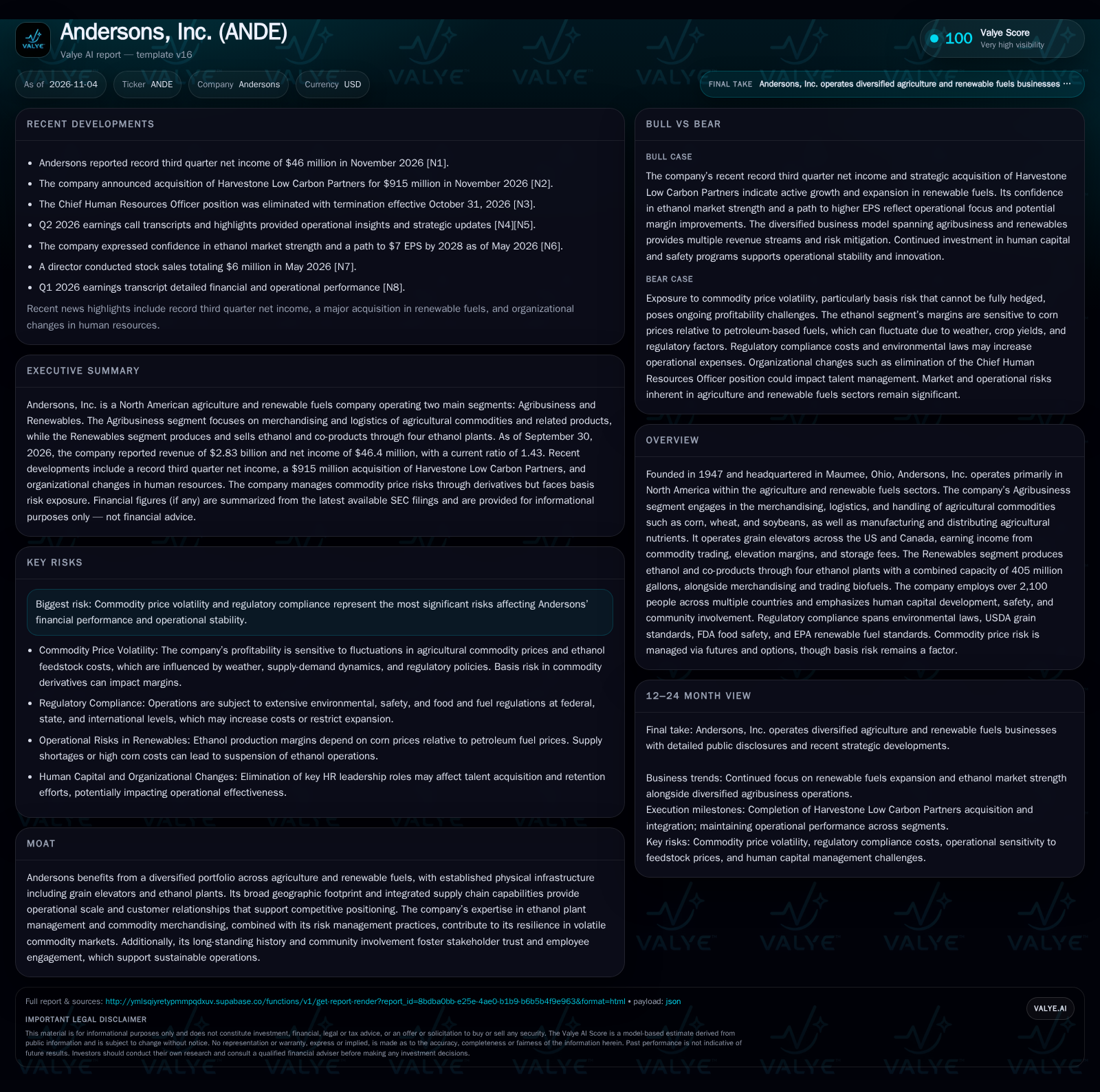
Andersons, Inc. reported a record Q3 net income and announced a major $915 million acquisition in renewable fuels, highlighting its strategy to scale up in ethanol and low-carbon products. The company’s dual exposure to commodity price swings and regulatory change is sharpened by recent moves, while the elimination of a key HR leadership role raises questions about operational continuity. The path to $7 EPS by 2028 hinges on margin capture in both core business lines and successful integration of new assets. [N1] [N2] [S2]
Andersons, Inc. is navigating a pivotal juncture as it seeks to scale its renewable fuels platform while maintaining an expansive, risk-heavy agribusiness operation. The company’s record third quarter and $915 million acquisition of Harvestone Low Carbon Partners underscore a pronounced shift toward integrated low-carbon solutions—betting on ethanol and biofuels as earnings drivers through 2028 and beyond. However, persistent commodity volatility, regulatory exposure, and recent organizational changes mean Andersons’ ability to translate scale into durable returns will hinge on execution, market conditions, and its risk management acumen.
Strategic Shifts: Record Earnings, Major Acquisition, and Organizational Change
Andersons reported a record third quarter net income of $46 million in November 2026, reflecting strong operational performance despite ongoing commodity market volatility. This financial milestone coincides with the announcement of a $915 million acquisition of Harvestone Low Carbon Partners, a move expected to materially expand Andersons’ renewable fuels footprint and vertical integration in low-carbon products. On the organizational front, the elimination of the Chief Human Resources Officer position as of October 31, 2026, introduces potential disruption to talent management and operational continuity. These developments collectively signal a decisive strategic push in renewables, against a backdrop of evolving internal structures and persistent external risks. [N1] [N2] [N3] [S2]
Decoding Andersons’ Earnings Engine: Margin Drivers and Cost Sensitivities
Andersons generates revenue across two principal segments: Agribusiness, which merchandises and stores commodities and earns from trading margins, elevation spreads, and storage fees; and Renewables, which produces ethanol and co-products through four plants with a combined 405 million gallon capacity. The Agribusiness segment's economics are inherently seasonal and volatile, with profitability tied to basis appreciation and the ability to arbitrage physical and futures markets—a dynamic that exposes the company to basis risk, which cannot be fully hedged. Fixed costs are significant in both segments due to infrastructure and labor requirements, but the Renewables segment offers operating leverage if ethanol spreads widen.
The $915 million Harvestone acquisition represents a substantial capital allocation and will likely increase both fixed costs and potential revenue/margin upside from greater scale and integration. However, it also raises the stakes for execution, especially if integration costs or market conditions deteriorate. Andersons’ ability to convert commodity flows and processing capacity into stable cash generation is contingent on effective risk management, disciplined capital deployment, and favorable market spreads. [S1] [S2] [N2]
Platform Scale, Commodity Risk, and the Contest for Biofuels Advantage
Andersons’ competitive strength derives from its broad infrastructure—grain elevators, ethanol plants, and logistics assets—spanning multiple geographies in North America and select international markets. This scale supports customer reach, supply chain optionality, and some degree of resilience to localized shocks. However, the core businesses face intense competition from both large integrated agribusinesses and specialized commodity traders, as well as pure-play biofuels producers.
In renewables, the acquisition of Harvestone Low Carbon Partners could position Andersons as a more formidable player in the low-carbon fuels space, potentially enhancing its standing with downstream customers seeking compliance with Renewable Fuel Standard mandates. Still, the company remains exposed to technology substitution risk if alternative low-carbon solutions (such as renewable diesel or electrification in transportation) gain share. The true test of Andersons’ competitive position will be its ability to capture superior margins through operational efficiency, integration, and customer relationships while managing the relentless pressures of commodity price swings and regulatory change. [S1] [N2]
Ethanol Margin Expansion and Integration Synergies Drive Accelerated Earnings
In a favorable scenario, Andersons successfully integrates Harvestone, realizing both cost and revenue synergies from expanded renewable fuels operations. Ethanol and co-product margins widen—driven by robust demand for low-carbon fuels, premium pricing for lower-carbon-intensity ethanol, and stable-to-declining corn input costs. The company leverages its increased scale to optimize logistics, capture more elevation margin, and negotiate stronger contracts with both suppliers and customers.
Confirmation would come from sustained improvement in segment margins, upward revisions to earnings guidance, and evidence of increased throughput/utilization at ethanol plants. Additional signs would include new long-term supply agreements with fuel blenders or refiners, and positive commentary on cross-segment integration benefits. Accelerated progress toward the targeted $7 EPS by 2028, backed by improved return on invested capital (ROIC) post-acquisition, would further validate this scenario. [N2] [N6]
Volatility Management and Steady-State Integration Define Near-Term Outcomes
The most plausible trajectory is that Andersons manages a measured integration of Harvestone while navigating typical swings in commodity prices and regulatory pressures. Earnings remain volatile quarter-to-quarter, reflecting both the inherent seasonality of agribusiness and the margin sensitivity of ethanol production. Some integration synergies materialize, but are offset by ongoing basis risk and periodic pressure on ethanol spreads due to corn or energy price shocks.
This scenario would be confirmed by relatively stable, but not dramatically expanding, EBITDA and net income figures, with incremental improvements in operating efficiency but no step-change in profitability. Progress toward $7 EPS by 2028 would remain on track but dependent on exogenous market conditions, rather than being fully within management’s control. Updates on Harvestone integration and commentary on risk management effectiveness would be central markers. [S2] [N6]
Commodity Dislocation, Margin Compression, and Integration Drag Weigh on Returns
In an adverse scenario, Andersons faces a period of unfavorable commodity price movements—such as a spike in corn costs or a collapse in ethanol prices—while basis risk leads to negative trading outcomes in Agribusiness. Integration of Harvestone proves more challenging than anticipated, with higher costs, cultural friction, or delayed synergy capture. Regulatory changes or new environmental compliance costs could further squeeze margins in both segments.
Downside confirmation would be visible in declining segment margins, missed earnings targets, and negative revisions to guidance. Rising integration expenses, operational disruptions, or loss of key talent following HR restructuring would compound the challenges. Deterioration in working capital or increased leverage to finance the acquisition, without offsetting cash generation, would put further pressure on the balance sheet. [S2] [N3] [N2]
Tracking Andersons’ Path: What Will Shape the Next Chapters?
Harvestone acquisition integration milestones: updates on synergy realization, cost structure, and operational alignment would help test the thesis. [N2]
Ethanol and co-product margin trends: quarterly disclosures on spread and utilization rates, if disclosed, are critical for Renewables segment outlook.
Basis risk impact and trading margin outcomes in Agribusiness: segment-level commentary or financial disclosures would clarify risk management efficacy.
Progress toward $7 EPS by 2028: management updates on guidance or strategic milestones remain a central thesis marker. [N6]
Employee turnover or operational disruptions following HR changes: disclosures on retention rates or talent initiatives, if provided, would indicate organizational stability. [N3]
Major regulatory developments affecting ethanol or grain trade: tracking federal/state policy shifts or compliance costs could alter margin structure.
New long-term contracts or customer wins in renewables: announcements of supply agreements or partnerships would signal commercial traction.
Disclaimer: This is research-only, informational analysis and not investment advice. It may include AI-generated interpretation and general industry context. Always verify important details using primary sources.

Comments