
Avient in Late 2026: Specialty Materials Execution, Global Risk Exposure, and the Stakes of Margin Management
Avient Corporation’s recent profit gains and raised EPS guidance highlight operational execution, yet the company’s global specialty materials platform remains exposed to volatile input costs, regulatory complexity, and competitive innovation cycles. The sustainability of margin improvement and the ability to navigate supply chain and geopolitical shocks will determine Avient’s next phase of value creation.
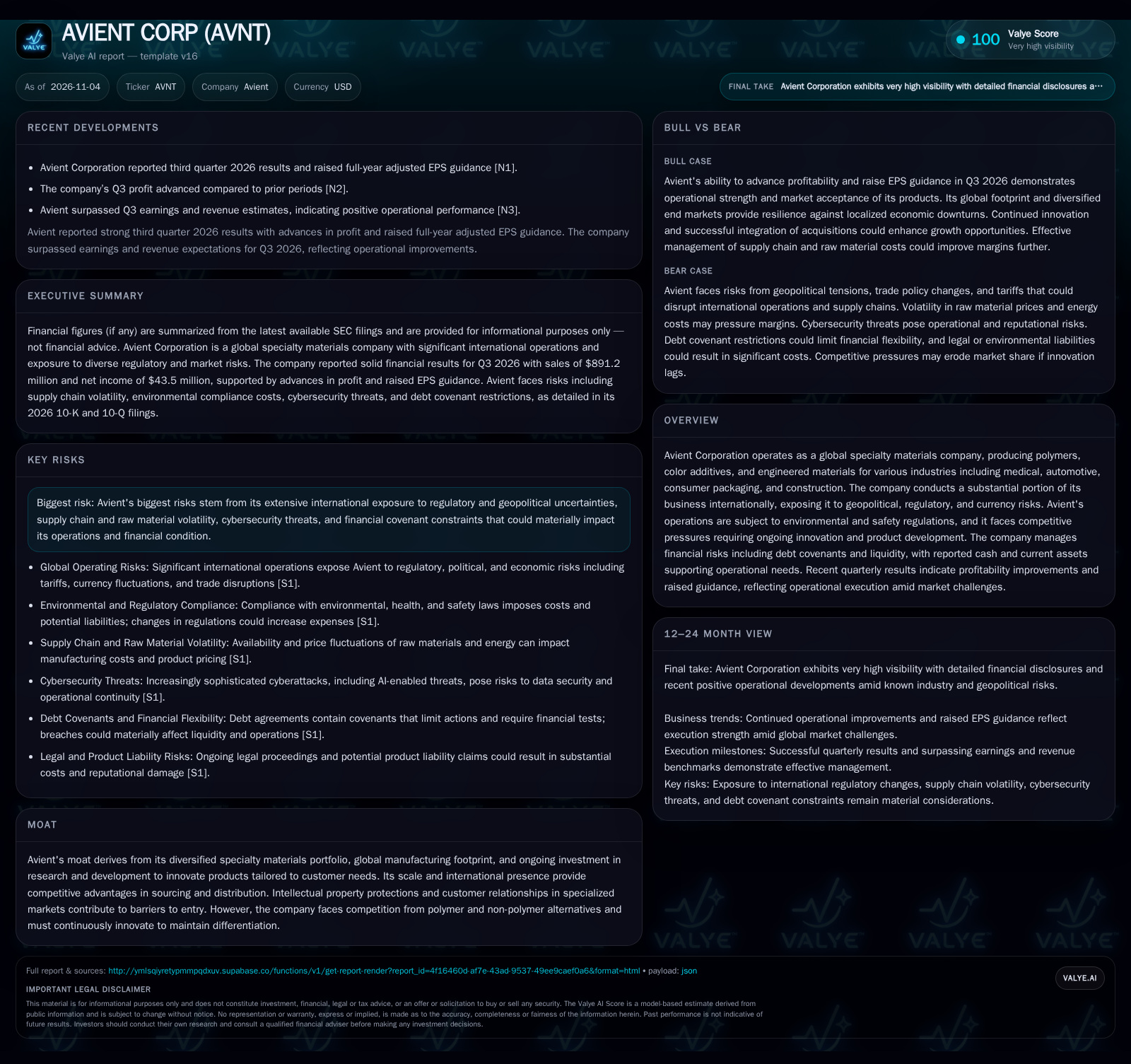
Avient’s Q3 2026 results show improved profitability and upgraded EPS guidance, driven by solid operational execution. The company’s global footprint and diverse end-markets offer resilience but also increase exposure to raw material volatility, regulatory risk, and competitive pressures. Sustainable margin expansion hinges on Avient’s ability to manage supply chains, innovate in specialty polymers, and adapt to shifting international conditions. [S2] [N1] [N2] [N3]
Avient Corporation’s strong Q3 2026 performance—marked by profit advancement and a raised full-year EPS outlook—reflects robust operational execution in a challenging global environment. As a specialty materials provider with a majority of revenue generated internationally, Avient’s future depends not only on continued innovation and manufacturing discipline, but also on its capacity to manage volatile input costs, comply with evolving regulations, and defend its market position against both established and emerging competitors. The company’s next chapter will be defined by how well it balances growth ambitions with risk management in a sector where margin swings and regulatory pressures are ever-present.
Recent Profit Gains and Upgraded Guidance: What’s Changed for Avient?
In Q3 2026, Avient reported sales of $891.2 million, gross margin of $271.8 million, operating income of $82.6 million, and net income of $43.5 million, with basic EPS of $0.47. For the nine months ended September 30, 2026, sales reached $2.656 billion and net income totaled $165.0 million. Most notably, the company raised its full-year adjusted EPS guidance and outperformed on both revenue and profit versus expectations. These advances suggest that recent operational initiatives—whether in procurement, manufacturing efficiency, or product mix—are translating into tangible financial improvement. However, Avient’s global exposure (61% of sales outside the U.S.) means these gains are set against a backdrop of persistent macroeconomic and regulatory risk. [S2] [N1] [N2] [N3]
How Avient’s Specialty Portfolio Drives Profitability—and Where Pressure Points Remain
Avient’s business model is built around specialty polymers, colorants, and engineered materials, serving sectors including medical, automotive, consumer packaging, and construction. The company’s economics depend on the value-added nature of its formulations, which can support premium pricing and customer stickiness—especially for applications with regulatory or performance requirements. Gross margins in the most recent quarter (about 30%) suggest Avient is achieving a mix shift toward higher-value offerings, but this is continually threatened by input cost volatility, particularly in raw polymers and specialty chemicals. Fixed manufacturing costs are significant, creating operating leverage when volumes are strong but exposing margins to downside in cyclical downturns or supply chain disruptions. Ongoing capital needs include maintenance, R&D for new formulations, and compliance investments, especially as environmental and safety regulations tighten. Debt covenants limit strategic flexibility, especially in downturns or periods of unexpected expense escalation. [S1] [S2]
The interplay between Avient’s specialty portfolio and its cost structure is critical in defining its margin resilience. Given the high fixed costs associated with advanced manufacturing facilities and R&D investments, the company’s profitability is sensitive to volume fluctuations. In periods of demand softness, fixed costs dilute margins more significantly, underscoring the importance of maintaining steady production levels. Furthermore, the ability to forecast input cost trends and secure long-term supply agreements can serve as a buffer against raw material price volatility, but such strategies require balancing the risk of overpaying during price declines against the protection they provide during spikes. Additionally, the company’s investments in sustainability and regulatory compliance, while potentially increasing near-term expenses, may reduce long-term risks and open new market opportunities if aligned with evolving customer and regulatory expectations.
Defending Differentiation in a Fragmented, Innovation-Driven Materials Market
Avient competes with both global materials giants and regional specialty firms, as well as with non-polymer substitutes in specific end-markets. Its competitive advantages derive from product customization, technical service, global scale in sourcing and distribution, and deep relationships in regulated or performance-sensitive applications. However, switching costs in specialty materials are moderate—customers may be willing to qualify alternatives if price or supply reliability shifts. The company’s moat is reinforced by intellectual property and the complexity of certain applications, but ongoing R&D is required to keep pace with evolving customer needs and regulatory standards. The risk of margin compression is heightened by the cyclical nature of some end-markets and the possibility of price wars during periods of weak demand or input cost spikes. Environmental regulation and sustainability trends create both opportunity (for new materials) and competitive threat (from next-generation alternatives). [S1]
Avient’s competitive positioning also hinges on its capacity to anticipate and respond to shifts in customer preferences and regulatory landscapes, which can rapidly alter material requirements. The company’s success in developing proprietary formulations that meet stricter environmental standards or enable product lifecycle improvements can enhance customer loyalty and justify premium pricing. However, the moderate switching costs in specialty materials mean that competitive differentiation must be continually reinforced through innovation and service excellence. Moreover, the global nature of Avient’s operations exposes it to diverse regulatory regimes and local competitors, requiring agile adaptation of product offerings and supply chain configurations. The risk of commoditization in certain segments further necessitates a focus on high-value niches where technical barriers and customization create defensible margins.
Margin Expansion Through Supply Chain Discipline and Innovation: The Bullish Pathway
If Avient continues to execute on procurement discipline, manufacturing efficiency, and portfolio mix upgrades, further gross margin expansion is plausible. Success in passing through raw material and energy cost increases, combined with innovation in high-margin specialty formulations—particularly for regulated or emerging markets—could drive above-market growth. Additional upside could come from successful integration of acquired capabilities or entry into high-growth sectors such as medical polymers or sustainable packaging. Confirmation would come from consecutive quarters of expanding gross and operating margins, sustained outperformance versus peer financials, and evidence of new product adoption in premium segments. Conversely, stagnation in margin trends or loss of share in targeted growth markets would falsify the bullish scenario.
Sustaining Profitability Amid Global Volatility: The Most Likely Outcome
The most plausible pathway for Avient is steady but modest margin improvement, with profitability supported by operational execution and ongoing product innovation, but tempered by persistent raw material and regulatory headwinds. The company is likely to maintain its market position in core specialty applications, while periodically contending with supply chain disruptions, currency movements, and tightening environmental standards. Confirming evidence would include stable or gradually rising margins, maintenance of revenue growth in line with specialty materials peers, and continued delivery on EPS guidance. Signs of sudden margin compression, persistent cost overruns, or regulatory fines would challenge this scenario.
When Volatility Overwhelms: Margin Compression and Strategic Constraints
A negative scenario could unfold if raw material or energy price spikes outpace Avient’s ability to pass through costs, or if supply chain disruptions lead to lost sales and underutilized manufacturing assets. Additional downside could come from regulatory shocks—such as new environmental mandates—that drive up compliance costs or limit product lines, or from legal liabilities not fully covered by insurance. Debt covenant breaches could further restrict operational flexibility, while a cyberattack or product recall could impose direct financial and reputational harm. Evidence of declining gross and operating margins, guidance cuts, or covenant-related restrictions would confirm this scenario.
In scenarios where external shocks accumulate, Avient’s operational and potential financial flexibility could become constrained, amplifying margin pressures. For instance, if raw material cost surges coincide with supply chain bottlenecks, the company may face challenges in passing through costs without eroding demand. Regulatory changes that impose sudden compliance costs or restrict certain formulations could necessitate costly reformulations or product withdrawals, disrupting customer relationships. Concurrently, debt covenant limitations may restrict the company’s ability to invest in necessary capital projects or strategic initiatives, potentially impairing long-term competitiveness. In such environments, the risk of customer attrition to lower-cost or more innovative competitors increases, potentially triggering a negative feedback loop of declining volumes and profitability.
What Will Determine Avient’s Value Creation Trajectory?
Gross margin trends and the company’s ability to sustain or expand margins in the face of input cost volatility.
Quarterly and full-year EPS guidance updates, and the degree to which actual results meet or exceed these targets.
Volume and mix of sales in high-value specialty segments, if disclosed, as a measure of product portfolio evolution.
Incidence and financial impact of supply chain disruptions, including any disclosed lost sales or increased costs.
Evidence of successful new product launches or penetration into regulated/emerging applications.
Material regulatory, legal, or environmental liabilities that could depress profitability or constrain operations.
Compliance with debt covenants and any disclosures of potential financial flexibility or restrictions.
Frequency and severity of cybersecurity incidents, along with any reported business interruption or remediation costs.
Disclaimer: This is research-only, informational analysis and not investment advice. It may include AI-generated interpretation and general industry context. Always verify important details using primary sources.

Comments