
Omega Healthcare Investors in Late 2026: Portfolio Management, Demographic Tailwinds, and the Stakes of Operator Resilience
Omega Healthcare Investors posts strong Q3 2026 results and raises guidance, but its future will depend on active portfolio management, sector demand, and the stability of its healthcare operator tenants. The interplay of demographic trends, regulatory risk, and real estate market dynamics will shape its income reliability and growth prospects.
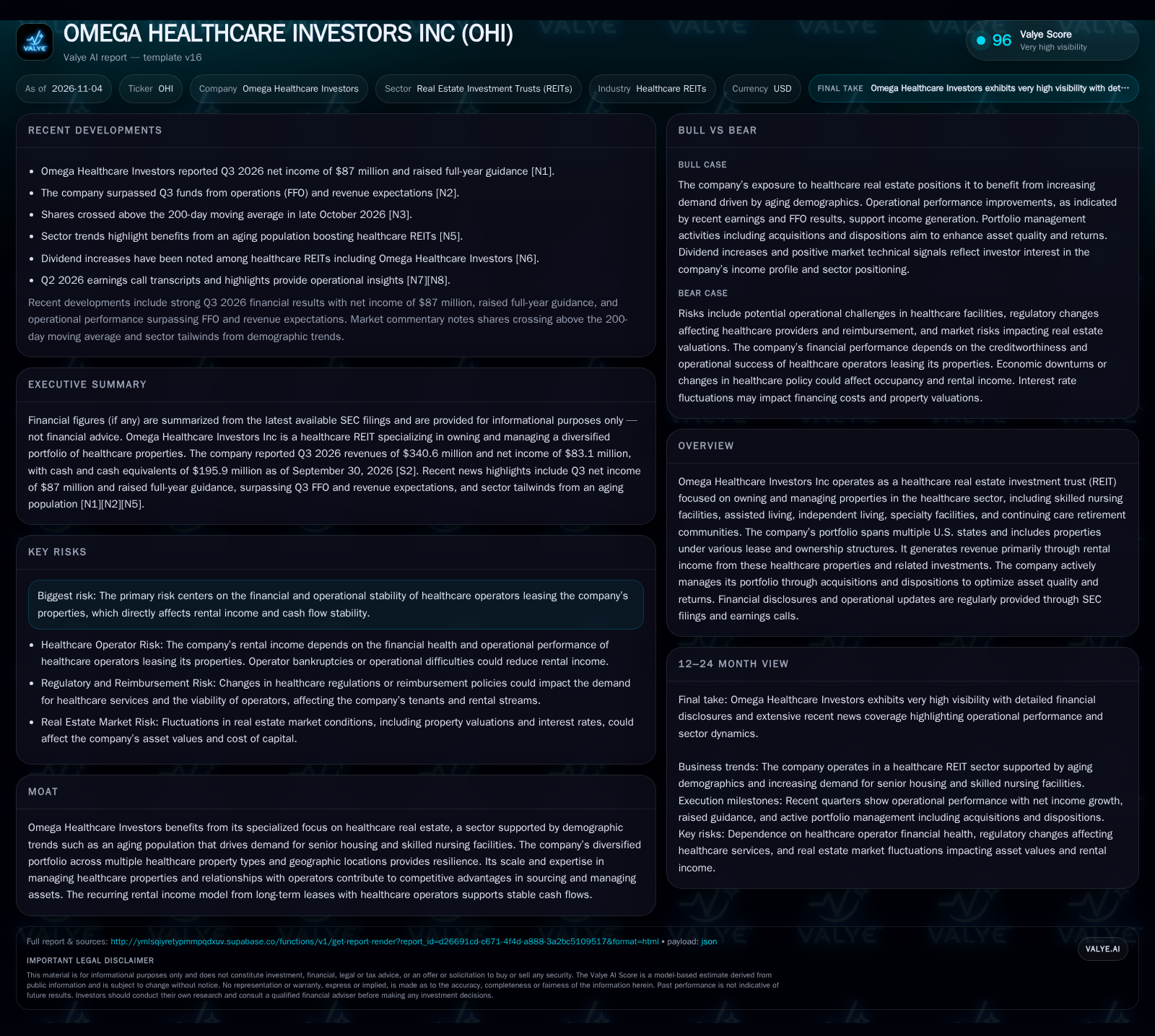
Omega Healthcare Investors reported Q3 2026 net income of $87 million, raised full-year guidance, and outperformed FFO and revenue expectations. Its diversified healthcare property portfolio is positioned to benefit from aging demographics, but its income stream relies heavily on the financial health of healthcare operator tenants and is exposed to regulatory and market risks. Active portfolio management and sector tailwinds underpin near-term performance, but long-term value creation will hinge on tenant resilience and adaptation to policy and market changes. [S2] [N1] [N2] [N5]
Omega Healthcare Investors, a major healthcare REIT, has delivered a robust Q3 2026 performance—reporting $87 million in net income and raising its full-year guidance. Its business model, built on owning and leasing a diverse portfolio of healthcare properties, is currently supported by demographic tailwinds and operational execution. However, the company’s income and asset values remain closely tied to the financial health of healthcare operators and the evolving landscape of healthcare regulation. As the U.S. population ages and demand for senior care rises, Omega’s ability to navigate operator risk and market volatility will be central to the durability of its cash flows and dividend appeal.
Financial Performance and Portfolio Dynamics in Q3 2026
Omega Healthcare Investors reported Q3 2026 net income of $87 million and raised its full-year guidance, reflecting operational strength and outperforming expectations for funds from operations (FFO) and revenue. The company’s portfolio includes skilled nursing, assisted living, and other healthcare facilities across numerous U.S. states, supported by $340.6 million in quarterly revenue and $195.9 million in cash as of September 30, 2026. Dividend increases and positive technical signals (shares crossing above the 200-day moving average) have reinforced its appeal among income-focused investors. These developments highlight both near-term momentum and the company’s capacity for active portfolio management, but the financial health of operator tenants and macro sector trends remain critical variables. [S2] [N1] [N2] [N3] [N6]
How Omega’s Revenue Model Interacts with Sector Forces
Omega generates the bulk of its revenue through rental income from long-term leases with healthcare operators who run skilled nursing, assisted living, and related facilities. The cited source reports dividend-related activity; that disclosure alone does not establish dividend-policy continuity, management confidence, or a material constraint on capital flexibility. However, the economics are tightly linked to the operational health and payment capacity of its tenants. If operator tenants experience financial distress—whether due to reimbursement cuts, labor costs, or occupancy pressure—Omega’s rental streams can be disrupted.
The company’s capital allocation strategy involves both acquisitions and dispositions to optimize asset quality, geographic diversification, and yield. This approach can help maintain or improve returns but also exposes Omega to transaction timing risk and the challenge of redeploying capital into accretive assets. Fixed costs, including financing expenses and property management, create some operating leverage, but the model is less scalable than asset-light structures since real estate requires ongoing capital investment for maintenance, upgrades, and compliance.
Omega’s funding needs are typical for a large REIT: access to debt and equity markets is crucial, especially as interest rates and property values fluctuate. The company’s ability to refinance maturing debt and fund acquisitions at attractive rates will influence its long-term cost structure and competitiveness.
Sector Specialization, Scale, and the Limits of Advantage
Omega’s specialization in healthcare real estate—particularly skilled nursing and senior living—offers some protection from broader commercial real estate downturns, as demographic trends drive steady demand for these assets. Its scale and relationships with a wide network of operators allow for portfolio diversification across geographies and facility types, helping to spread risk and enhance negotiating power.
However, the competitive landscape includes other healthcare REITs and private capital with similar strategies, as well as potential substitutes such as home healthcare and outpatient care models that could limit demand for institutional care facilities over time. Regulatory shifts or reimbursement changes could also compress operator margins and, by extension, Omega’s rental income. While the company’s recurring lease model and sector expertise offer some moat characteristics, these advantages are not insurmountable and could be eroded if sector headwinds intensify or if new care delivery models gain market share.
Demographic Tailwinds and Portfolio Optimization Drive Durable Growth
In a favorable scenario, the aging U.S. population continues to drive demand for skilled nursing and senior living facilities, supporting high occupancy and stable to rising rents across Omega’s portfolio. Operator tenants remain financially healthy, buoyed by steady Medicare and Medicaid reimbursement rates and improved operational efficiency. Omega leverages its scale to acquire high-quality assets at attractive cap rates and selectively disposes of underperforming properties, enhancing portfolio yield and resilience.
If disclosed, rising occupancy rates, favorable lease renewal spreads, and successful execution on acquisitions would further validate this outcome.
Managing Through Mixed Operator Health and Market Volatility
The most plausible path is one where Omega continues to benefit from secular demographic demand but faces intermittent challenges from operator tenant distress, regulatory uncertainty, and real estate market fluctuations.
Evidence for this middle path would include steady but not accelerating FFO, a manageable level of tenant restructuring activity, and periodic but not systemic asset write-downs. Confirming data would be stable occupancy and rent coverage ratios, with Omega’s portfolio management actions offsetting isolated operator weakness. A useful metric would be the proportion of rental income from tenants on watch lists or undergoing restructuring, if disclosed.
Operator Distress and Policy Shocks Threaten Income Stability
In an adverse scenario, a combination of regulatory changes (such as reimbursement cuts), rising labor costs, or a cyclical downturn leads to widespread financial distress among operator tenants. This could trigger a cascade of lease defaults, forced rent concessions, and higher vacancy rates, undermining Omega’s cash flows and necessitating asset write-downs or dilutive capital raises.
Such a scenario would be confirmed by a spike in tenant non-payment, sharp declines in FFO per share, suspended or reduced dividends, and a rising proportion of unleased or underperforming properties. If disclosed, an increase in the number of facilities transitioned to new operators or returned to Omega for direct management would also signal material stress.
Factors That Will Shape Omega Healthcare’s Resilience and Value Creation
The pace and quality of acquisitions and dispositions—especially the yield and risk profile of newly acquired assets relative to those sold—would help test portfolio optimization claims.
Changes in same-store occupancy rates and rent coverage ratios, if disclosed, are crucial for assessing underlying tenant health and income visibility.
The percentage of rental income from tenants on financial watch lists or in restructuring would provide early warning of potential cash flow disruptions.
Trends in FFO per share and dividend payout ratios will signal the sustainability of income distributions and the company’s ability to absorb shocks.
Any material regulatory or reimbursement policy changes affecting Medicare, Medicaid, or other funding streams for operators would directly impact Omega’s revenue base.
Access to and cost of capital—measured by recent refinancing activity and effective interest rates on new debt—will influence the company’s ability to grow and manage through downturns.
If disclosed, operator churn rates (the number of facilities transitioned to new tenants or returned for direct management) would indicate stress within the tenant base.
Geographic or asset-type concentration risk: shifts in exposure to specific states, facility types, or operator groups could amplify vulnerability to localized shocks.
Disclaimer: This is research-only, informational analysis and not investment advice. It may include AI-generated interpretation and general industry context. Always verify important details using primary sources.

Comments