
Old Second Bancorp in Late 2026: Interest Rate Exposures, Funding Flexibility, and the Stakes of Regional Bank Scale
Old Second Bancorp's late-2026 performance highlights the mechanics of asset sensitivity, diversified funding, and disciplined risk management. The company's ability to navigate shifting rate environments and credit cycles will shape its earnings resilience and growth prospects in the next phase of regional banking competition.
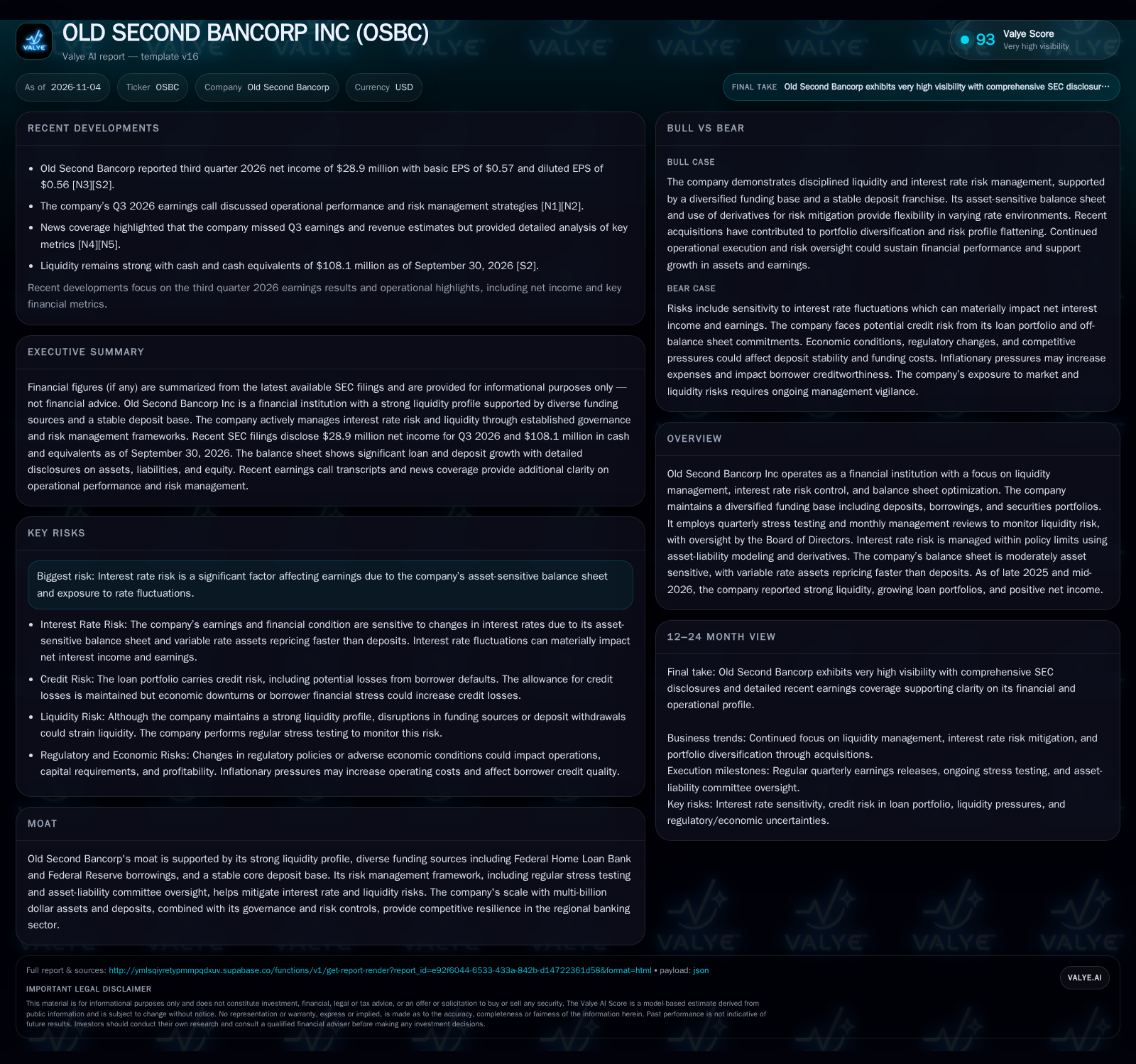
Old Second Bancorp reported Q3 2026 net income of $28.9 million and maintained a reported liquidity position with $108.1 million in cash and equivalents as of September 30, 2026. The bank’s asset-sensitive balance sheet means earnings benefit from rising rates but face pressure if rates fall. Diverse funding sources and robust risk controls underpin operational stability, but credit quality and deposit competition remain critical watchpoints as the economic and regulatory landscape evolves. [S2] [N3] [N4]
Old Second Bancorp’s latest disclosures reveal a regional bank positioned for resilience but exposed to the crosscurrents of interest rate cycles and evolving competitive pressures. Yet, as net interest margins become more volatile and competition for deposits intensifies, the company’s next chapter will hinge on its ability to balance growth, credit quality, and disciplined risk oversight.
Recent Financial Performance and Liquidity: Where Old Second Stands Now
Old Second Bancorp reported net income of $28.94 million for the third quarter of 2026, translating to basic earnings per share of $0.57 and diluted EPS of $0.56 [S2] [N3]. While these results affirm ongoing profitability, news coverage highlighted that the bank missed consensus estimates for both earnings and revenue in Q3—an early signal that margin pressures or loan performance may be emerging issues [N4] [N5].
As of September 30, 2026, the company reported $108.1 million in cash and cash equivalents, compared to $99.3 million at the end of 2024. In addition, Old Second Bancorp had access to $850.7 million in unused borrowing capacity from the Federal Home Loan Bank of Chicago, the Federal Reserve Bank, and correspondent banks, as well as $410.3 million in unencumbered securities available for sale as of year-end 2025 [S1] [S2].
The bank’s balance sheet is moderately asset sensitive, meaning that variable rate assets reprice faster than the deposit base. This structural position has historically allowed the company to benefit from rising rates, but it also exposes net interest income to downside if rates fall or flatten further [S1].
How Asset Sensitivity and Funding Mix Drive Profit Dynamics
Old Second Bancorp’s core earnings engine is net interest income, derived from the spread between loan yields (primarily variable rate) and funding costs (primarily from deposits). In a rising rate environment, the bank’s asset-sensitive profile allows loan yields to adjust upward more quickly than deposit costs, supporting margin expansion and earnings growth. However, this dynamic can reverse: if rates fall or competitive pressure forces up deposit rates, the spread compresses, reducing profitability.
The company’s funding structure is diversified, with a stable core deposit base supplemented by significant borrowing capacity and a large securities portfolio. This diversity reduces reliance on any single funding channel and provides flexibility to manage liquidity shocks or fund loan growth. However, the cost of wholesale funding and the market value of securities can become material if deposit flows become volatile or rates move sharply.
Operating leverage for the bank arises from its ability to grow assets without commensurate increases in fixed costs—typical in regional banking when branch networks and technology platforms scale. However, the need to continually invest in compliance, risk management, and digital capabilities can raise the fixed cost base, especially in a tightening regulatory environment. Credit losses, while currently provisioned at $72.3 million as of year-end 2025, remain a variable cost that can swing sharply in a downturn [S1].
Regional Bank Scale, Risk Controls, and the Battle for Deposits
Old Second Bancorp operates in a regional banking landscape where competitive advantage is shaped by funding costs, risk management discipline, and the ability to maintain customer relationships amid digital disruption. Its competitive strengths include a stable core deposit franchise, access to diversified funding, and a rigorous risk management framework featuring quarterly stress tests and board-level oversight [S1].
However, the company faces counterforces: larger national and super-regional banks can often undercut deposit rates and invest more heavily in technology, while digital-only banks and fintechs may attract rate-sensitive or tech-savvy customers. Regulatory expectations around liquidity, stress testing, and credit underwriting continue to rise, raising the bar for operational discipline.
Potential substitutes for Old Second’s core products include digital banking platforms, direct online lenders, and money market funds, all of which can siphon away deposits or lending opportunities if customer preferences shift or rate competition intensifies. The company’s ability to maintain and grow its core franchise will likely depend on its agility in product innovation, customer experience, and relationship banking.
Earnings Expansion if Rate Environment and Credit Quality Hold
A favorable scenario for Old Second Bancorp would see interest rates remain stable or rise modestly, allowing the bank’s asset-sensitive balance sheet to generate expanding net interest margins.
Evidence confirming this scenario would include sequential improvement in net interest margin, stable or declining non-performing asset ratios, growth in loan originations, and continued expansion of the deposit base without material increases in funding costs. Disciplined expense control and limited need for additional credit provisioning would further support bottom-line growth.
Falsification would occur if net interest margins compress despite a favorable rate backdrop, credit losses begin to rise, or the cost of funding outpaces asset yield improvements—potentially due to competitive deposit pricing or customer attrition.
Managing Through Mixed Rate Signals and Heightened Competition
The most plausible near-term outcome for Old Second Bancorp is a period of stable, moderately positive earnings growth, but with growing sensitivity to margin compression and credit costs. Modest loan growth and a steady deposit base are likely, but net interest income may flatten if rates stabilize or begin to fall, especially if deposit competition intensifies.
Under this scenario, operational discipline—evidenced by regular stress testing, risk management oversight, and prudent expense control—will be critical to sustaining profitability. Loan portfolio diversification and ongoing investments in customer experience could help offset some margin pressures.
Confirmation would include a stable net interest margin, manageable credit costs, and no material deterioration in funding mix or deposit retention. This scenario would be challenged if earnings miss persist, deposit outflows accelerate, or loan losses spike, indicating a shift toward the downside case.
Margin Compression and Rising Credit Losses Undermine Returns
A negative scenario emerges if interest rates fall sharply or flatten further, compressing loan yields while competitive pressure forces up deposit rates. In this case, Old Second’s asset-sensitive advantage becomes a liability, and net interest income declines. Simultaneously, if economic conditions deteriorate, credit losses could rise above provisioned levels, eroding profitability.
Signs confirming this outcome would include sequential declines in net interest margin, rising non-performing assets, increasing credit loss provisions, and negative deposit growth as customers seek higher yields elsewhere. Elevated expense ratios or regulatory costs could further pressure earnings.
This scenario would be mitigated if the bank is able to rapidly adjust funding costs, shift its asset mix, or successfully defend its core deposit base despite adverse market conditions.
What Will Determine Old Second’s Next Chapter in Regional Banking?
Quarterly net interest margin trends—sequential improvement or compression would test the interest rate sensitivity thesis.
Loan growth and portfolio mix: growth in variable versus fixed rate assets, and the impact of any new loan portfolio acquisitions, if disclosed.
Non-performing asset ratio and changes in the allowance for credit losses—indicators of emerging credit stress or benign credit conditions.
Deposit growth and composition, including the proportion of non-interest bearing versus interest-bearing accounts, if disclosed.
Cost of funds: tracking changes in deposit and wholesale funding rates relative to loan yields.
Liquidity coverage, including changes in cash balances, borrowing capacity, and unencumbered securities.
Expense ratio trends, particularly in response to inflation, regulatory requirements, or technology investments.
Management commentary on competitive deposit pricing and customer retention strategies, as discussed in future earnings calls.
Disclaimer: This is research-only, informational analysis and not investment advice. It may include AI-generated interpretation and general industry context. Always verify important details using primary sources.

Comments