
CHS Inc. in 2026: Integrated Agriculture, Segment Realignment, and the Stakes of Commodity Cycles
CHS Inc. emerges from its 2026 fiscal year as a diversified agricultural cooperative with substantial revenues, a new operating model focused on Energy, Grains, and Agronomy, and ongoing exposure to commodity market volatility.
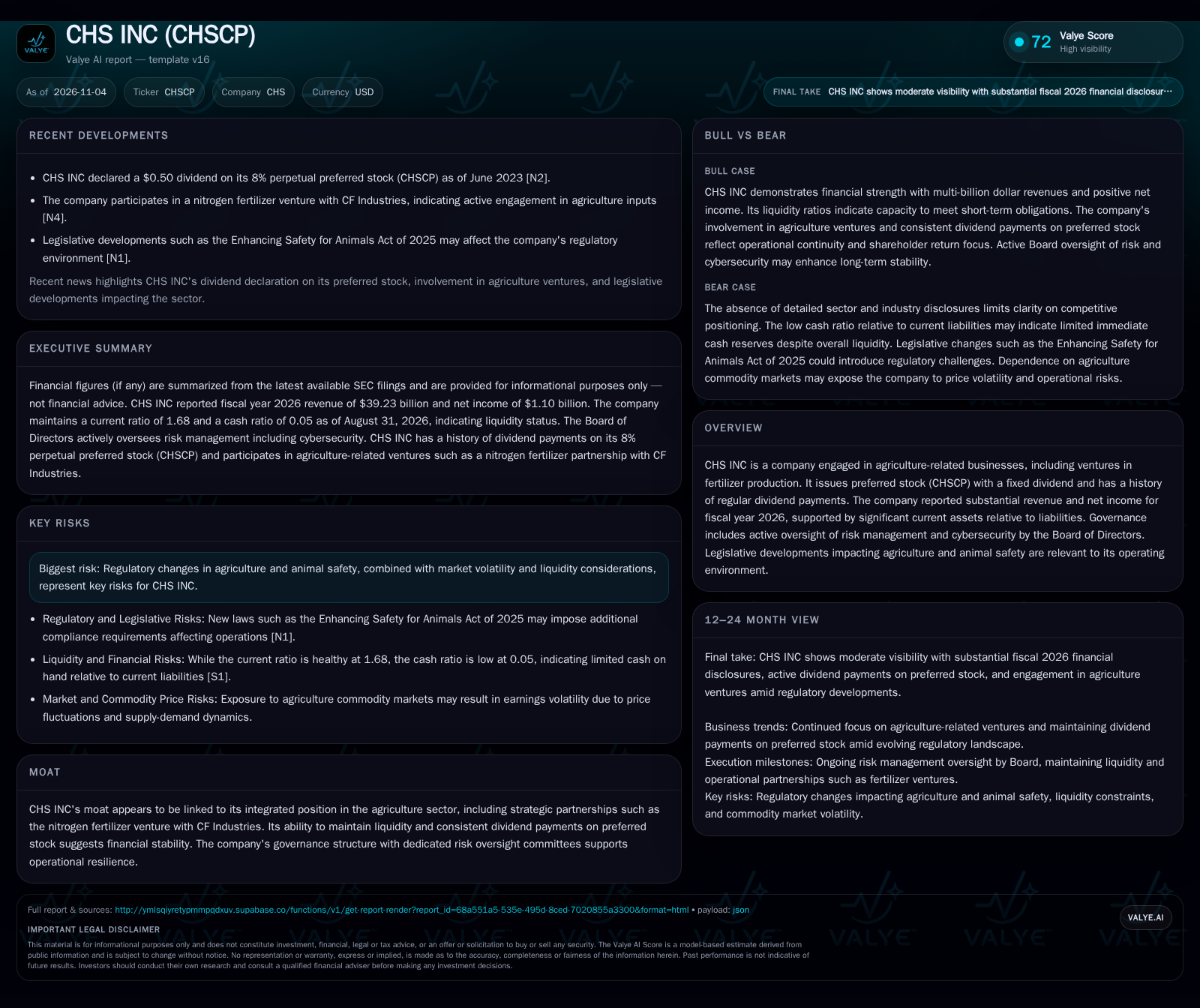
CHS Inc. reported $39.23B in fiscal 2026 revenue and $1.10B in net income, supported by a multi-segment model spanning Energy, Grains, and Agronomy. The company’s current ratio indicates reported liquidity position, but its reported cash ratio highlights limited immediate reserves. Board-level risk governance and ventures like nitrogen fertilizer production may support resilience, yet the business remains exposed to commodity cycles and margin pressures. Monitoring segment profitability, capital needs, and market shocks will be crucial.
CHS Inc., a major player in the U.S. agricultural sector, concluded its 2026 fiscal year with $39.23 billion in revenue and $1.10 billion in net income, underlining its scale and ability to generate profits in a volatile industry. With governance emphasizing risk management and ongoing exposure to commodity cycles, the company’s resilience will hinge on segment execution, partnership leverage, and the ability to navigate both market upswings and downturns.
2026 Financial Results and Operating Model: What’s Changed for CHS Inc.
CHS Inc. reported $39.23 billion in revenue and $1.10 billion in net income for fiscal 2026, reflecting significant scale and continued profitability in the agricultural sector [S1]. The company realigned its operations under a new product-line model as of September 2025, organizing around three reportable segments: Energy, Grains, and Agronomy. This shift is material because it changes the company’s approach to performance management, resource allocation, and financial reporting, potentially improving focus and segment-level accountability. [S1] The Board’s active oversight of risk, including cybersecurity, factors into the company’s operational resilience.
How CHS Inc. Monetizes Scale: Segment Economics, Margin Drivers, and Capital Needs
CHS Inc. operates as an integrated agricultural cooperative, deriving revenue from a blend of commodity trading, energy product distribution, and agronomy services. The company’s Energy segment includes wholesale and retail activities in refined fuels, propane, and lubricants, leveraging both owned infrastructure (such as pipelines and terminals) and established brands (notably Cenex®). The Grains segment operates globally, marketing and processing feed grains, oilseeds, and wheat, participating in both upstream procurement and downstream sales. The Agronomy segment focuses on crop nutrients and protection products, supported by ventures like the nitrogen fertilizer partnership with CF Industries.
Revenue is driven by a mix of volume (grain aggregation, energy throughput), product mix (commodities versus value-added products), and pricing—each highly sensitive to market conditions. Cost of goods sold (COGS) dominates the expense base, reflecting the thin margin nature of commodity businesses. Operating leverage is present but constrained: while fixed infrastructure and logistics assets can support scale, margin volatility from commodity price swings and input costs often offsets the benefits.
Capital intensity varies significantly across CHS Inc.'s segments, influencing both short-term liquidity and long-term return on invested capital. The Energy segment typically requires substantial investment in infrastructure such as storage terminals, pipelines, and retail outlets, which while providing stable throughput capacity, also impose fixed costs that must be managed carefully during demand fluctuations. Conversely, the Grains segment's capital needs are more cyclical, tied to seasonal procurement and inventory holding, which can strain working capital especially when commodity prices are volatile. Agronomy, while less capital-intensive in physical assets, demands ongoing investment in research, supply chain integration, and partnerships to maintain competitive product offerings. Understanding the interplay between these capital requirements and cash flow generation is critical to assessing CHS's potential financial flexibility and resilience.
Margin drivers in CHS's business are subject to complex external and internal factors. Commodity price volatility directly affects revenue and cost of goods sold, but the company's ability to pass through price changes to customers varies by segment and product. For example, energy products often have more transparent market pricing, enabling quicker price adjustments, whereas agronomy inputs may face longer contract cycles or regulatory constraints that delay price responsiveness. Additionally, operational efficiency improvements—such as logistics optimization or procurement scale—can partially offset margin compression but are constrained by the cooperative's need to balance member interests and competitive pricing. Therefore, margin expansion depends not only on market conditions but also on effective internal cost management and strategic pricing flexibility.
Strategic Positioning in Agriculture: Integration, Partnerships, and Market Exposures
CHS Inc.’s competitive position is anchored in its integrated value chain, spanning from farm inputs (energy, agronomy) to grain marketing and processing. This breadth allows for some risk diversification and cross-segment synergies, potentially reducing dependence on any single commodity or market. Strategic partnerships, such as the nitrogen fertilizer venture with CF Industries, may provide access to advantaged supply and cost structures, though details of margin sharing or capital commitments are not disclosed in the current report.
However, CHS operates in highly competitive and fragmented markets, facing peer cooperatives, global agribusinesses, and regional players. Substitutes and counterforces—such as farm consolidation, direct-to-market grain platforms, and alternative crop input providers—can pressure both pricing and customer retention. The company’s ability to maintain relevance hinges on service quality, supply reliability, and member loyalty, but switching frictions in agricultural supply chains can be limited if alternatives offer better pricing or terms.
The cooperative structure of CHS Inc. introduces unique competitive dynamics compared to investor-owned agribusinesses. Member loyalty can provide a stable customer base and reduce churn, but it may also limit aggressive pricing or expansion strategies if they conflict with member interests. Furthermore, cooperative governance can slow decision-making relative to publicly traded peers, potentially impacting responsiveness to market shifts. However, integration across segments offers opportunities for cross-selling and bundling services, which can enhance value propositions and could increase switching costs for members. The balance between leveraging these synergies and maintaining competitive agility will be a key determinant of CHS's long-term positioning amid evolving agricultural supply chain models.
Leveraging Segment Realignment and Partnerships for Margin Expansion
A favorable scenario for CHS Inc. would see the new product-line operating model enabling sharper segment focus and improved capital allocation. If segment leaders can optimize procurement, logistics, and sales strategies within Energy, Grains, and Agronomy, the company could realize operational efficiencies and boost margins—even in a challenging commodity environment. Strategic partnerships, such as the fertilizer venture, may further strengthen supply security and cost competitiveness, supporting the Agronomy segment’s profitability.
Confirmation of this scenario would come from rising segment income before income taxes (IBIT), improved gross and operating margins, and evidence of cost discipline despite volatile input prices. Additional signals could include expanded partnerships, new value-added product offerings, or successful customer retention initiatives that translate to more stable or growing volumes. Disclosure of increased segment ROIC or capital returns would strengthen the case.
Sustained Profitability Amid Commodity Cycles and Margin Pressures
The most plausible outcome is that CHS Inc. continues to generate substantial revenues and positive net income, but with earnings and margin volatility reflecting the realities of commodity-driven markets. The new operating model may yield incremental improvements in cost control and segment accountability, but not enough to fundamentally alter the business’s exposure to external shocks or cyclical downturns.
Confirmation of the base case would include continued multi-billion dollar revenues and positive net income, but with segment performance swinging in response to market prices for grains, fuels, and crop inputs. Stable or slightly improving operating margins—without dramatic expansion—would reinforce this scenario. Falsification would occur if segment realignment fails to deliver on efficiency or if external shocks (such as commodity price collapses or supply chain disruptions) result in sustained losses or liquidity stress.
Commodity Shocks and Liquidity Strain: How Adverse Cycles Could Pressure CHS Inc.
In a negative scenario, CHS Inc. could face simultaneous commodity price declines and rising input costs, compressing margins and stressing working capital needs. If major customers or cooperative members shift business to alternative suppliers—driven by better pricing, reliability, or new platforms—revenue could decline more sharply than costs can be reduced.
This scenario would be confirmed by falling segment income, declining gross margins, and possible negative operating cash flow. Watchpoints include any uptick in short-term borrowing, delayed supplier payments, or reduced dividend declarations. A material deterioration in current assets relative to liabilities—or adverse developments in credit markets—would further validate the downside risk.
Testing the CHS Inc. Thesis: Segment Results, Liquidity Trends, and Market Triggers
Quarterly and annual segment-level income before income taxes (IBIT) for Energy, Grains, and Agronomy—disclosed in filings—will show whether realignment is driving improved performance.
Gross and operating margin trends across segments, if disclosed, would help assess the effectiveness of cost management and pricing strategies.
Working capital movements, including changes in inventory, receivables, and payables, will reveal how the company is managing liquidity amid market swings.
Short-term borrowing activity or changes in access to credit facilities would indicate whether CHS is under liquidity strain or maintaining potential financial flexibility.
The cash ratio and current ratio should be monitored for further deterioration or improvement, signaling changes in immediate liquidity.
Any new or expanded strategic partnerships, particularly in crop inputs or energy supply, would signal efforts to strengthen competitive positioning.
Material shifts in customer/member retention rates or new customer acquisition, if disclosed, would test the company’s ability to defend or grow its market share.
Disclaimer: This is research-only, informational analysis and not investment advice. It may include AI-generated interpretation and general industry context. Always verify important details using primary sources.

Comments