
Perrigo’s Strategic Refocus: Divestiture, Margin Pressures, and the Stakes of Concentration Risk
Perrigo’s recent divestiture of its infant formula business, combined with a Q3 net loss and persistent customer and supply chain concentration, signals a pivotal moment for the self-care product manufacturer. The company’s ability to manage regulatory, operational, and margin pressures will determine whether this strategic pivot yields resilience or exposes deeper vulnerabilities.
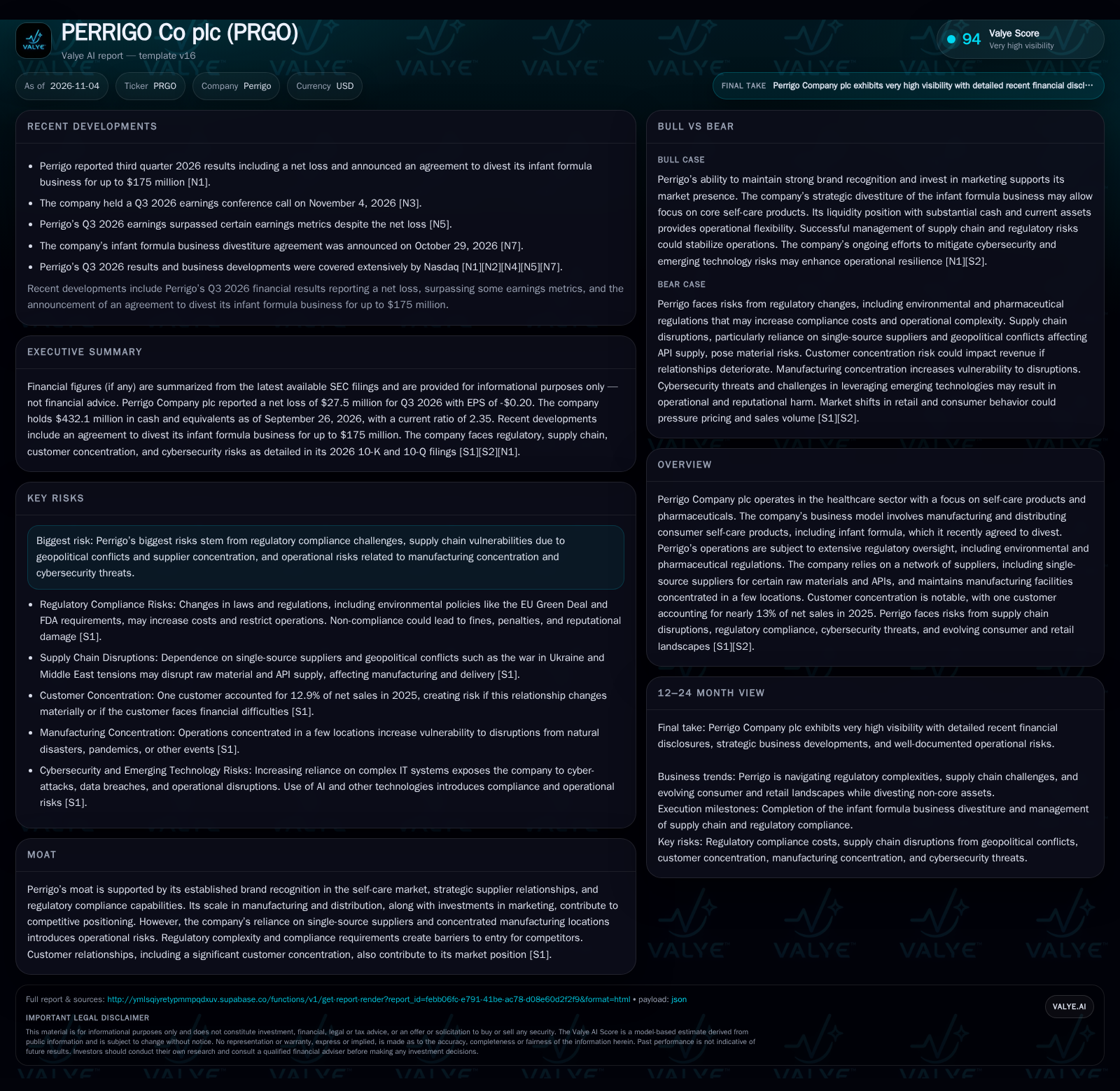
Perrigo reported a Q3 2026 net loss and has agreed to divest its infant formula business for up to $175 million. With one customer representing nearly 13% of sales and ongoing supply chain and regulatory pressures, the company faces a critical test of its ability to refocus on core self-care offerings and stabilize margins in a challenging operating environment. Execution on cost controls, supply chain resilience, and customer diversification will be central to the company’s trajectory over the next 12-24 months. [S2] [N1] [N7]
Perrigo Company plc stands at a strategic crossroads after posting a Q3 net loss and announcing the divestiture of its infant formula business for up to $175 million. The move away from infant formula is intended to sharpen the company’s focus on its core self-care product portfolio, but it also exposes Perrigo to intensified risks around customer concentration, supply chain fragility, and regulatory compliance. As the company seeks to stabilize performance and defend its share in a competitive consumer health market, its ability to manage these structural vulnerabilities will be decisive for future value creation.
Divestiture and Q3 Losses Mark a Turning Point in Perrigo’s Strategic Direction
Perrigo reported a net loss of $27.5 million for the quarter ended September 26, 2026, reflecting ongoing margin pressure and operational challenges. This financial result coincided with the announcement that Perrigo has agreed to divest its infant formula business to MeridianMade for up to $175 million, a move designed to streamline the company’s portfolio and potentially free up resources for its core self-care and pharmaceutical products. Notably, customer concentration remains high, with a single customer accounting for 12.9% of net sales in 2025—a structural exposure that could amplify volatility if the relationship changes. [S2] [N1] [N7] [S1]
Portfolio Simplification and Margin Dynamics: How Perrigo’s Model Could Evolve
Perrigo’s core economic engine is the manufacture and distribution of consumer self-care products, typically sold through retail and pharmacy channels. The recent divestiture of the infant formula segment—historically exposed to raw milk pricing and regulatory volatility—could reduce margin variability and working capital needs, allowing management to reallocate resources to higher-margin OTC, wellness, and branded self-care categories. However, Perrigo’s business remains capital-intensive, with significant fixed costs tied to its concentrated manufacturing footprint. Variable costs are driven by raw material inputs, some of which are subject to global commodity cycles and single-source supplier dynamics. Pricing power is structurally limited by retailer bargaining leverage and regulatory price controls, especially in Europe and for certain pharmaceutical lines. As a result, Perrigo’s margin trajectory will depend on its ability to drive volume growth in differentiated categories, optimize cost structure, and mitigate input volatility—none of which are assured in the current environment.
The interplay between Perrigo’s cost structure and pricing environment is critical to understanding its margin dynamics. Given the company’s capital-intensive manufacturing footprint, fixed costs represent a substantial portion of total expenses, limiting operational leverage in periods of volume decline. In this context, any downturn in sales volume can disproportionately depress margins, as fixed overheads remain largely unchanged. Conversely, volume growth in higher-margin product lines could improve absorption of these fixed costs, but this is contingent on successful product innovation and market acceptance. Additionally, the company’s exposure to raw material price swings—often influenced by global commodity markets and geopolitical factors—introduces input cost volatility that is only partially mitigated through supplier contracts or hedging strategies. This volatility complicates forecasting and requires agile procurement and inventory management to protect margins.
Another dimension to consider is the regulatory environment’s indirect impact on Perrigo’s economics. Compliance with evolving FDA and EU regulations imposes not only direct costs but also operational constraints that can delay product launches or require reformulations, thereby affecting time-to-market and competitive positioning. These regulatory demands can also necessitate investments in quality assurance and manufacturing upgrades, increasing capital expenditures and maintenance costs. The cumulative effect is a higher breakeven point for new products and a potential dampening of pricing flexibility, especially in price-sensitive OTC segments. This environment incentivizes a strategic focus on product categories with clearer regulatory pathways or differentiated formulations that justify premium pricing, yet such a pivot requires careful portfolio management and innovation capabilities.
Brand Recognition vs. Structural Exposures: Assessing Perrigo’s Place in Consumer Healthcare
Perrigo benefits from established brand recognition and scale in the self-care segment, but its competitive position is defined as much by vulnerabilities as by strengths. The company’s reliance on single-source suppliers and a concentrated manufacturing base increases exposure to supply chain shocks—risks that are magnified in periods of geopolitical instability or regulatory change. While regulatory complexity and investment in compliance create some barriers to entry for smaller players, they also weigh on Perrigo’s cost base. Major competitors include large branded OTC and generic pharmaceutical companies, private-label manufacturers, and increasingly, direct-to-consumer health brands leveraging digital channels. Customer concentration—where a single retailer accounts for nearly 13% of sales—limits Perrigo’s negotiating leverage and could expose it to abrupt volume or pricing shifts if retail strategies change. The divestiture of infant formula may narrow the company’s product breadth, but could also allow greater strategic clarity if reinvestment is disciplined.
If Focus Brings Resilience: How a Streamlined Perrigo Could Unlock Margin Recovery
In a favorable scenario, Perrigo successfully completes the infant formula divestiture and redeploys proceeds to shore up its core self-care product lines, investing in innovation, marketing, and supply chain resilience. This focus could allow the company to rationalize its manufacturing footprint, negotiate better terms with suppliers, and pursue higher-margin product extensions—potentially offsetting customer concentration by winning share with additional retail partners or through direct-to-consumer channels. Confirmation of this scenario would come from sustained gross margin improvement, evidence of new product launches or partnerships, and a reduction in dependency on any single customer. Accelerated revenue growth and stabilization of earnings—particularly if coupled with lower volatility in input costs—would also validate the thesis that the company’s strategic pivot is yielding results.
Managing Through Volatility: Perrigo’s Most Likely Trajectory Post-Divestiture
The most plausible outcome is that Perrigo, post-divestiture, experiences some reduction in operational complexity but continues to face margin headwinds from persistent input cost volatility, regulatory compliance expenses, and pricing pressure from large retail customers. While the sale of the infant formula unit may improve near-term cash flow and simplify operations, it does not fundamentally alter the company’s exposure to supply chain disruptions or its dependence on a handful of major customers. Incremental improvements in cost management and selective new product introductions could stabilize earnings, but a step-change in profitability is unlikely unless Perrigo can materially diversify its customer base and further reduce fixed cost intensity. Confirmation would come from modest but consistent improvements in operating margins and cash flow, without significant new supply or customer shocks.
Concentration Risks Materialize: How Operational Shocks Could Derail Perrigo’s Recovery
A more adverse outcome could occur if Perrigo suffers a significant disruption at a key manufacturing site or faces a breakdown in its relationship with its largest customer. Given the company’s concentrated manufacturing and customer base, such shocks could result in abrupt revenue loss, margin compression, and working capital strain. Regulatory changes—such as new EU environmental mandates or FDA actions—could further inflate compliance costs or restrict product offerings, while continued raw material price inflation would erode profitability. Evidence of this downside would include sudden declines in net sales, missed earnings targets, increased inventory write-downs, or emergency cost-cutting measures. If the proceeds from the infant formula sale are not effectively redeployed, the company could also face pressure to divest additional assets or seek external financing under less favorable terms.
Milestones and Metrics That Will Shape Perrigo’s Strategic Trajectory
Completion and terms of the infant formula business divestiture, including the final proceeds realized and any retained liabilities.
Gross margin trends and operating expense ratios post-divestiture, as indicators of whether cost structure improvements are materializing.
Revenue concentration metrics, especially the proportion of sales attributable to the top one or two customers in subsequent quarters.
Volume and revenue growth in remaining core self-care categories, particularly from new product launches or expanded distribution channels.
Supply chain resilience indicators, such as the number of critical single-source suppliers and any reported disruptions or inventory shortages (if disclosed).
Regulatory compliance expenses and any new disclosures on impacts from evolving EU or FDA requirements.
Progress on manufacturing footprint diversification or investments in supply chain risk mitigation.
Cybersecurity incidents or material technology disruptions, given the stated risk from emerging technologies and increased IT reliance.
Disclaimer: This is research-only, informational analysis and not investment advice. It may include AI-generated interpretation and general industry context. Always verify important details using primary sources.

Comments