
ArcBest in Late 2026: Freight Expansion, Margin Durability, in a Cyclical Market
ArcBest posts rising revenue and net income in Q3 2026, underscoring operational execution amid a competitive and cyclical freight market.
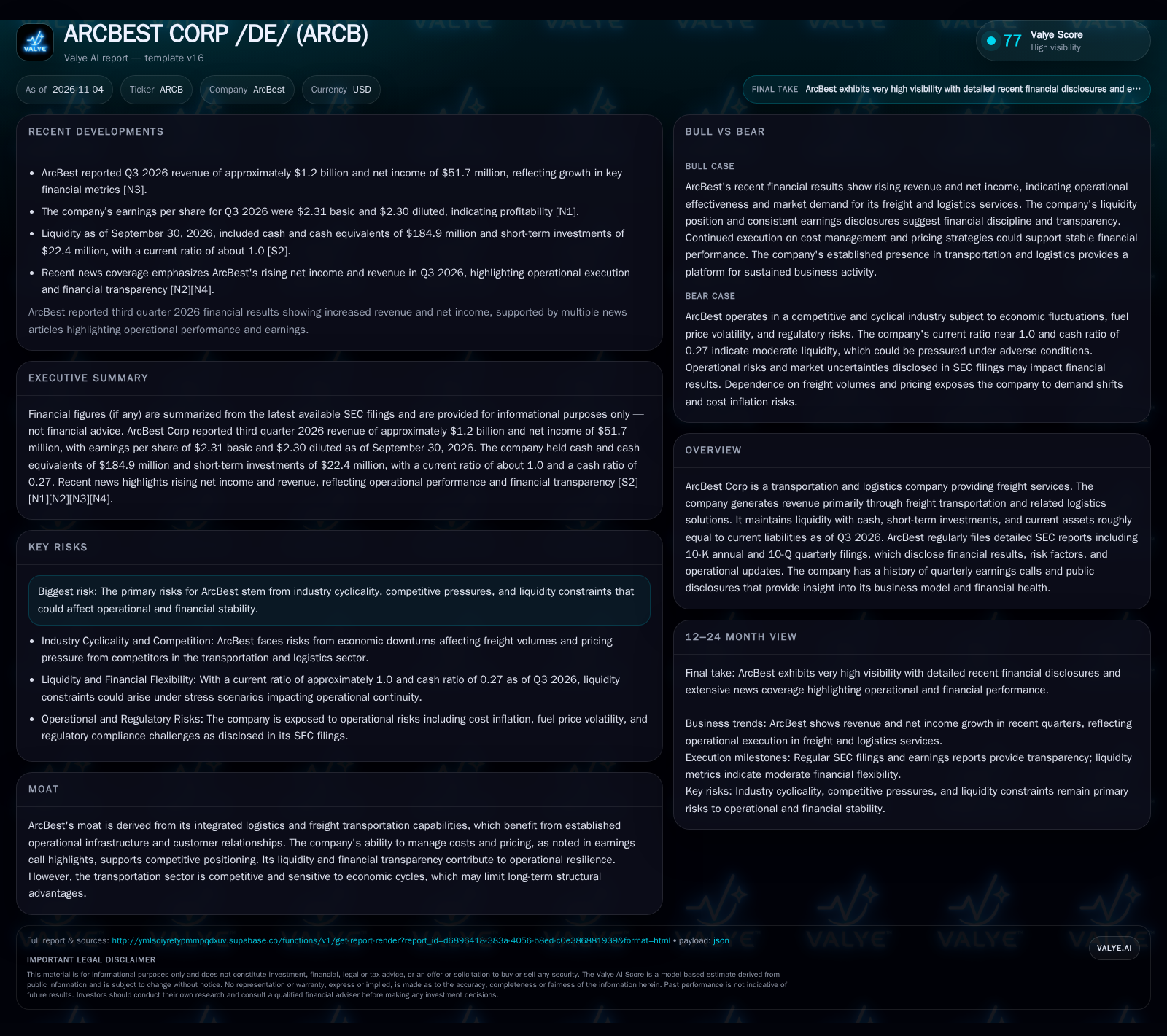
ArcBest’s Q3 2026 results show revenue of $1.2 billion and net income of $51.7 million, reflecting operational momentum in freight and logistics. The next phase depends on maintaining pricing power and controlling costs in a sector vulnerable to economic and regulatory shifts. [S2] [N2] [N3] [N4]
ArcBest’s Q3 2026 earnings confirm a period of revenue and net income growth, suggesting effective operational execution in the freight and logistics sector. The company’s next act will be defined by its ability to preserve margins and manage working capital through the inevitable swings of a cyclical, competitive industry.
Recent Performance Reflects Growth Offset by Liquidity Constraints
ArcBest reported Q3 2026 revenue of approximately $1.2 billion and net income of $51.7 million, marking a period of positive operational momentum and financial discipline. These results reflect the company’s ability to execute in a challenging market, but the balance sheet tells a more nuanced story: as of September 30, 2026, ArcBest held $184.9 million in cash and $22.4 million in short-term investments, while current assets and liabilities were closely matched at roughly $760 million each. This yields a current ratio of about 1.0 and a cash ratio of just 0.27, indicating that while liquidity is present, it is not ample. The company reported cash and liquidity metrics for the period; these figures do not by themselves establish operating runway, investment capacity, financial flexibility, or financing capacity. [S2] [N3]
In capital-intensive industries like freight and logistics, working capital management is critical; delays in accounts receivable collections or unexpected increases in payables could quickly tighten cash flow. Consequently, the company's ability to maintain supplier relationships and fund day-to-day operations without resorting to costly short-term borrowing will be a key determinant of financial resilience. Monitoring the composition and turnover of current assets, such as receivables and inventory, would provide further insight into liquidity sustainability.
Revenue Growth and Cost Dynamics in Freight Operations
ArcBest’s core business model relies on generating revenue from freight transportation and logistics services. In this sector, revenue growth is typically driven by a combination of shipment volume, pricing power, and the mix of value-added services. Fixed costs—such as fleet maintenance, labor, and facilities—create operating leverage, meaning incremental revenue can drive disproportionate profit gains in strong markets but amplify losses when volumes drop. Variable costs, especially fuel and purchased transportation, are significant and subject to market volatility. Pricing discipline is crucial: the ability to pass through cost inflation to customers, especially when freight markets are tight, determines margin resilience. If ArcBest can maintain or improve yield per shipment while controlling input costs, it could continue to convert top-line growth into earnings. However, a downturn in freight demand or a spike in costs could quickly squeeze margins and strain liquidity.
Furthermore, the interplay between fixed and variable costs creates a delicate balance in profitability. When volumes increase, fixed costs are spread over a larger revenue base, enhancing operating leverage and profitability. However, if volumes decline, these fixed costs become a heavier burden, potentially leading to margin compression. Fuel price volatility, a notable variable cost, can erode margins if not effectively hedged or passed on to customers. Additionally, labor costs, often a significant fixed or semi-fixed expense, may limit the company's flexibility in adjusting cost structures quickly. Therefore, the company's cost management strategies, including workforce optimization and fuel procurement practices, are vital to sustaining margin durability amid fluctuating demand.
Balancing Operational Scale Against Fierce Industry Rivalry
ArcBest operates in a highly fragmented and competitive industry, facing competition from both large national carriers and regional or niche logistics providers. Its established infrastructure and integrated service offerings—spanning traditional less-than-truckload (LTL) freight, truckload, and logistics solutions—provide a platform for customer retention and cross-selling. However, switching costs for shippers are generally low, barring deep integration or contractual lock-ins. Technology investments, operational efficiency, and network density are common sources of advantage, but these can be quickly eroded by aggressive pricing from rivals or shifts in customer preferences. In this environment, the ability to differentiate through service reliability, digital tools, and end-to-end logistics offerings could strengthen ArcBest’s position, but pricing wars and economic cycles remain persistent threats.
In addition to pricing and service differentiation, strategic investments in technology can serve as a competitive moat by improving operational efficiency and customer experience. For example, advanced route optimization, real-time shipment tracking, and predictive analytics can reduce delivery times and costs, enhancing customer satisfaction and retention. However, technology adoption requires upfront capital and ongoing maintenance, which may pressure margins if not carefully managed. Moreover, as competitors also invest in similar capabilities, the relative advantage may diminish over time, making continuous innovation and integration with customer supply chains essential. The company's ability to leverage data-driven insights to anticipate market shifts and optimize asset utilization will influence its competitive positioning in a fragmented market.
Potential for Margin Gains Through Pricing and Efficiency
If ArcBest sustains its recent trajectory of revenue and net income growth, the most likely mechanism is a combination of disciplined pricing and effective cost containment. In favorable markets—where freight demand is steady or rising—the company could leverage its operational scale to push through rate increases and optimize network utilization, boosting yields and absorbing fixed costs. Enhanced digital logistics offerings or value-added services could further differentiate ArcBest and support higher margins. Evidence that would confirm this scenario includes continued sequential improvement in operating margin, rising yield per shipment, and stable or growing cash balances despite ongoing investment. Conversely, if future quarters show margin compression or deteriorating liquidity, the thesis of sustained operational leverage would be weakened.
Growth Outlook Shaped by Market Cycles and Cost Pressures
The most plausible outcome is a continuation of moderate revenue growth with periodic margin fluctuations, reflecting broader industry cycles. ArcBest is likely to experience swings in shipment volumes and pricing as macroeconomic conditions shift and competitors adjust strategies. In this scenario, ArcBest maintains profitability but faces periods of cost inflation and price competition that compress margins. Confirmation would come from stable revenue and net income trends, but with little improvement in liquidity ratios or material expansion in operating margins. Falsification would involve either a sustained deterioration in earnings or a material improvement in working capital efficiency that lifts liquidity above current levels.
Risks to Liquidity from Volume Declines or Rising Expenses
A pronounced downturn—caused by a macroeconomic slowdown, sharp drop in freight demand, or spike in input costs—could create acute pressure on ArcBest’s liquidity. In such a scenario, ArcBest might be forced to seek external financing, scale back operations, or curtail investment, potentially eroding customer service levels and competitive positioning. Evidence of this downside unfolding would be a rapid increase in short-term borrowing, reductions in capex or headcount, or negative operating cash flow trends. If ArcBest manages to maintain service levels and profitability even as conditions worsen, this would challenge the downside thesis.
Assessing ArcBest’s Position Through Margin, Liquidity, and Market Developments
Sequential changes in operating margin: Sustained improvement would suggest successful pricing and cost management; deterioration could indicate margin pressure.
Yield per shipment or revenue per hundredweight (if disclosed): Rising yields point to effective pricing power and service differentiation.
Working capital efficiency: Faster collections, slower payables, or inventory management improvements could enhance liquidity and reduce risk.
Net cash provided by operating activities: Positive and growing cash flow from operations would support resilience, while declines could flag stress.
Short-term debt or credit line utilization: An uptick may signal emerging liquidity strain in the face of working capital needs or revenue shortfalls.
Trends in shipment volumes and mix: Shifts toward higher-margin segments or value-added logistics services would support the upside thesis.
Competitive pricing dynamics: Evidence of aggressive rate competition or customer churn would test ArcBest’s ability to defend margins.
Macro indicators for freight demand: Economic data on industrial production, retail sales, or supply chain activity could foreshadow volume swings impacting ArcBest.
Disclaimer: This is research-only, informational analysis and not investment advice. It may include AI-generated interpretation and general industry context. Always verify important details using primary sources.

Comments