
United Fire Group in Late 2026: Commercial Focus, Underwriting Discipline, and the Stakes of Agency Distribution
United Fire Group’s late 2026 results highlight a profitable pivot away from personal lines and a continued emphasis on disciplined underwriting in U.S. commercial property and casualty insurance. With strong agency relationships and capital above regulatory minimums, the company’s challenge is to sustain earnings momentum despite intense competition, regulatory headwinds, and catastrophe risk.
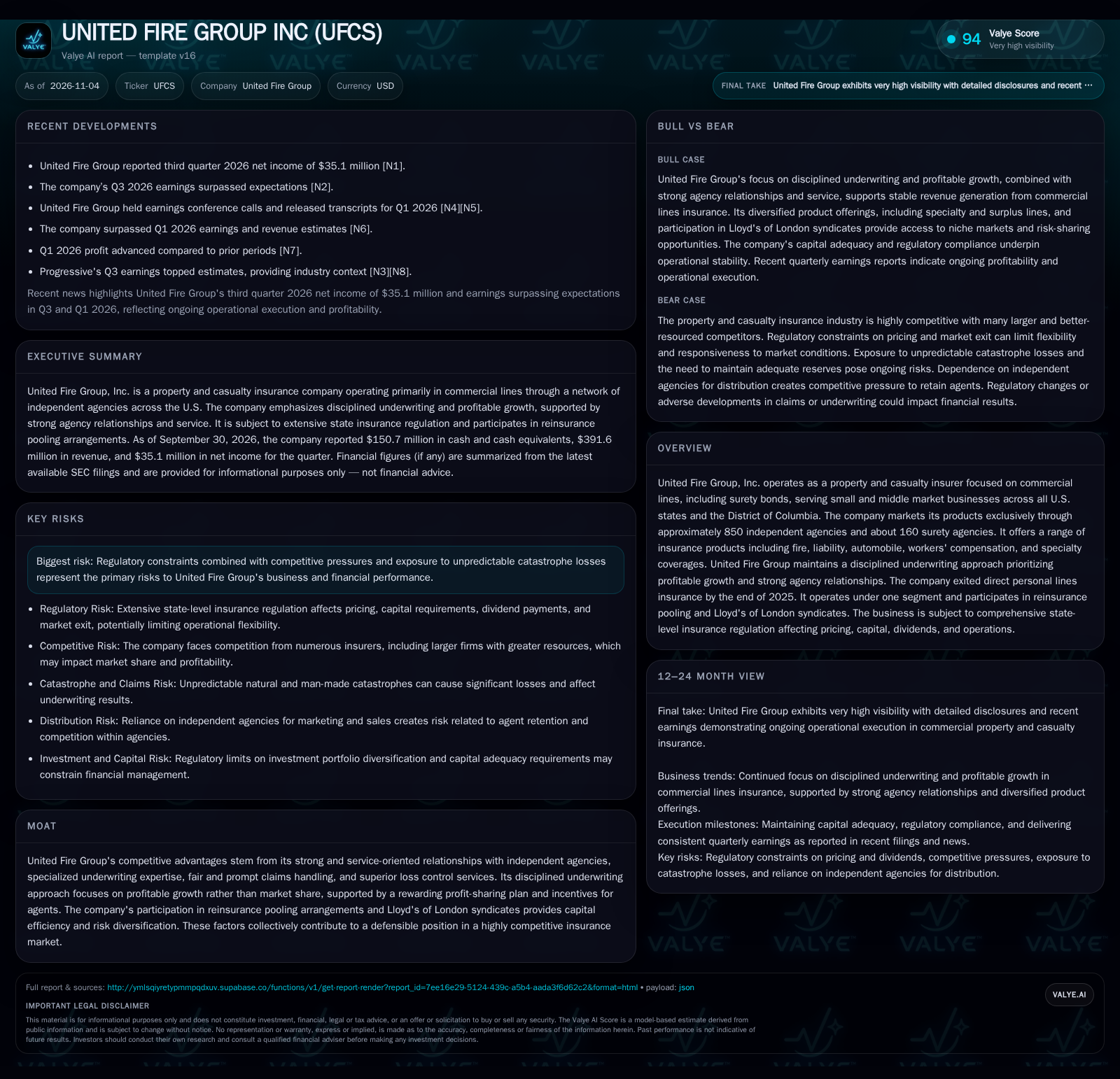
United Fire Group reported Q3 2026 net income of $35.1 million, marking continued profitability after its exit from direct personal lines. The company’s strategy centers on disciplined commercial underwriting, agency-driven distribution, and niche offerings like specialty and surplus lines. While recent earnings beat expectations, future performance will depend on risk selection, agency retention, and navigating regulatory and catastrophe exposures. [S2] [N1] [N2]
United Fire Group’s late 2026 financials reflect a property and casualty insurer that has sharpened its commercial focus and posted solid profits after a strategic exit from personal lines. By concentrating on small and mid-market commercial clients and leveraging a broad agency network, the company has delivered quarterly earnings that outpace expectations. However, the road ahead is defined by the need to defend market share against larger rivals, manage catastrophe exposures, and operate within a heavily regulated industry—all while sustaining agency loyalty and underwriting discipline.
Recent Profitability and Strategic Realignment Define United Fire Group’s Position
As of September 30, 2026, United Fire Group reported quarterly revenue of $391.6 million and net income of $35.1 million, with earnings per share of $1.36 (basic) and $1.34 (diluted). These results exceeded analyst expectations for both Q3 and Q1 2026, signaling operational momentum and effective risk selection in the company’s core commercial lines. Notably, the insurer completed its exit from direct personal lines by the end of 2025, leaving it fully focused on commercial property and casualty products, including specialty and surplus lines. This strategic pivot is reflected in improved profitability and a portfolio more insulated from the volatility typical of personal auto and homeowners insurance. [S2] [N1] [N2] [N6]
United Fire Group’s insurance subsidiaries all held capital in excess of regulatory minimums at year-end 2025, and the company reported $150.7 million in cash and cash equivalents at the end of Q3 2026. The company reported cash and liquidity metrics for the period; these figures do not by themselves establish operating runway, investment capacity, financial flexibility, or financing capacity. [S1] [S2]
How Underwriting Discipline and Agency Distribution Drive Earnings Potential
United Fire Group’s commercial lines business model generates revenue primarily through premiums earned on property, casualty, and surety insurance products. The company’s economics are shaped by the balance of premium volume, loss ratios (claims paid relative to premiums), and operating expenses—particularly commissions and claims management costs. By emphasizing disciplined underwriting and profitable growth over premium volume, the company aims to avoid underpricing risk and to maintain combined ratios that allow for consistent profitability.
Pricing power is constrained by regulatory oversight, especially for admitted commercial lines, with rate changes often subject to state approval. The company’s focus on small and middle market businesses typically allows for some risk-based pricing, but competition limits the ability to push through aggressive rate hikes. Distribution via independent agencies means commission costs are significant but variable, providing some flexibility on the expense side if volumes shift.
United Fire Group’s participation in reinsurance pooling and Lloyd’s of London syndicates spreads large risk exposures and provides access to niche markets, though it also introduces external reinsurance costs and profit-sharing mechanisms. The insurer’s capital requirements are dictated by regulatory rules on surplus and portfolio diversification, which limit investment options and can cap return on equity compared to less regulated financial firms.
Agency Loyalty, Underwriting Expertise, and the Challenge of Scale
United Fire Group competes in a fragmented but fiercely contested insurance landscape, where larger carriers often have scale advantages in technology, data analytics, and reinsurance purchasing. The company’s competitive edge rests on its strong relationships with approximately 850 independent property and casualty agencies and 160 surety agencies, as well as a reputation for responsive service, fair claims handling, and specialized underwriting. These factors foster agent loyalty and may help the company retain business in the face of aggressive pricing from larger players or digital-first entrants.
However, exclusive reliance on independent agencies introduces channel risk: if agency partners shift allegiance to competing carriers, United Fire Group could see rapid premium attrition. The absence of direct distribution limits opportunities to build proprietary customer relationships or leverage digital self-service platforms that are increasingly valued by business clients. The company’s specialty and surplus lines, as well as Lloyd’s participation, provide some product differentiation, but these segments are also targets for more nimble or capital-rich competitors.
The insurer’s disciplined approach to underwriting and loss control services is a potential moat, but the question is whether this can offset the resource and technology gap vis-à-vis larger national or global insurers, especially as regulatory and catastrophe risks continue to mount.
If Risk Selection and Agency Retention Outperform, Profitable Growth Could Accelerate
The most favorable outcome for United Fire Group would see its disciplined underwriting yielding loss ratios consistently below industry averages, while agency relationships remain strong and premium volumes grow organically. If the company can continue to access higher-margin specialty and surplus lines—possibly leveraging Lloyd’s participation—and avoid major catastrophe losses, underwriting profits could expand even in a competitive market.
Confirming evidence would include several quarters of combined ratios below 95%, sustained premium growth in core commercial segments, and public commentary or disclosures about agency retention or expansion. Additional upside could come from favorable regulatory environments permitting modest rate increases, or from successful technology investments that enhance claims efficiency without sacrificing service.
This scenario would be falsified by evidence of rising loss ratios, agency defections, or stagnant premium growth despite stable market conditions.
Sustaining Profitability Amid Market Competition and Regulatory Constraints
The most plausible outcome is that United Fire Group sustains moderate profitability by maintaining underwriting discipline and leveraging its agency network, but faces ongoing margin pressure from competitive pricing and regulatory limits on rate increases. Premium growth may track with overall commercial insurance market trends, with occasional boosts from specialty lines or Lloyd’s syndicate participation.
Earnings are likely to remain sensitive to catastrophe events and reserve development, with the company’s capital position supporting its ability to absorb moderate shocks but not insulating it from industry-wide cycles. Regulatory oversight will continue to shape both pricing and capital management, limiting the company’s flexibility compared to less regulated peers.
Confirmation would come from continued quarterly profitability, stable or slightly improving combined ratios, and disclosures pointing to agency stability. Falsification would be signaled by a spike in loss ratios, significant negative reserve adjustments, or evidence of agency churn.
What Happens If Catastrophe Losses or Agency Attrition Pressure Margins?
Adverse outcomes could arise if United Fire Group is hit by outsized catastrophe losses—such as from hurricanes, wildfires, or severe convective storms—leading to a sharp deterioration in underwriting results and possible reserve strengthening. In parallel, if key agency partners are poached by larger or more digitally enabled competitors, premium volumes could decline, amplifying the impact of fixed costs and reducing the company’s ability to invest in technology or service enhancements.
Further downside could stem from regulatory shocks (such as unexpected capital requirements or pricing restrictions) or from unfavorable developments in reinsurance markets, which could raise costs or limit risk transfer options. These pressures could drive combined ratios above 100% for multiple quarters, eroding capital and potentially triggering rating agency scrutiny.
This scenario would be confirmed by disclosures of major catastrophe impacts, adverse reserve development, negative trends in agency count or premium retention, or regulatory actions affecting capital or pricing flexibility.
What Will Determine United Fire Group’s Commercial Insurance Trajectory?
Quarterly combined ratio trends—if disclosed—are critical for assessing underwriting discipline and risk selection effectiveness.
Premium growth rates in core commercial and specialty lines would help test the company’s ability to gain share or defend its agency-driven portfolio.
Agency retention and new agency appointments—if reported—would provide direct evidence of distribution channel health and competitive positioning.
Trends in catastrophe and large loss frequency/severity, relative to industry benchmarks, will shape earnings volatility and capital needs.
Reserve development (favorable or adverse) in quarterly filings would signal the quality of prior loss estimates and risk management.
Capital and surplus levels at insurance subsidiaries, especially after large events, are necessary to monitor regulatory compliance and financial resilience.
Regulatory developments affecting pricing, capital adequacy, or market participation could quickly alter the company’s flexibility and risk profile.
Any commentary on technology investment or digital capabilities would indicate the company’s ability to keep pace with evolving distribution and service models.
Disclaimer: This is research-only, informational analysis and not investment advice. It may include AI-generated interpretation and general industry context. Always verify important details using primary sources.

Comments