
Modine Manufacturing in 2026: Data Center Cooling, Segment Diversification, and the Stakes of Profit Consistency
Modine’s latest quarter highlights both its strategic push into high-growth thermal management sectors like data center cooling and ongoing challenges in sustaining profitability. As investor attention intensifies and analyst coverage broadens, the company’s ability to convert diversified operations into steady earnings growth will be central to its medium-term trajectory.
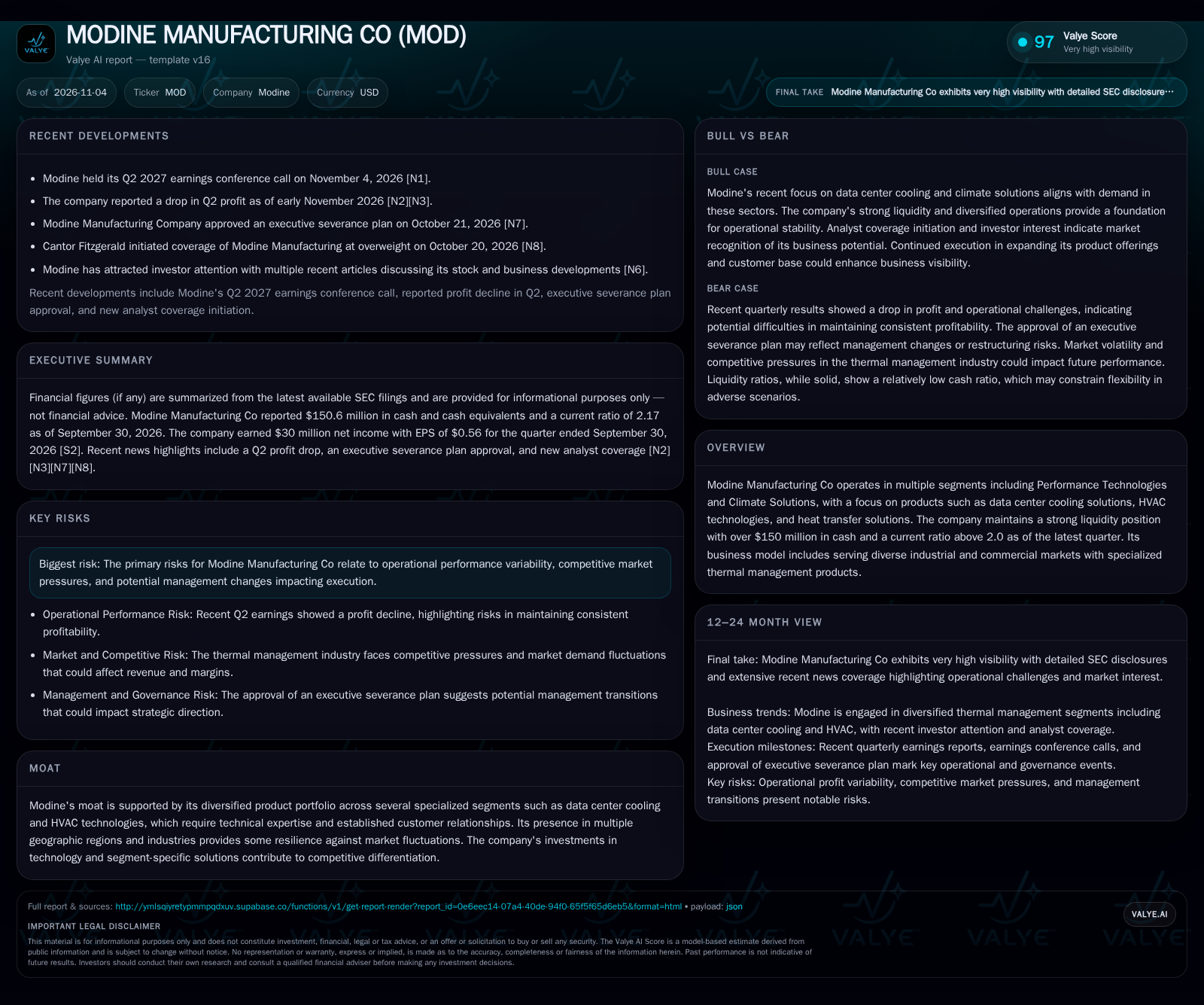
Modine Manufacturing reported a $30 million net profit in Q2 2026 on a broad base of thermal management offerings, including data center cooling and HVAC.Despite maintaining a reported current ratio, the quarter saw a profit drop, raising questions about margin stability. Recent analyst coverage and investor interest reflect Modine’s potential in high-demand markets, but execution risks and competitive pressures remain material. The path forward hinges on operational consistency and the ability to capture growth opportunities in data-driven and climate-critical segments. [S2] [N2] [N3] [N8]
Modine Manufacturing’s latest quarterly results illuminate both the promise and the pressures facing this diversified thermal management company. With a $30 million net profit and reported liquidity position, Modine is leveraging its expertise in data center cooling, HVAC, and heat transfer to tap into expanding industrial and commercial markets. As new analyst coverage and investor attention converge on Modine, the central question for the next 12–24 months is whether the company can translate its segment breadth and specialized products into consistent, scalable earnings.
Recent Profit Drop and Segment Breadth Shape the Near-Term Outlook
Modine Manufacturing reported net income of $30 million and basic and diluted EPS of $0.56 for the quarter ended September 30, 2026. While these results reflect ongoing profitability, multiple reports confirm that Q2 profit declined compared to prior periods, suggesting margin compression or increased operating costs. The company held $150.6 million in cash and cash equivalents, with current assets of $1.817 billion and current liabilities of $835.6 million, resulting in a current ratio of 2.17 and a cash ratio of 0.18. The product portfolio spans data center cooling, HVAC, and heat transfer solutions, situating Modine in markets with both cyclical and secular demand drivers. Recent overweight analyst initiation and heightened investor interest further increase scrutiny on execution and profitability. [S2] [N2] [N3] [N6] [N8]
How Modine’s Segment Mix Drives Revenue and Margin Potential
Modine’s business economics are shaped by its multi-segment structure, targeting industrial and commercial customers with specialized thermal management solutions. The revenue model likely blends project-based hardware sales (e.g., heat exchangers, custom cooling systems) with potential for aftermarket parts, system upgrades, and—where HVAC or data center cooling is sold as a managed service—recurring or maintenance revenue streams. Pricing power is typically stronger in high-specification, mission-critical applications, such as data center cooling, where reliability and efficiency are paramount. However, Modine’s exposure to heavy-duty equipment and general HVAC markets may involve more commoditized pricing and volume-driven competition.
Fixed costs in manufacturing (plant, R&D, engineering talent) could create operating leverage if volume ramps in growth areas like data center cooling. However, inconsistent project flow or margin pressure in legacy segments can quickly erode profitability, as reflected in the recent profit decline. Capital needs center on maintaining and upgrading manufacturing capabilities and investing in R&D for differentiated solutions. If Modine can shift its mix toward higher-margin, less cyclical segments, the pathway to more resilient earnings could open up.
Evaluating Modine’s Edge in an Intensely Competitive Thermal Management Industry
Modine competes in fragmented but technically demanding markets, where scale, engineering expertise, and established customer relationships are critical. In data center cooling, competitors include diversified industrials, HVAC giants, and niche technology specialists, all vying for contracts with hyperscale operators and colocation providers. Modine’s advantage may stem from its ability to deliver custom, integrated solutions and leverage cross-segment engineering know-how. In commercial HVAC and heavy-duty equipment, competition is intense and often price-driven, with competitors ranging from global conglomerates to regional manufacturers.
Switching costs for customers can be significant in mission-critical or highly integrated systems—especially when reliability and energy efficiency are core requirements—but are lower in commodity applications. Modine’s moat is thus strongest in bespoke, high-specification segments where performance and compliance drive procurement decisions. However, rapid technological change (e.g., new cooling media, digital controls, or modular systems) could erode any advantage if Modine fails to keep pace. The breadth of its portfolio provides some resilience, but it also means constant pressure to invest and differentiate across multiple fronts.
If Data Center and Climate Segments Deliver, Margin Expansion Could Follow
A favorable scenario for Modine hinges on outpacing competitors in fast-growing sectors like data center cooling and advanced climate solutions. If the company successfully wins share in these segments—leveraging its technical expertise, customer relationships, and ability to deliver turnkey solutions—it could see a sustained shift toward higher-margin, less cyclical revenue. Operating leverage would materialize as fixed manufacturing and R&D costs are spread over greater volume, while pricing discipline in specialized applications could preserve or expand gross margins.
Confirmation of this scenario would come from sequential improvements in segment revenue mix (with a rising share from data center and climate solutions), upward movement in operating or gross margins, and evidence of recurring or multi-year customer relationships. Additional analyst upgrades, major contract wins, or increased R&D investment in next-generation cooling would also signal momentum. Conversely, a lack of growth in targeted high-value segments or continued margin stagnation would undermine the thesis.
Mixed Performance as Diversification Offsets, but Does Not Eliminate, Volatility
The most plausible trajectory is that Modine’s diversified segment approach helps smooth, but not eliminate, earnings volatility. Growth in data center cooling and climate solutions may partially offset cyclical or competitive pressures in legacy HVAC and heavy-duty equipment. Profitability could remain uneven if margin gains in high-growth segments are diluted by pricing pressure or cost inflation elsewhere.
Evidence for this scenario would include stable or slightly improving consolidated margins, ongoing investment in R&D and manufacturing, and moderate but positive earnings growth. A continued mix of analyst optimism and operational hiccups would reinforce the sense of a company in transition, rather than one with a fully realized growth or turnaround story. Sharper swings in quarterly results or further profit declines would point to downside risk, while sustained margin and revenue improvement would indicate upside.
Margin Compression and Execution Missteps Could Derail Progress
The adverse case for Modine is one where competitive pricing in core markets, supply chain disruptions, or execution challenges in new segments erode margins and stall revenue growth. If the company’s diversification leads to unfocused capital allocation or repeated operational missteps, fixed costs could outpace revenue gains, leading to further profit declines.
Confirmation would come from continued quarterly profit drops, deteriorating gross or operating margins, and rising working capital needs without corresponding revenue growth. Loss of key customers, failed product launches, or inability to secure contracts in data center cooling would be red flags. Downward analyst revisions and negative investor sentiment would likely follow. A sharp increase in debt or asset sales to maintain liquidity would also signal distress.
What Will Prove Whether Modine Can Sustain Profitable Growth?
Quarterly revenue and margin performance by segment, especially the share and profitability of data center cooling and climate solutions (if disclosed), would help validate the growth thesis.
Gross and operating margin trends—sustained improvement would indicate pricing power and operating leverage; stagnation or decline would signal risk.
Major contract wins or customer renewals in high-value, high-growth segments would demonstrate competitive success and revenue visibility.
R&D spending levels and pipeline disclosures—investment in next-generation products is critical for maintaining technical differentiation.
Any material changes in analyst coverage or consensus earnings estimates could signal shifts in external confidence or company outlook.
Management turnover or changes in strategic focus—stability and clarity will be important for consistent execution.
Evidence of cost inflation, supply chain disruptions, or pricing pressure in core markets would help test margin resilience.
Disclaimer: This is research-only, informational analysis and not investment advice. It may include AI-generated interpretation and general industry context. Always verify important details using primary sources.

Comments