
Home Bancorp in Late 2026: Regional Franchise Stability, Margin Dynamics, and the Stakes of Credit Quality Management
Home Bancorp, Inc. navigates a shifting community banking landscape with a stable regional footprint, disciplined capital returns, and resilient net interest margins, but faces margin pressure and asset quality risks as competition and credit cycles evolve.
Home Bancorp’s late-2026 snapshot shows a $3.6 billion asset base, a solid deposit franchise, and continued profitability. Recent results highlight both the strengths of disciplined expense control and the challenges of meeting earnings expectations amid margin pressure. The bank’s ability to sustain returns will hinge on balancing credit quality, deposit costs, and prudent capital deployment as the regional banking environment remains competitive and sensitive to rate and economic cycles. [S2] [N4] [N5]
Home Bancorp, Inc. presents a portrait of regional banking stability as of late 2026, with a $3.6 billion asset base, a robust deposit franchise, and a disciplined approach to capital returns. Recent quarters underscore the company’s ability to generate consistent net interest income and maintain profitability, but also reveal the mounting challenges of competitive deposit markets, credit risk, and margin compression. As the community bank sector navigates a period of rising costs and evolving customer expectations, Home Bancorp’s future performance will likely depend on its ability to safeguard asset quality, manage funding costs, and judiciously deploy capital in a competitive, regulation-heavy environment. [S2] [N4] [N5]
Late-2026 Snapshot: Franchise Scale, Profitability, and Asset Quality Signals
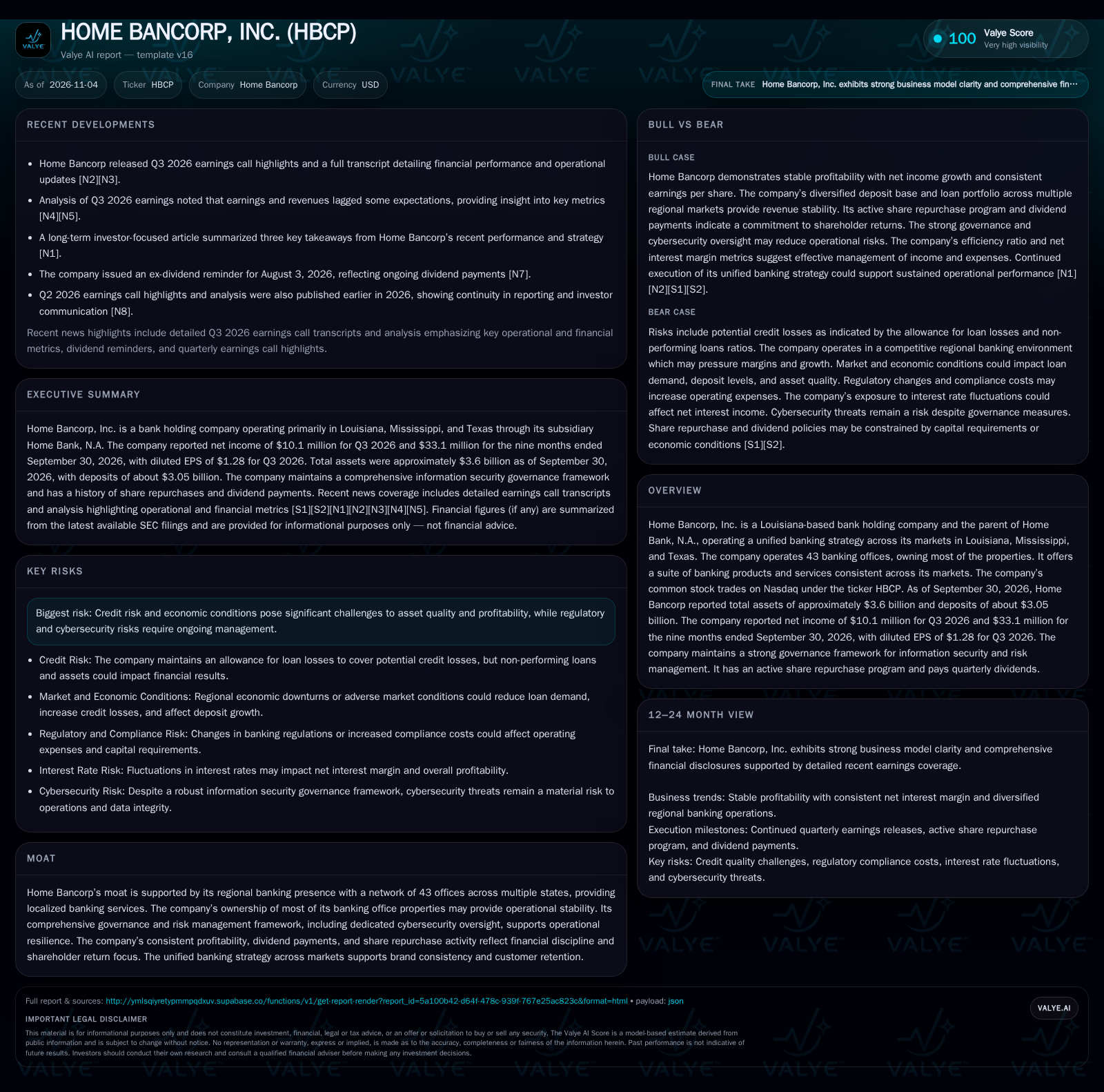
As of September 30, 2026, Home Bancorp reported total assets of approximately $3.6 billion and deposits of $3.05 billion, confirming its position as a substantial regional player across Louisiana, Mississippi, and Texas. Loans net of allowance totaled $2.74 billion, with the allowance for loan losses at $34.4 million (1.21% of loans), reflecting ongoing attention to credit risk management. Q3 2026 net income was $10.1 million, with diluted EPS of $1.28, and net income for the first nine months of 2026 reached $33.1 million. The cited source reports dividend-related activity; that disclosure alone does not establish dividend-policy continuity, management confidence, or a material constraint on capital flexibility. These data points together highlight a company balancing profitability, risk discipline, and shareholder returns, but recent earnings calls and analysis indicate that Q3 earnings and revenues lagged some market expectations, underscoring the pressure points facing regional banks in late 2026. [S1] [S2] [N4] [N5]
How Home Bancorp Earns: Margin, Mix, and the Cost of Stability
Home Bancorp’s core earnings model is typical of community banks: the spread between interest income (primarily from loans) and interest expense (mainly on deposits) is the main profit engine. With a reported net interest margin of 4.03% for 2025, the bank has historically maintained a favorable spread, likely aided by its regional franchise and stable deposit base. Noninterest income streams—such as service charges, card fees, loan sales, and bank-owned life insurance—add diversification but remain modest relative to net interest income. On the expense side, compensation, occupancy, technology, and compliance are the largest fixed and variable cost drivers. The company owns 33 of its 43 office properties, which may mitigate some occupancy costs and provide operational stability.
Operating leverage is a persistent challenge: while scale helps absorb fixed costs, incremental revenue growth in a mature regional market is often limited. Rising deposit competition and higher funding costs—especially as rate cycles shift—can compress margins, while credit costs may swing with the economic environment. Capital needs are moderate, with retained earnings funding expansion and a portion returned through dividends and share buybacks. The question is whether Home Bancorp can sustain its margin and efficiency edge as competitive and regulatory pressures mount.
Franchise Strength and the Pressures of Regional Banking Competition
Home Bancorp’s competitive position rests on its established presence in Louisiana, Mississippi, and Texas, with 43 branch offices and a unified banking strategy. This regional density may support brand recognition and customer loyalty, but it also means the bank faces direct competition from other community banks, regional super-community banks, and occasional encroachment by larger national players. Fintech entrants and digital-only banks, while less dominant in rural and small-city markets, have raised customer expectations for convenience and digital services.
The company’s owned-branch model provides some operational control and cost visibility, but it does not necessarily confer a lasting moat if depositors become more rate-sensitive or if digital convenience trumps local presence. Cybersecurity and compliance investments are now table stakes, rather than differentiators. In this environment, sustainable advantage may come down to disciplined credit underwriting, local relationship management, and the ability to balance attractive deposit rates with prudent lending standards. The risk is that as funding costs rise and loan growth slows, it becomes harder to maintain both profitability and market share.
What Would Drive Outperformance: Margin Resilience, Credit Quality, and Capital Allocation
A favorable scenario for Home Bancorp would center on its ability to sustain above-average net interest margins while keeping credit losses contained and maintaining operational efficiency. If the regional economy remains stable, loan demand could pick up, supporting asset growth and fee income. Effective management of deposit pricing—retaining low-cost, sticky core deposits—would help contain funding costs even as larger banks and fintechs compete more aggressively.
Outperformance could also be driven by disciplined expense control, successful digital initiatives that enhance customer retention, and the ability to deploy capital into high-return lending or selective acquisitions. Continued share repurchases and regular dividends would reinforce the shareholder return story. Confirmation would come from future quarters showing stable or rising net interest margin, low net charge-offs, and efficiency ratios holding steady or improving despite a challenging macro backdrop. If these trends persist, Home Bancorp could outperform peers and deliver superior returns.
Likely Trajectory: Navigating Margin Compression and Credit Normalization
The most plausible outlook is one of steady, but modest, earnings as Home Bancorp manages through a period of margin compression and potentially rising credit costs. As deposit competition intensifies and customers seek higher yields, funding costs are likely to rise faster than loan yields, narrowing the net interest margin. Loan growth may moderate if regional economic growth slows or if risk appetite tightens. Noninterest income and expense control could provide some offset, but are unlikely to shift the overall earnings trajectory materially.
Credit quality is likely to remain manageable, but the allowance for loan losses may need to be maintained or slightly increased if macroeconomic risks materialize. Capital return via dividends and share repurchases should continue, but may be calibrated to reflect underlying earnings and regulatory capital needs. Evidence supporting this scenario would include continued, but gradually moderating, profitability; a stable but not expanding NIM; and allowance coverage ratios that remain prudent but do not spike sharply. Conversely, a sharp rise in nonperforming assets or a sudden drop in deposit balances would signal a deviation from this base case.
How Adverse Cycles Could Erode Returns: Credit Deterioration and Funding Pressures
The primary downside risk for Home Bancorp is a scenario where deteriorating regional economic conditions trigger higher credit losses, while intensifying deposit competition forces the bank to pay up for funding. In this environment, net interest margins could compress rapidly if loan yields fail to keep pace with rising deposit costs. Credit losses could exceed the allowance, requiring higher provisioning and eroding earnings power.
A spike in nonperforming loans, coupled with outflows of low-cost deposits to higher-yielding alternatives, could further pressure both the balance sheet and profitability. Regulatory scrutiny might intensify if asset quality metrics deteriorate, potentially constraining capital returns. Confirmation of this downside would include a sharp rise in charge-offs or nonperforming assets, a material drop in NIM, or the suspension of dividends or buybacks in response to capital stress. This scenario would likely result in underperformance relative to peers and challenge the sustainability of the current business model.
Benchmarks for Testing Home Bancorp’s Resilience and Return Potential
Net interest margin trends: Sustained NIM above 4% would support the upside case, while persistent compression would indicate rising funding cost pressure.
Allowance for loan losses as a percentage of total loans: Movement above or below current levels (1.21%) will signal management’s view of emerging credit risk.
Quarterly net charge-offs and nonperforming asset ratios: If disclosed, a spike would be an early warning of credit deterioration.
Deposit growth and composition: Monitoring the mix of core versus rate-sensitive deposits would help test funding cost resilience.
Efficiency ratio: Stability or improvement would confirm cost discipline; deterioration may indicate rising technology or compliance costs.
Dividend and share repurchase activity: Any reduction or suspension could indicate pressure on capital or earnings.
Loan growth by segment: If disclosed, shifts in commercial versus consumer lending may reveal risk appetite and market demand.
Regulatory capital ratios: Material declines could constrain future capital allocation and shareholder returns.
Disclaimer: This is research-only, informational analysis and not investment advice. It may include AI-generated interpretation and general industry context. Always verify important details using primary sources.

Comments