
Natural Resource Partners in Late 2026: Royalty Resilience, Soda Ash Volatility, and the Stakes of Asset Diversification
NRP’s core mineral rights portfolio continues to anchor steady royalty cash flows, but sharp declines in soda ash pricing and distributions from its Sisecam Wyoming stake highlight the risks of commodity exposure. As regulatory pressures and global supply shifts reshape coal and soda ash markets, the company’s liquidity, low leverage, and asset optionality set the stage for both defensive durability and future strategic pivots.
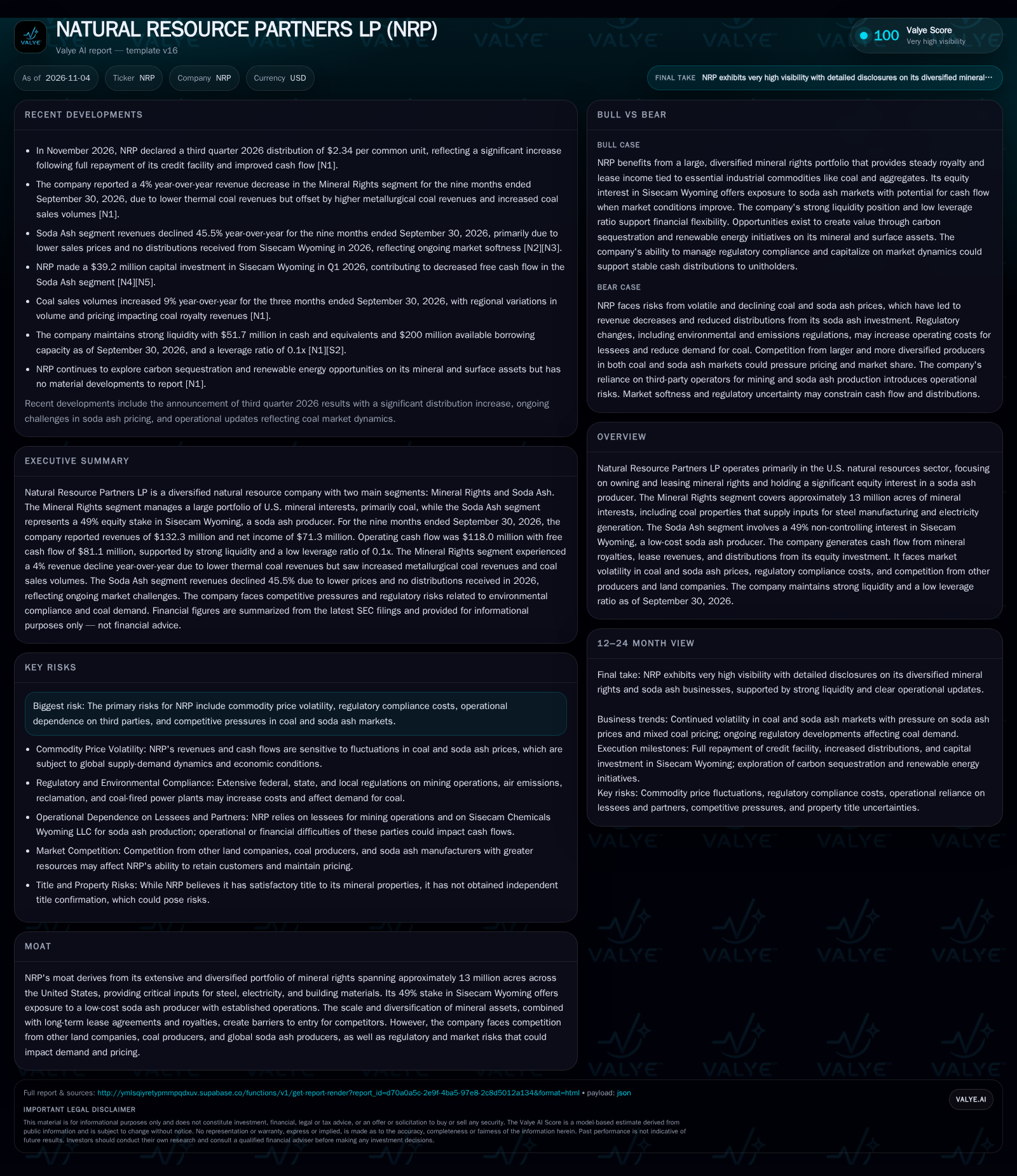
Natural Resource Partners LP’s 2026 results highlight the durability of its mineral rights cash flows, offset by a dramatic downturn in soda ash segment revenues and distributions. Monitoring the recovery of soda ash prices, coal demand, and progress on new asset monetization avenues will be central to the forward thesis. [S2] [N1] [N2] [N3]
Natural Resource Partners LP enters late 2026 at a crossroads: its foundational mineral rights segment continues to deliver steady royalties, even as the business absorbs the full force of a global soda ash slump and ongoing regulatory headwinds in coal. The key question now is whether NRP can leverage its asset base and optionality to offset external pressures—or whether the current environment marks a new baseline for distributable cash.
Diverging Segment Outcomes Define 2026 Financials
NRP’s 2026 results are shaped by sharply contrasting trends between its two core segments. The Mineral Rights business, anchored by approximately 13 million acres of mineral interests, delivered a 3% year-over-year increase in coal royalty revenues for Q3 2026, driven by a 9% rise in coal sales volumes, despite ongoing weakness in thermal coal and minimum lease payments. [S2] [N1] In stark contrast, the Soda Ash segment saw revenues fall 45.5% for the first nine months of 2026, with no distributions from Sisecam Wyoming due to depressed global pricing and oversupply. [S2] [N2] [N3] The company reported $51.7 million in cash and $200 million in available borrowing capacity as of September 30, 2026, and a leverage ratio of just 0.1x. [S2] These liquidity figures provide a snapshot of financial resources but do not, by themselves, establish the company’s operating runway or investment capacity. NRP also made a $39.2 million capital investment into Sisecam Wyoming in Q1 2026, which contributed to a lower free cash flow for the year. [N4] [N5]
How NRP’s Royalty and Equity Model Drives Cash Flow—And Where It Breaks Down
NRP’s economics hinge on two structurally different sources: recurring royalties and lease payments from mineral rights (primarily coal, aggregates, and specialty minerals), and equity distributions from its non-operating stake in Sisecam Wyoming’s soda ash business. The mineral rights model offers high-margin, capital-light cash flows, with operating leverage tied to production and commodity prices but limited direct exposure to mining capex or operational volatility. Pricing is typically set by lease terms and royalty rates, with upside from volume and price increases, and downside from regulatory or demand shocks.
The soda ash equity stake exposes NRP to both global pricing cycles and operating performance at Sisecam Wyoming. While the asset is among the world’s lowest-cost producers, this benefit is muted in periods of global oversupply—such as 2026, when soda ash prices collapsed due to excess Chinese capacity, leading to a complete halt in distributions. [S2] [N2] [N3] The absence of distributions, paired with a $39.2 million capital call, demonstrates the risk that equity investments can become cash drains rather than cash contributors in downcycles.
NRP’s capital needs are low relative to typical resource operators, but episodic investments—such as the recent Sisecam Wyoming capital injection—can temporarily suppress free cash flow.
Asset Scale, Diversification, and the Realities of Commodity Market Competition
NRP’s competitive position is rooted in the scale and geographic diversity of its mineral rights portfolio, which spans multiple basins and commodities, providing a hedge against regional or single-commodity downturns. Fee-simple ownership of mineral rights allows for long-term lease structuring and stable royalty income, creating moderate barriers to entry for new competitors.
However, in both core segments, NRP faces formidable competition: in coal, from larger, vertically integrated mining companies and alternative landowners with scale-driven cost advantages; in soda ash, from global producers in the U.S., Europe, and Asia, with Chinese capacity growth exerting significant downward pressure on prices. [S2] The non-operating nature of NRP’s soda ash interest limits its ability to influence operational outcomes or cost structure at Sisecam Wyoming, creating a structural disadvantage in downturns.
The company’s optionality around carbon sequestration and renewables could, over time, provide a differentiated source of value—but these initiatives remain largely conceptual at present, and the moat is best characterized as asset-based rather than process- or technology-driven.
Unlocking Value Through Commodity Recovery and Asset Monetization
A bullish scenario for NRP requires a stabilization or rebound in global soda ash prices, restoring distributions from Sisecam Wyoming and converting the equity stake back into a cash flow contributor. This could plausibly occur if Chinese capacity additions slow, demand from glass and chemical sectors recovers, or trade barriers restore market balance. A recovery in thermal coal demand—potentially driven by delays in coal plant retirements or regional industrial demand—would further support the royalty base.
On the asset monetization front, successful commercialization of carbon sequestration or renewables projects on NRP’s vast land holdings could provide new, uncorrelated revenue streams. Confirmation of this scenario would require: (1) resumption and growth of soda ash distributions, (2) upward movement in realized coal and soda ash prices, (3) binding agreements or regulatory approvals for carbon/renewables initiatives, and (4) sustained high free cash flow and distributions to unitholders.
Stability Anchored by Mineral Royalties—With Soda Ash Recovery Lagging
The most plausible near-term scenario is one of continued stability in mineral rights cash flows, with modest growth in metallurgical coal and override royalties offsetting ongoing softness in thermal coal and lease minimums. Soda ash distributions are likely to remain minimal until global pricing improves, given current oversupply and weak demand.
This scenario would be confirmed by: (1) steady or slightly rising coal royalty and lease revenues, (2) limited or no soda ash distributions through 2027, (3) stable operating cash flow and free cash flow, and (4) no major capital outlays or asset impairments.
When Both Commodity Cycles Align Adversely
A bearish outcome would emerge if both mineral rights and soda ash segments experience simultaneous, prolonged downturns. Regulatory tightening—such as new EPA emissions rules or accelerated coal plant retirements—could sharply erode coal demand and royalty income, while persistent global soda ash oversupply keeps prices and distributions depressed. Operational disruptions or cost overruns at Sisecam Wyoming could further impair returns from the equity stake.
Evidence for this scenario would include: (1) sequential declines in coal royalty revenues and lease payments, (2) continued absence of soda ash distributions, (3) negative free cash flow or liquidity drawdowns despite a low leverage base, and (4) failure to generate meaningful revenue from new asset classes such as carbon sequestration or renewables.
Tracking the Pivot Points for NRP’s Cash Flow and Asset Value
Magnitude and trend of coal royalty and lease revenues as reported quarterly; a useful metric would be regional mix and realized price per ton if disclosed.
Frequency, amount, and timing of cash distributions received from Sisecam Wyoming; resumption would be a positive inflection.
Total operating and free cash flow generation, especially relative to distribution coverage and capital needs.
Updates on regulatory developments—specifically, new emissions rules or coal plant closures impacting lessee demand.
Progress on carbon sequestration and renewables initiatives, including any binding commercial agreements or regulatory approvals.
Capital allocation decisions, including further investments in Sisecam Wyoming or other non-core assets.
Evidence of asset impairments, lease renegotiations, or title disputes that could affect the underlying value or cash generation potential of the mineral rights portfolio.
Disclaimer: This is research-only, informational analysis and not investment advice. It may include AI-generated interpretation and general industry context. Always verify important details using primary sources.

Comments