
Expeditors International: Strategic Leverage and Margin Strength in a Changing Global Freight Market
Recent performance in air and ocean freight has driven Expeditors International’s earnings above market expectations, but the company’s future hinges on its ability to sustain pricing discipline, adapt to industry cyclicality, and differentiate amid global logistics competition.
Expeditors International delivered strong Q3 earnings, outperforming estimates on the back of robust airfreight and ocean freight operations. However, the sustainability of margin strength and growth depends on navigating industry cyclicality, regulatory shifts, and intense competition.
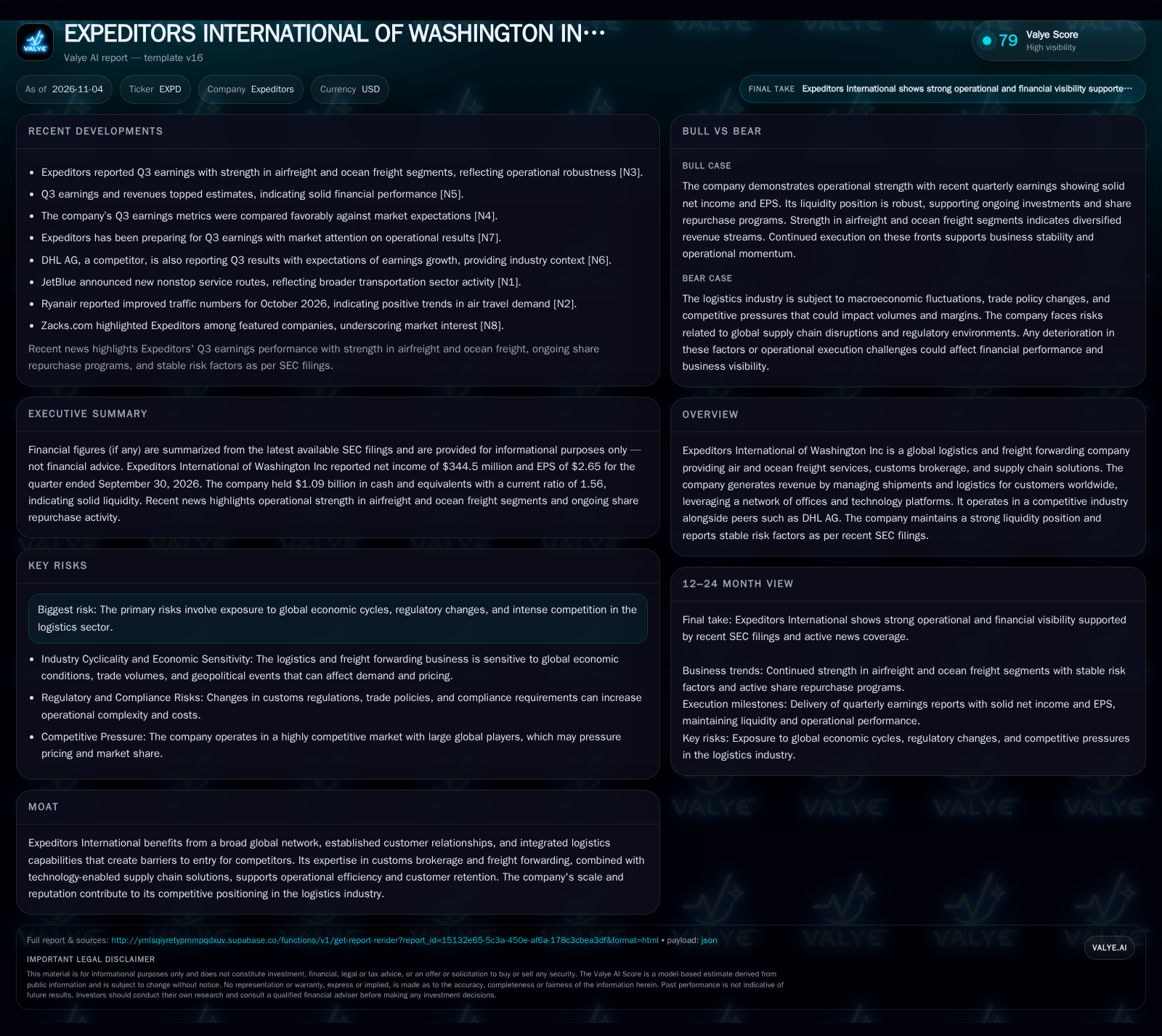
Expeditors International of Washington Inc has once again demonstrated its operational agility, with Q3 2026 results topping earnings and revenue expectations thanks to notable strength in airfreight and ocean freight. The company’s reported liquidity position and ongoing share buybacks highlight financial discipline, yet the logistics landscape remains highly cyclical and fiercely competitive. As global trade flows shift and regulatory demands evolve, Expeditors’ ability to sustain margin performance and leverage its global network will be critical to future value creation.
Strong Earnings Performance and Operational Developments
Expeditors International reported net income of $344.5 million and basic/diluted EPS of $2.65 for the quarter ended September 30, 2026, exceeding market expectations [S2] [N3] [N5]. This outperformance was driven by operational strength in the company’s airfreight and ocean freight segments, which were specifically cited as outperforming in recent news coverage [N3] [N5]. Cash and cash equivalents at quarter-end were approximately $1.09 billion, with a current ratio of 1.56, indicating a reported liquidity position [S2]. The firm continued its share repurchase program during early 2026, returning capital to shareholders [S2]. These facts collectively indicate robust recent performance, but also highlight the importance of segment trends and capital allocation as levers for shareholder value.
How Revenue Trends, Margin Profiles, and Capital Deployment Shape Freight Forwarding
Expeditors generates revenue primarily by managing shipments and logistics for customers globally, with fees linked to the volume and complexity of freight handled. The company’s operating model is asset-light compared to traditional carriers, relying on third-party providers for air and ocean transport while focusing on value-added services like customs brokerage, cargo insurance, and supply chain visibility.
Pricing in freight forwarding is highly variable, influenced by global trade volumes, carrier capacity, and customer urgency. During periods of tight capacity—such as post-pandemic or when supply chains are disrupted—forwarders like Expeditors can command higher margins on both air and ocean shipments. Conversely, oversupply or muted demand compresses pricing power and exposes operators to margin risk.
Fixed costs are relatively low, with variable costs scaling with shipment volumes. This structure confers operating leverage: incremental revenue growth can translate into disproportionate improvements in profitability when volumes rise. However, this also means margins are vulnerable when volumes contract.
The company’s ongoing share repurchases reflect a disciplined approach to capital allocation, suggesting management confidence in cash generation and limited near-term need for large-scale capital investment. The company reported cash and liquidity metrics for the period; these figures do not by themselves establish operating runway, investment capacity, financial flexibility, or financing capacity.
Maintaining Market Position in a Complex and Global Logistics Landscape
Expeditors competes with global freight forwarders such as DHL Global Forwarding, Kuehne + Nagel, and DB Schenker, as well as regional and niche logistics providers. Its competitive positioning relies on an extensive global office network, integrated technology platforms for shipment management, and deep expertise in customs brokerage and regulatory compliance.
Barriers to entry in global forwarding stem from scale, customer relationships, and the complexity of cross-border logistics. However, switching costs for customers are relatively low, as freight services are often bid out and service differentiation can be limited outside of technology, reliability, and value-added offerings. The widespread adoption of digital freight platforms and increasing customer expectations for real-time visibility are gradually eroding traditional relationship-based moats.
Expeditors’ reputation for reliability and its breadth of services provide some insulation from pure price competition, but the risk of technology-driven disruption and margin compression remains. The company’s ability to invest in automation, digital customer interfaces, and data-driven supply chain optimization will shape its long-term competitive resilience.
Network Scale and Technology as Engines for Growth Amid Freight Fluctuations
A favorable scenario would see Expeditors capitalizing on ongoing volatility in global freight markets—whether due to geopolitical disruptions, supply chain reshoring, or capacity constraints. If air and ocean freight rates remain elevated or spike intermittently, the company’s asset-light model could convert incremental revenues into higher operating margins, especially if it continues to outperform on service reliability and speed.
Successful investment in digital platforms and supply chain visibility tools could further differentiate Expeditors, allowing it to win higher-value contracts from multinational customers seeking integrated, tech-enabled logistics solutions. Ongoing share repurchases would amplify per-share value creation.
Evidence supporting this scenario would include sustained outperformance in segment margins relative to peers, new customer wins in strategic verticals, and continued above-market EPS growth. Confirmation would come from disclosures of increased contract wins tied to technology adoption, or from management commentary on pricing power in volatile freight markets.
Performance Outlook in a Stabilizing Freight Market
The most plausible trajectory is for Expeditors to maintain stable but unspectacular growth as global trade volumes normalize post-pandemic. Air and ocean freight rates may gradually revert toward long-term averages, compressing margins from recent peaks but still supporting profitability through operational discipline.
The company’s global network and established customer base would enable it to retain core volumes, even as competition intensifies and pricing pressure increases. Technology investments may improve efficiency and customer retention, but are unlikely to fully offset macro-driven headwinds.
Confirmation of this scenario would be ongoing delivery of solid, though not exceptional, quarterly earnings and cash flows, stable or modestly improving margins, and continued capital returns via share repurchases. Falsifying evidence would include a sudden drop in segment profitability or significant customer defections.
Risks of Margin Erosion and Volume Reduction from Economic or Competitive Pressures
A negative scenario could unfold if global economic growth slows, trade tensions escalate, or new regulatory barriers disrupt cross-border flows. In this case, both air and ocean freight volumes would contract, and excess capacity could drive rates—and thus margins—sharply lower.
Rising competition from digital-forwarders or aggressive pricing by larger peers could further erode Expeditors’ share or force margin concessions. If the company fails to keep pace with technology-driven service expectations or operational efficiency, it risks losing relevance with enterprise customers.
Evidence supporting this scenario would include a marked decline in segment revenues, a squeeze on operating margins, or management guidance signaling weaker volumes ahead. Additional warning signs could be increased customer churn or negative revisions to revenue outlooks.
Criteria for Assessing Expeditors’ Margin Stability and Strategic Execution
Quarterly segment margin trends in airfreight and ocean freight, as disclosed, to assess pricing power and cost discipline.
Volume growth or contraction by segment, particularly in response to global trade or supply chain shocks, if disclosed.
Rate of share repurchases and management commentary on capital allocation priorities, which would signal confidence and capital flexibility.
Investment in digital platforms and automation—disclosures or commentary on technology spend and customer adoption would help gauge competitive positioning.
Customer retention rates or new contract wins, if disclosed, to test the durability of Expeditors’ network advantage.
Comparative analysis of operating margins and revenue growth versus global peers, as reported in industry surveys or filings.
Any changes in regulatory risk disclosures or commentary on customs/trade policy, which could signal future cost or compliance headwinds.
Management guidance on near-term demand outlook and freight rate expectations, to triangulate short-term risk and opportunity.
Disclaimer: This is research-only, informational analysis and not investment advice. It may include AI-generated interpretation and general industry context. Always verify important details using primary sources.

Comments