
Mosaic’s Fertilizer Profit Model: Navigating Input Cost Shocks and Geopolitical Supply Risks in 2026
Mosaic Co’s 2026 operating results reveal the impact of volatile input costs, global supply chain disruptions, and the challenges of managing a commodity-based fertilizer business. With phosphate production guidance withdrawn and leadership in transition, the company’s path forward depends on cost control, operational resilience, and its ability to defend margins in a turbulent market.
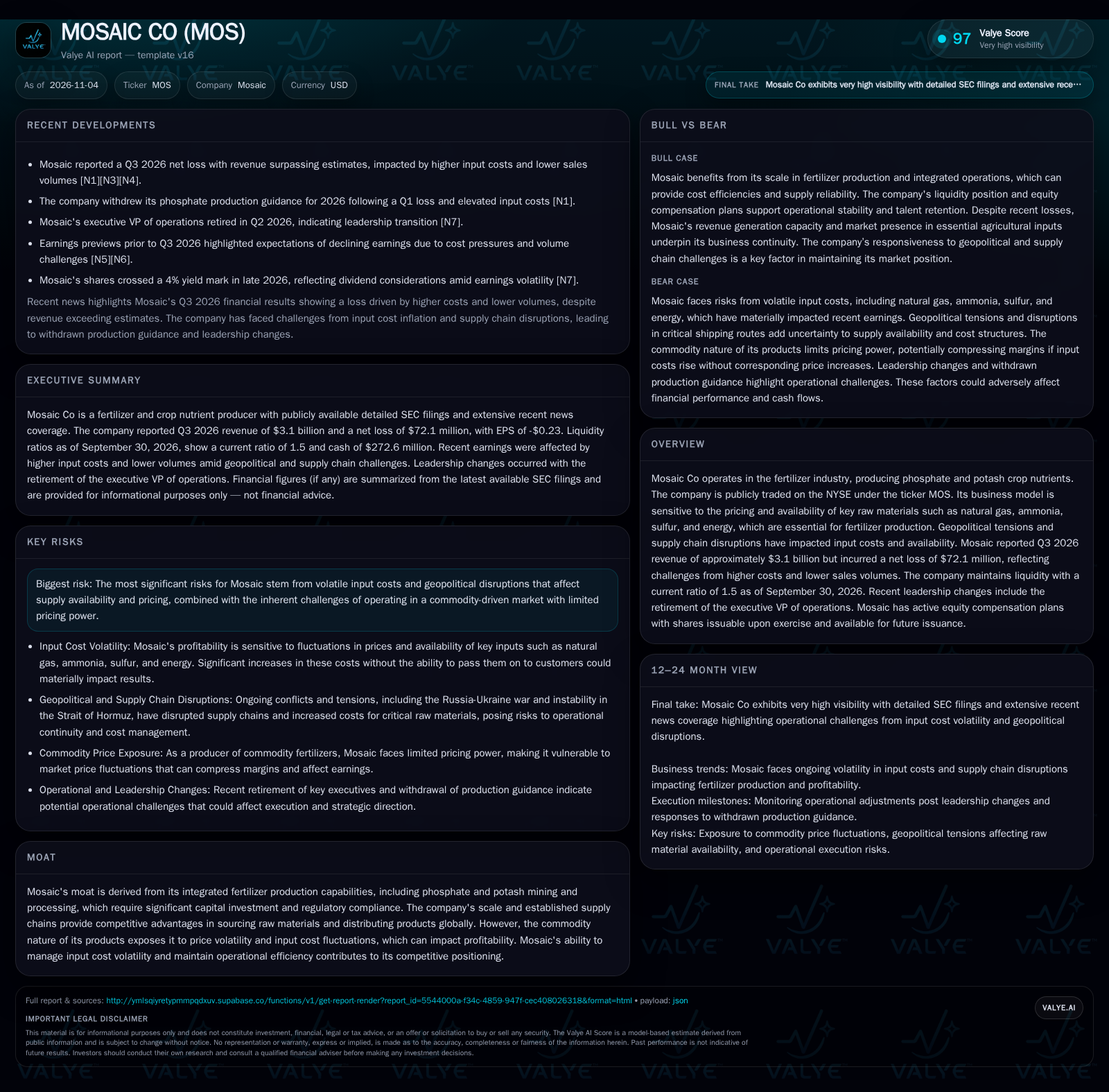
Mosaic posted a Q3 2026 net loss of $72.1 million on $3.1 billion in revenue, as rising input costs and lower volumes pressured margins. The company withdrew its phosphate production guidance for the year and saw executive leadership changes. With a current ratio of 1.5 and $272.6 million in cash, Mosaic’s near-term focus is likely on operational adjustments and navigating ongoing supply and pricing volatility. The key question is whether Mosaic can stabilize costs and production to restore profitability in a market shaped by commodity price swings and geopolitical risks. [S2] [N1]
Mosaic Co’s 2026 trajectory underscores the difficulties facing global fertilizer producers: surging input costs, unpredictable supply chains, and the unforgiving economics of commodity markets. The company’s Q3 net loss and withdrawn phosphate production guidance point to a business under pressure, forced to adapt rapidly to shifting market and geopolitical realities. As Mosaic works through leadership changes and cost headwinds, its ability to stabilize operations and defend margins will determine whether it can regain profitability—or remain exposed to the volatile swings that define the sector.
Recent Losses, Withdrawn Guidance, and Leadership Change Define 2026 Mosaic Landscape
Mosaic reported a net loss of $72.1 million in Q3 2026 on $3.1 billion in revenue, illustrating the impact of elevated input costs and weaker sales volumes on profitability. The withdrawal of phosphate production guidance for the year further signals significant operational and market uncertainty, particularly following a Q1 loss and ongoing cost pressures. Compounding these financial and operational headwinds is the retirement of the executive VP of operations in Q2 2026, leaving Mosaic to manage transition risk at a critical juncture. [S2] [N1] [N7]
How Mosaic’s Profit Engine Is Squeezed: Input Price Exposure and Commodity Margin Dynamics
Mosaic’s core business is the production and sale of phosphate and potash fertilizers—classic commodities with prices set by global supply and demand, not by Mosaic itself. The company’s economics hinge on the spread between the sale price of these fertilizers and the cost of key inputs: natural gas, ammonia, sulfur, and energy. When input costs spike and fertilizer prices do not keep pace, gross margins compress rapidly. Recent periods of volatility have highlighted just how sensitive Mosaic’s earnings are to these cost swings.
The fixed-cost base—mines, processing plants, logistics infrastructure—means that volume leverage is crucial. Lower volumes, as seen in 2026, undermine operating leverage, while higher input costs cannot always be passed through to customers in a timely manner. Mosaic’s capital requirements remain substantial, from sustaining mining operations to environmental compliance and working capital for raw material procurement. The absence of share repurchases in Q3 2026 further suggests that capital allocation is being prioritized for liquidity and operational needs rather than returns to shareholders. [S2]
In this environment, cost discipline, supply chain agility, and the ability to modulate production in response to market signals are critical. Any sustained divergence between input cost inflation and fertilizer price realization threatens profitability and cash flow.
Competitive Advantages and Limits: Scale, Integration, and the Realities of the Commodity Game
Mosaic’s competitive position stems from its integrated mining and processing operations, global distribution reach, and scale in both phosphate and potash. These factors can provide cost advantages over smaller or less integrated peers, as well as some resilience in sourcing and logistics. However, the commodity nature of fertilizer products means that even the largest players have limited pricing power: global market prices, not company strategy, set the revenue ceiling.
The company’s moat is rooted in the capital intensity and regulatory burden of large-scale fertilizer production, which deters new entrants. However, Mosaic faces competition from global producers in Canada, Russia, China, and the Middle East, many of whom also benefit from scale and government support. Substitutes for chemical fertilizers—such as organic or specialty crop nutrients—have not displaced commodity fertilizers at scale, but could incrementally erode demand if adoption accelerates.
Ultimately, Mosaic’s ability to sustain margin depends less on absolute size than on cost position relative to global peers, operating efficiency, and agility in managing input supply disruptions.
Margin Recovery If Input Costs Ease or Fertilizer Prices Rebound
A favorable scenario for Mosaic would see input costs normalize or decline—perhaps as global energy markets stabilize or supply chains recover from geopolitical shocks—while fertilizer demand remains robust due to agricultural fundamentals. In this environment, Mosaic’s operating leverage could work in its favor: fixed costs would be spread across higher volumes, and gross margins would recover as the spread between product prices and input costs widens.
Confirmation of this scenario would come through a return to positive net income, improved gross margin percentage, and the reinstatement of production guidance. Additional signs would include management commentary on cost improvements, stabilization or reduction in raw material expenses, and any resumption of share repurchases or increased capital returns. Evidence that global fertilizer prices are firming, or that Mosaic is regaining market share in key regions, would further support the upside thesis.
Operating in a Volatile Equilibrium: Cost Pressures and Margin Compression Persist
The most plausible near-term trajectory for Mosaic is continued exposure to volatile input costs and commodity price swings, with profitability remaining under pressure but not collapsing. The company may be forced to operate with tight margins, making incremental operational adjustments—such as modulating production, renegotiating supply contracts, or seeking efficiency gains—to partially offset cost headwinds.
Absent a major easing of input costs or a sharp increase in fertilizer prices, Mosaic’s earnings may remain weak, with the possibility of periodic losses. This scenario would be confirmed by further cautious management guidance, continued suspension of production outlooks, and limited capital returns. If Mosaic’s liquidity position remains stable but does not improve, and if operational execution remains challenged amid leadership transitions, this would reinforce the base case.
Prolonged Margin Squeeze and Strategic Drift from Sustained Cost Inflation
A more adverse scenario would see input costs remain elevated or rise further due to entrenched geopolitical disruptions, energy market instability, or supply chain bottlenecks. If global fertilizer prices fail to keep pace, Mosaic’s margins could erode further, leading to extended periods of net losses and potential cash flow strain. Operational missteps—amplified by leadership transitions—could exacerbate the situation, resulting in production inefficiencies or loss of market share.
Signs confirming this scenario would include deepening net losses, further reductions in production or guidance withdrawals, negative free cash flow, or the need to raise capital through debt or equity issuance. Any evidence of inability to secure key raw materials, significant write-downs, or asset impairments would also point toward the downside case.
What Will Determine Mosaic’s Resilience in 2027 and Beyond?
Gross margin percentage trend, especially relative to prior quarters and historical averages, as a direct measure of input cost pass-through and operational efficiency.
Updates on phosphate and potash production volumes, including any reinstatement of guidance or commentary on capacity utilization.
Management’s commentary on input cost trends for natural gas, ammonia, sulfur, and energy, and any evidence of supply contract renegotiation.
Evidence of resumed share repurchases or increased dividends, which could signal renewed confidence in operating stability.
Progress on leadership transition, including the appointment of a new executive VP of operations or other senior operational hires.
Market share or pricing data in key regional markets, if disclosed, to assess competitive position and demand resilience.
Any material supply chain disruptions or geopolitical developments that impact raw material availability or cost structure.
Disclaimer: This is research-only, informational analysis and not investment advice. It may include AI-generated interpretation and general industry context. Always verify important details using primary sources.

Comments