
Aprea Therapeutics: Advancing Synthetic Lethality with Clinical Milestones and Oncology Innovation
The company’s next phase hinges on translating early biomarker-driven efficacy into broader clinical validation and navigating the complexities of combination therapy development.
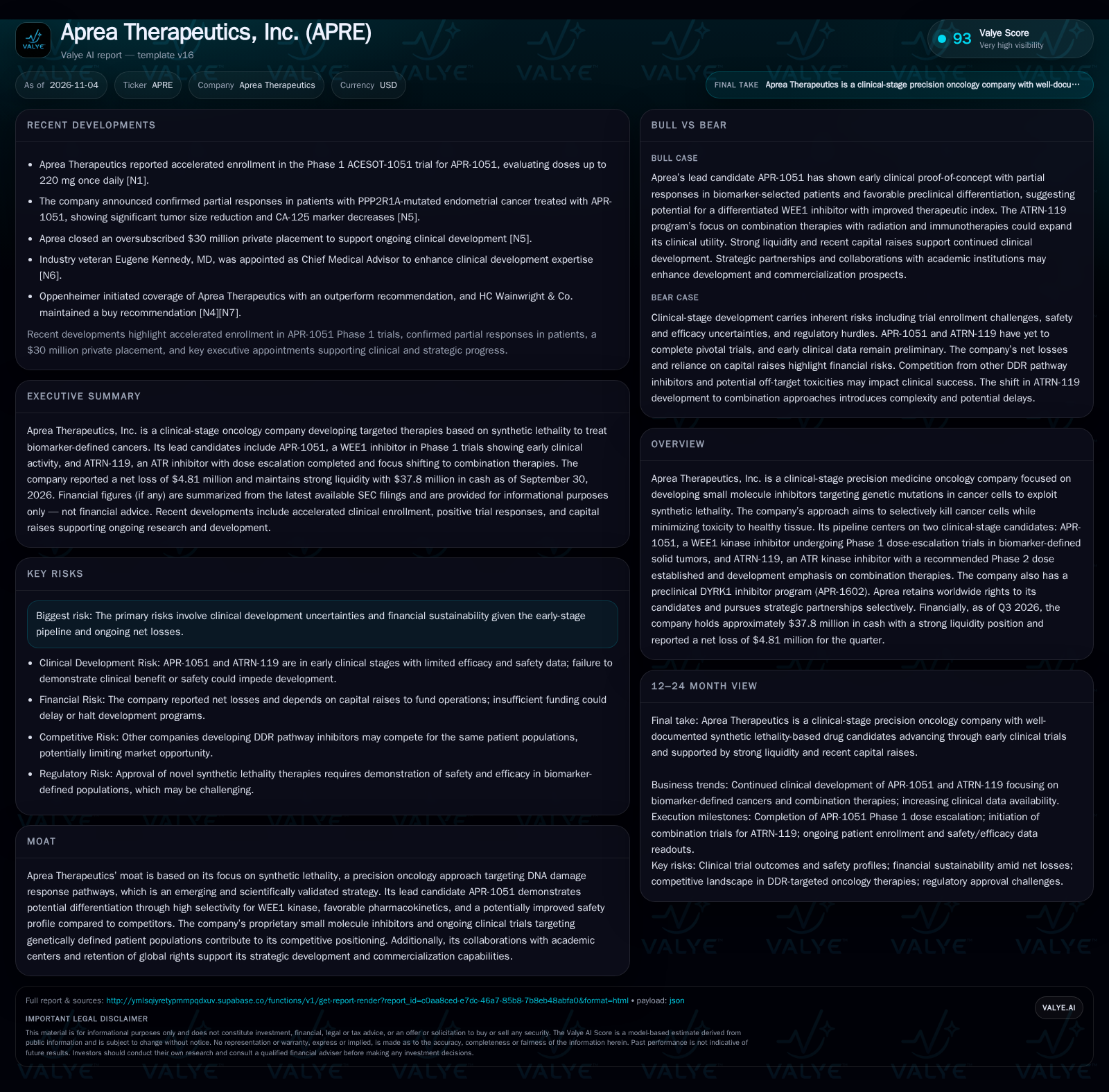
Aprea Therapeutics’ lead asset APR-1051, a WEE1 kinase inhibitor, has demonstrated early signs of clinical activity in biomarker-defined endometrial cancer, while its ATRN-119 ATR inhibitor program pivots to combination therapy. With $37.8M in cash and recent capital raised, Aprea is positioned to progress its pipeline but must overcome the inherent risks of early-stage oncology development and prove durable efficacy in competitive DNA damage response markets. Watch for confirmation of clinical benefit, safety profile differentiation, and strategic partnering activity as key inflection points. [S1] [S2] [N1] [N5]
Aprea Therapeutics is at a pivotal juncture as a clinical-stage precision oncology company leveraging synthetic lethality to target biomarker-defined cancers. With its WEE1 inhibitor APR-1051 showing preliminary clinical responses and its ATRN-119 ATR inhibitor program moving into combination therapy, Aprea’s pipeline is supported by a reported liquidity position base and recent capital infusion. The company’s next stage of value creation depends on translating promising early data into robust, differentiated clinical outcomes—while navigating the competitive and financial challenges inherent to early oncology innovation. The coming quarters will test Aprea’s ability to validate its scientific approach and position its assets for advancement or partnership.
Recent Clinical and Financial Developments Guide Aprea’s Short-Term Outlook
As of September 30, 2026, Aprea Therapeutics reported cash and equivalents of approximately $37.8 million, bolstered by a recently closed $30 million private placement [S2] [N5]. This liquidity positions the company to sustain its ongoing clinical efforts. The lead asset, APR-1051, a WEE1 kinase inhibitor, is actively enrolling patients in a Phase 1 dose-escalation trial, with cohort 8 (220 mg) currently underway [S1] [N1]. Importantly, early clinical data show confirmed partial responses—including significant tumor reduction and CA-125 marker decreases—in patients with PPP2R1A-mutated endometrial cancer [N5]. Meanwhile, ATRN-119, an ATR kinase inhibitor, has completed dose escalation and is now being positioned for combination therapy development, with monotherapy enrollment paused [S1]. The appointment of a chief medical advisor with deep oncology experience and positive analyst coverage further signal external validation and clinical development momentum [N4] [N6].
Value Generation through Synthetic Lethality and Pipeline Economics
Aprea Therapeutics’ business model is built on the development and potential commercialization of precision oncology therapies targeting DNA damage response (DDR) pathways. The economics of such a model depend on advancing candidates through costly and high-risk clinical trials, with value inflection typically occurring at proof-of-concept or pivotal data readouts. The company’s current net loss of $4.81 million for the quarter reflects the capital-intensive nature of early-stage R&D and clinical operations [S2].
If successful, synthetic lethality drugs can command premium pricing, particularly in biomarker-defined populations with high unmet need. However, commercial realization is contingent on demonstrating both meaningful efficacy and a differentiated safety profile—especially as payers scrutinize incremental benefit relative to existing standards of care and competing DDR pathway inhibitors. Fixed costs are dominated by R&D and clinical operations, with variable costs rising upon commercialization through manufacturing and marketing. Aprea’s retention of global development and commercialization rights gives it strategic flexibility, but also implies high capital requirements absent a partnership. The company reported cash and liquidity metrics for the period; these figures do not by themselves establish operating runway, investment capacity, financial flexibility, or financing capacity.
Standing Out within the Competitive DDR Inhibitor Field
Aprea operates in a highly competitive precision oncology space, particularly within the synthetic lethality and DDR inhibitor segments. Competitor categories include established PARP, ATR, and WEE1 inhibitor developers, many of which are larger companies with late-stage or approved assets. The central challenge is demonstrating a clinically meaningful advantage—either through improved efficacy in biomarker-selected patients, a superior safety profile, or greater combinatorial utility.
APR-1051’s high selectivity for WEE1 (over PLK kinases) and its favorable early safety profile—including a lower likelihood of QT prolongation—may offer a basis for differentiation if these findings persist in larger trials [S1]. For ATRN-119, the pivot to combination therapy reflects a recognition that monotherapy efficacy may be limited, but also introduces complexity and execution risk. Intellectual property protection and first-mover advantage in niche biomarker populations may create some initial barriers, but these are eroded if competitors demonstrate broader or more robust clinical results. Ultimately, Aprea’s competitive position will hinge on the strength and durability of its clinical data and its ability to align with evolving standards of care.
Early Clinical Data as a Foundation for Platform Validation
The most favorable scenario for Aprea involves APR-1051 and ATRN-119 delivering robust clinical benefit and safety in biomarker-defined populations, leading to accelerated advancement through the clinic and potentially attracting lucrative strategic partnerships or acquisition interest. The early partial responses and tumor marker reductions in PPP2R1A-mutated endometrial cancer provide a potential proof-of-concept [N5], but the key will be reproducing these outcomes in larger, more diverse cohorts.
Further upside could come from positive combination data with ATRN-119, especially if synergy with immunotherapies or radiation is demonstrated. Evidence that would confirm this scenario includes sustained high response rates, durable progression-free survival, a differentiated safety profile versus existing WEE1 or ATR inhibitors, and public disclosure of major partnership or licensing deals. Rapid enrollment and positive analyst coverage may further validate the approach. Falsification would occur if subsequent data fail to confirm early efficacy, if safety issues emerge, or if the competitive landscape shifts rapidly with superior alternatives.
Clinical Advances Tempered by Execution and Financing Hurdles
The most plausible near-term path for Aprea is continued, but measured, clinical progress. APR-1051 is likely to complete its Phase 1 dose escalation, with additional data clarifying the reproducibility and durability of early signals. ATRN-119 may enter early-stage combination trials, but timelines and outcomes may be extended due to the complexities of combination development and patient recruitment.
Confirmation would be incremental expansion of clinical activity—such as additional partial responses or disease stabilization—and continued absence of severe safety events. Falsification would be signaled by slow enrollment, inconclusive or negative efficacy data, or an inability to secure further capital or strategic interest.
Risks from Trial Challenges, Funding Shortfalls, and Market Competition
The adverse scenario centers on failure to confirm early clinical signals or emergence of safety concerns that limit dose escalation or patient recruitment. In this case, APR-1051’s initial responses may not translate into broader efficacy, or off-target toxicities could emerge at higher doses. ATRN-119 monotherapy has already been paused; if combination regimens fail to deliver additive benefit or introduce new tolerability issues, the program could stall.
Financially, persistent net losses and high burn rates, coupled with an inability to raise additional capital, could force program delays, asset out-licensing on unfavorable terms, or even a strategic review. The competitive environment—if other DDR inhibitors demonstrate superior data—could further erode Aprea’s prospects. Confirmation of this scenario would come from negative data releases, clinical holds, or disclosure of workforce reductions or halted studies. Falsification would require clear evidence of trial progress, new capital raised, or strategic partnerships that extend the company’s runway.
Factors Shaping Aprea’s Progress and Market Position
The pace and outcome of APR-1051 Phase 1 dose-escalation, including number and durability of confirmed responses, especially in PPP2R1A-mutated populations.
Additional clinical data on APR-1051’s safety profile, including absence or presence of dose-limiting toxicities and QT prolongation events.
Initiation and early outcomes of ATRN-119 combination therapy trials, with particular attention to synergistic efficacy and combinatorial safety (if disclosed).
Quarterly cash burn rates and updated liquidity projections, especially if pivoting to larger or later-stage trials.
Announcements of strategic partnerships, licensing deals, or non-dilutive funding that could offset future capital needs.
Recruitment rates and trial enrollment metrics, as slow accrual could signal market or clinical challenges (if disclosed).
Regulatory milestones, such as IND clearances or fast track designations, which could accelerate development and signal agency endorsement.
Disclaimer: This is research-only, informational analysis and not investment advice. It may include AI-generated interpretation and general industry context. Always verify important details using primary sources.

Comments