
Bankwell Financial Group: Urban Expansion, Profitability, and the Stakes of Regional Banking Scale
Bankwell Financial Group enters late 2026 with solid profitability, a reported liquidity position, and a deliberate push into Brooklyn’s urban banking market. The company’s challenge now is whether its regional banking model can achieve durable growth and margin resilience amid competitive and regulatory headwinds.
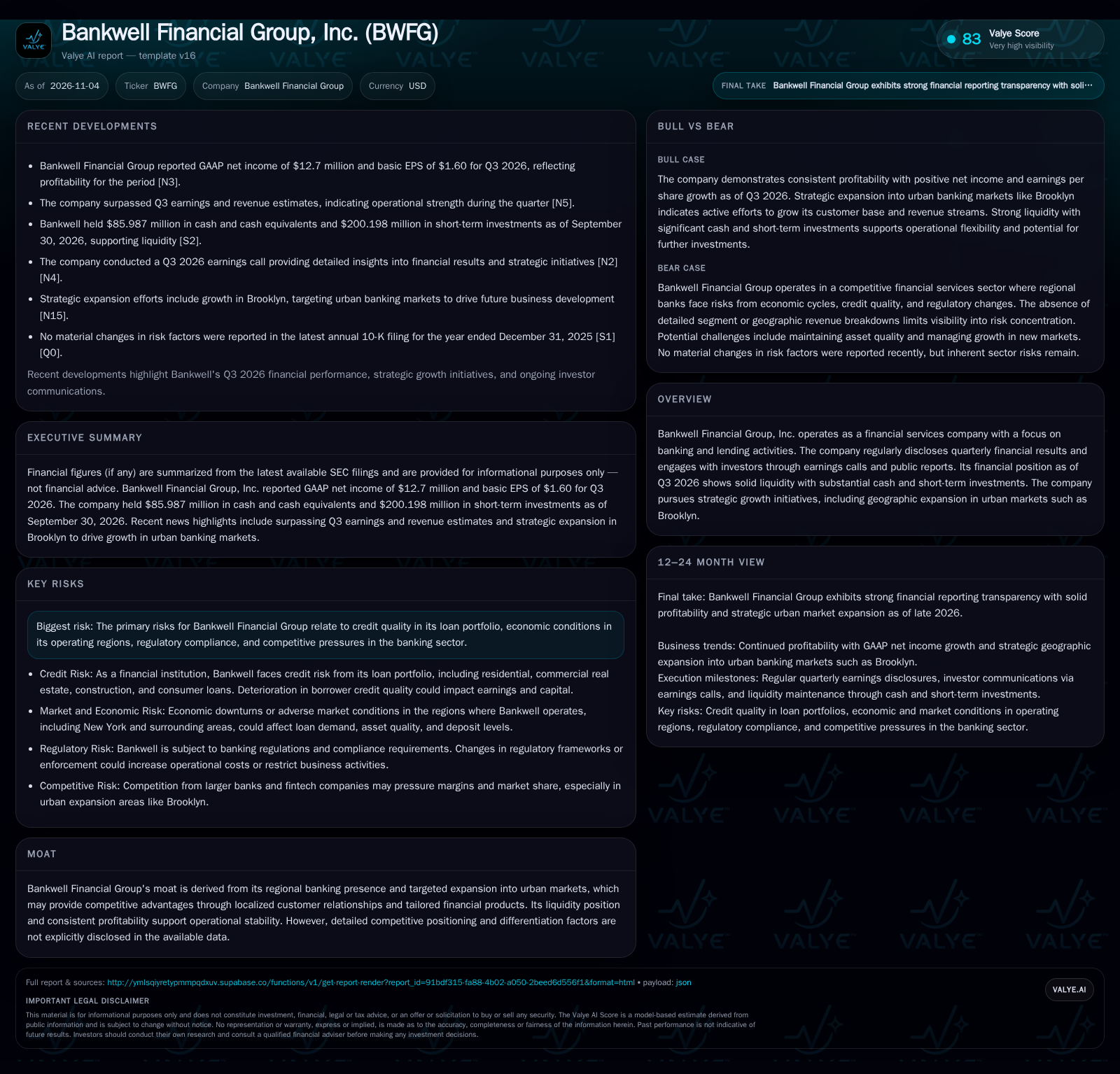
Bankwell Financial Group reported Q3 2026 GAAP net income of $12.7 million, with basic EPS of $1.60 and a combined $286 million in cash and short-term investments. The company is pursuing strategic growth in Brooklyn to tap urban banking opportunities. Its outlook depends on successfully scaling in new markets while managing credit quality and competitive pressures in a maturing regional banking landscape. [S2] [N3] [N5]
Bankwell Financial Group’s late-2026 operating profile is defined by solid profitability and robust liquid resources, positioning the company for strategic moves in a competitive regional banking market. Its recent expansion into Brooklyn marks a shift toward urban customer acquisition and growth beyond its legacy suburban and exurban footprint. The company’s future trajectory hinges on whether this urban push can deliver sustainable volume, margin, and competitive differentiation without elevating credit or execution risk. With sector-wide pressures from digital entrants and regulatory scrutiny, Bankwell’s next phase will test both its adaptability and its ability to leverage a reported balance sheet position for disciplined growth.
Profitability, Liquidity, and Urban Strategy Define the 2026 Snapshot
Bankwell Financial Group reported GAAP net income of $12.7 million in Q3 2026, translating to basic earnings per share of $1.60 and diluted EPS of $1.58 [S2] [N3]. This level of profitability, paired with $85.987 million in cash and cash equivalents and $200.198 million in short-term investments on the balance sheet as of September 30, 2026, underscores the company’s potential financial flexibility [S2]. Operationally, Bankwell’s expansion into Brooklyn signals a deliberate pivot toward urban markets, aiming to diversify and grow its customer base beyond traditional geographies. Notably, there were no material changes in risk factors disclosed in the most recent 10-K, indicating a steady risk profile at this stage [S1]. Together, these elements set the stage for a business model that seeks growth through both core profitability and targeted geographic bets.
How Bankwell Earns: Spread Lending, Deposit Mix, and Urban Growth Leverage
Like most regional banks, Bankwell’s core economics hinge on net interest income—earning the spread between loan yields and funding costs. Profitability is sensitive to the volume, mix, and pricing of loans (commercial, real estate, construction, consumer) versus the cost and stability of deposits. Urban expansion, such as the Brooklyn initiative, could bring higher deposit volumes and more diversified customer relationships, but may also entail higher acquisition costs and competitive pricing pressure. Fee income from ancillary services can enhance returns but typically remains a smaller share for banks of Bankwell’s scale.
Operating leverage in this model comes from spreading fixed infrastructure and regulatory costs over a larger deposit and loan base. Successful entry into new urban markets could allow Bankwell to grow assets faster than expenses—if it achieves sufficient scale and customer stickiness. Conversely, rapid expansion could raise credit risk or dilute underwriting standards if not carefully managed. Capital needs are relatively modest in the absence of large-scale acquisitions, with retained earnings and existing liquidity supporting organic growth. However, regulatory capital requirements and stress testing will set hard limits on growth pace, especially if loan concentration or asset quality metrics deteriorate.
Urban Expansion Tests Regional Bank Differentiation
Bankwell’s move into Brooklyn places it in direct competition with both large national banks and agile fintechs, in addition to established regional and community banks. The urban banking market offers attractive deposit and lending opportunities, but customer acquisition is costly and price-sensitive. Large incumbents typically have scale advantages in technology, marketing, and compliance, while digital banks can undercut on fees and deliver superior digital experiences.
Bankwell’s potential edge lies in localized relationship banking—tailoring services to the needs of small businesses and urban professionals underserved by larger players. However, the durability of this advantage depends on the company’s ability to establish brand trust and deliver differentiated service in dense, competitive markets. Switching costs in banking are low for transactional accounts but higher for business lending and complex financial relationships, suggesting that initial customer wins must be followed by cross-selling and retention strategies to build lasting value.
If Urban Growth Delivers: Margin Expansion and Franchise Value Creation
A favorable outcome would see Bankwell’s Brooklyn expansion rapidly attracting new deposits and lending opportunities, leveraging its liquidity and relationship-banking approach to win share from less nimble incumbents. If the company can scale efficiently, operating leverage would drive margin expansion as fixed costs are spread over a larger asset base. Cross-selling of treasury, wealth management, and business services could supplement core lending income, deepening customer relationships and improving retention.
Evidence supporting this scenario would include accelerating deposit and loan growth in the Brooklyn market, rising non-interest income, stable or improving net interest margin, and credit quality metrics holding steady or improving despite portfolio growth. Confirmation would also come from management commentary on customer acquisition costs, cross-sell rates, and early signs of outsized share gains in targeted urban segments.
Incremental Asset Growth, Stable Margins, and Disciplined Risk Management
The most plausible trajectory for Bankwell is one of steady, incremental growth as the company works to establish its presence in Brooklyn while maintaining its core suburban and exurban franchise. Asset and deposit growth are likely to track market averages, with modest improvements in scale offset by ongoing investment in talent, compliance, and technology to support new market entry. Net interest margin may see only limited upside given competitive pressures and rising funding costs in urban markets.
This scenario would be confirmed by continued profitability in line with recent quarters, stable credit quality, slow but positive growth in loans and deposits, and management commentary indicating a measured approach to urban expansion. Evidence against this scenario would include a sharp increase in non-performing assets, outsized expense growth relative to revenue, or an inability to attract new customers in Brooklyn at target acquisition costs.
Urban Expansion Falters: Margin Compression and Credit Deterioration
The principal risk is that Bankwell’s urban expansion fails to achieve critical mass, leading to elevated customer acquisition costs, competitive pricing concessions, and subpar deposit growth. If underwriting standards are relaxed to gain volume, credit losses could rise, eroding profitability and potentially triggering regulatory scrutiny. Intensifying competition from larger banks and fintechs could compress net interest margins and force higher promotional spending.
This adverse scenario would manifest in rising non-performing loans, declining net interest margin, elevated expense ratios, and negative operating leverage. Early warning signs would include higher charge-off rates, a spike in loan loss provisions, management guidance cuts, or evidence of customer attrition in legacy markets as resources are diverted to the urban push.
Milestones That Will Determine Whether Bankwell’s Urban Bet Pays Off
Quarterly loan and deposit growth in Brooklyn and other targeted urban markets—if disclosed, this would directly measure the traction of the expansion strategy.
Net interest margin trends, especially in the context of funding cost pressures and competitive pricing in urban geographies.
Non-performing asset and charge-off rates, with attention to whether credit quality is sustained as the loan book grows.
Expense growth versus revenue growth, as operating leverage will be a key indicator of the scalability of new market entries.
Customer acquisition cost and retention rates in Brooklyn and other expansion areas—if disclosed, these would clarify the efficiency and stickiness of new relationships.
Regulatory capital ratios and any commentary on capital adequacy, especially if loan growth accelerates.
Management commentary and strategic updates on the pace, cost, and competitive dynamics of the Brooklyn initiative.
Disclaimer: This is research-only, informational analysis and not investment advice. It may include AI-generated interpretation and general industry context. Always verify important details using primary sources.

Comments