
Intrepid Potash Refocuses on Core Fertilizer Strengths as Specialty Demand and U.S. Sourcing Advantages Deepen
The only U.S.-based potash producer, Intrepid Potash is sharpening its focus on core fertilizer operations after divesting its oilfield solutions segment. Recent gains in potash and specialty fertilizer pricing, reported liquidity position, and a $139 million USDA grant for a new sulfate of potash project position the company for potential margin expansion—but durability will depend on weather-driven agricultural demand, regulatory landscape, and the pace of specialty product adoption.
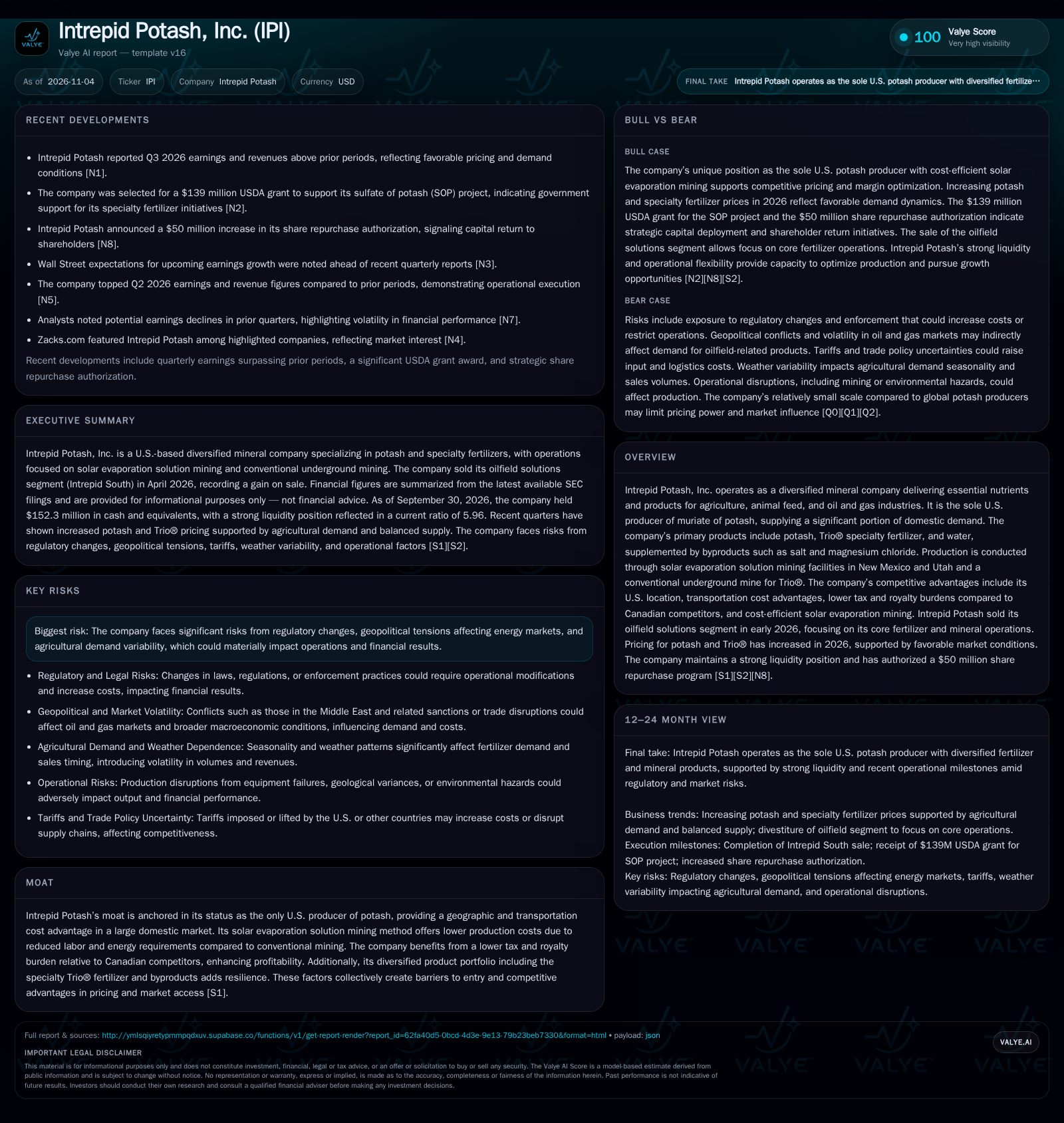
Intrepid Potash, Inc. has reinforced its position as the sole U.S. potash producer by focusing on core fertilizer segments and divesting its oilfield solutions business in early 2026. Recent quarters saw higher realized prices for both potash and Trio® specialty fertilizer, supported by healthy demand and stable volumes. However, future outcomes remain tethered to volatile agricultural demand, weather patterns, and potential regulatory or supply-chain disruptions.
Intrepid Potash, Inc. stands at a pivotal juncture as it consolidates its identity as the only domestic supplier of muriate of potash and amplifies its commitment to specialty fertilizers. By divesting its oilfield solutions segment, the company is doubling down on its core competencies just as agricultural markets reward higher pricing for both traditional and specialty products. With a robust balance sheet and new government backing for its sulfate of potash ambitions, Intrepid is better positioned to navigate the cyclical and weather-sensitive fertilizer market—but its long-term trajectory will hinge on continued demand strength, operational resilience, and the evolving regulatory environment.
Recent Strategic Moves and Financial Markers Define Intrepid’s New Chapter
Intrepid Potash’s operational and financial profile has shifted meaningfully in 2026. The company divested its oilfield solutions segment (Intrepid South) in April for $68.9 million, recording a $13.3 million gain and allowing for a singular focus on fertilizer and mineral products [S2]. As of September 30, 2026, Intrepid reported $152.3 million in cash, a current ratio of 5.96, and net income of $1.732 million for the first nine months of the year [S2]. Potash and Trio® prices increased year-over-year, while byproduct sales fell due to mild winter conditions [S2]. The company also secured a $139 million USDA grant for its sulfate of potash (SOP) project, underpinning a strategic push into higher-value specialty fertilizers [N2]. A $50 million expansion of the share repurchase authorization further signals a willingness to return capital to shareholders [N8].
How Intrepid Monetizes Potash and Specialty Fertilizers in a Volatile Market
Intrepid’s principal revenue drivers are sales of potash and Trio®, which together accounted for 87% of 2025 sales (potash 39%, Trio® 48%) [S1]. Potash is supplied mainly to U.S. agricultural, animal feed, and industrial markets, with pricing that is sensitive to crop prices, planting decisions, and global supply-demand balances. The company’s solar evaporation mining method reduces variable costs, particularly energy and labor, compared to conventional mining—yielding a cost structure with a high fixed component but low marginal production expense. The Trio® product, combining potassium, magnesium, and sulfur, commands a specialty premium and targets farmers seeking balanced crop nutrition.
The company’s byproducts (salt, magnesium chloride, brines) provide incremental revenue but are subject to weather-driven demand, especially for deicing. The recent sale of the oilfield solutions business eliminates a more volatile, non-core revenue stream and could improve margin visibility. The company reported cash and liquidity metrics for the period; these figures do not by themselves establish operating runway, investment capacity, financial flexibility, or financing capacity. However, earnings remain vulnerable to weather volatility, regulatory shifts, and global fertilizer price cycles.
Geographic Monopoly and Solar Evaporation: Durable Advantages or Temporary Edge?
Intrepid’s status as the only U.S. producer of muriate of potash gives it unique proximity to domestic markets, translating into lower transportation costs and faster response times for American customers [S1]. This local presence also means the company faces lower production taxes and royalties than Canadian peers, supporting relative margin strength. The solar evaporation process is less energy-intensive and more cost-effective in the arid American Southwest, but is inherently exposed to weather risk and limited by geography.
Despite these advantages, Intrepid is a small player globally—supplying just 0.5% of world potassium consumption—which limits its influence over global pricing and leaves it exposed to import competition when international prices soften. Large Canadian and Russian producers can flood the U.S. market in periods of oversupply, compressing margins. Specialty products like Trio® and the future SOP line offer potential insulation from pure commodity cycles, but adoption rates and pricing power will depend on agronomic validation and farmer willingness to pay.
Specialty Fertilizer Adoption and Domestic Sourcing Preferences Fuel Outperformance
If U.S. agricultural demand for balanced nutrition continues to rise and farmers increasingly seek out domestic, specialty fertilizers, Intrepid could realize sustained pricing premiums for both Trio® and the planned SOP product. The $139 million USDA grant provides a non-dilutive capital base for SOP development, reducing project risk and enabling faster commercialization [N2]. In this scenario, the company could leverage its U.S. monopoly, cost-effective production, and specialty portfolio to expand both margin and market share—particularly if concerns about global supply chain reliability persist.
Key evidence supporting this upside would include: robust multi-year volume growth in Trio® and SOP (if disclosed); continued increases in realized prices; margin expansion outpacing input cost inflation; and additional government or industry partnerships that endorse Intrepid’s role as a strategic domestic supplier.
Balanced Growth: Core Fertilizer Markets Support Stability, with Cyclical Swings
The most plausible outcome is that Intrepid maintains its position as a niche but reliable domestic fertilizer supplier, capturing modest growth as U.S. agriculture remains healthy and specialty product adoption gradually increases. Potash and Trio® pricing may remain above historical averages but will likely fluctuate with crop cycles and weather events. The SOP project, supported by the USDA grant, could come online within the next several years, but its contribution will depend on market acceptance and execution.
Evidence confirming this scenario would include steady to modestly rising annual sales volumes in potash and Trio®, stable gross margins, and the absence of major operational or regulatory disruptions. Falsification would come from a sharp decline in agricultural demand, sustained price erosion from imports, or delays/cost overruns in the SOP project.
Commodity Price Compression and Weather Volatility Threaten Margins
Intrepid’s earnings could be impaired if global potash prices decline due to oversupply from Canadian and Russian producers, or if U.S. agricultural demand contracts following poor crop years or declining commodity prices. The company’s cost advantage could be eroded if energy costs spike or if regulatory/tariff changes increase input or logistics expenses. Weather anomalies—such as unseasonably wet or cool conditions—could disrupt both solar evaporation operations and demand for deicing byproducts, leading to volume and revenue shortfalls.
This scenario would be signaled by declining realized prices, reduced sales volumes, shrinking gross margins, and underutilization of capacity. Additional evidence would include project delays, inability to ramp SOP production, or significant increases in regulatory compliance costs.
Milestones Shaping Intrepid’s Specialty Fertilizer Focus and Market Resilience
Quarterly and annual trends in realized potash and Trio® prices—continued premium pricing would support the margin thesis; price declines could signal competitive or demand pressure.
Volume growth or retention in Trio® specialty fertilizer sales—if disclosed, would indicate farmer adoption and pricing power.
Progress milestones and capex cadence for the SOP project, including timelines, capital deployment, and initial production or sales figures—critical for assessing the grant’s impact.
Changes in U.S. agricultural commodity prices and planted acreage—serve as leading indicators for fertilizer demand.
Weather-related production metrics, including solar evaporation efficiency and byproduct (salt, magnesium chloride) sales—would help test operational resilience.
Import volume trends for potash and specialty fertilizers into the U.S.—could affect pricing power and market share.
Any new regulatory or tariff developments affecting fertilizer production, transportation, or input costs—would signal risk to cost advantages.
Share repurchase activity and capital allocation decisions—would provide insight into management’s confidence and ability to return value to shareholders.
Disclaimer: This is research-only, informational analysis and not investment advice. It may include AI-generated interpretation and general industry context. Always verify important details using primary sources.

Comments