
RAND Capital’s Investment Model: Portfolio Diversification, Income Generation, and the Challenges of Concentration Risk
The cited source reports dividend-related activity; that disclosure alone does not establish dividend-policy continuity, management confidence, or a material constraint on capital flexibility.
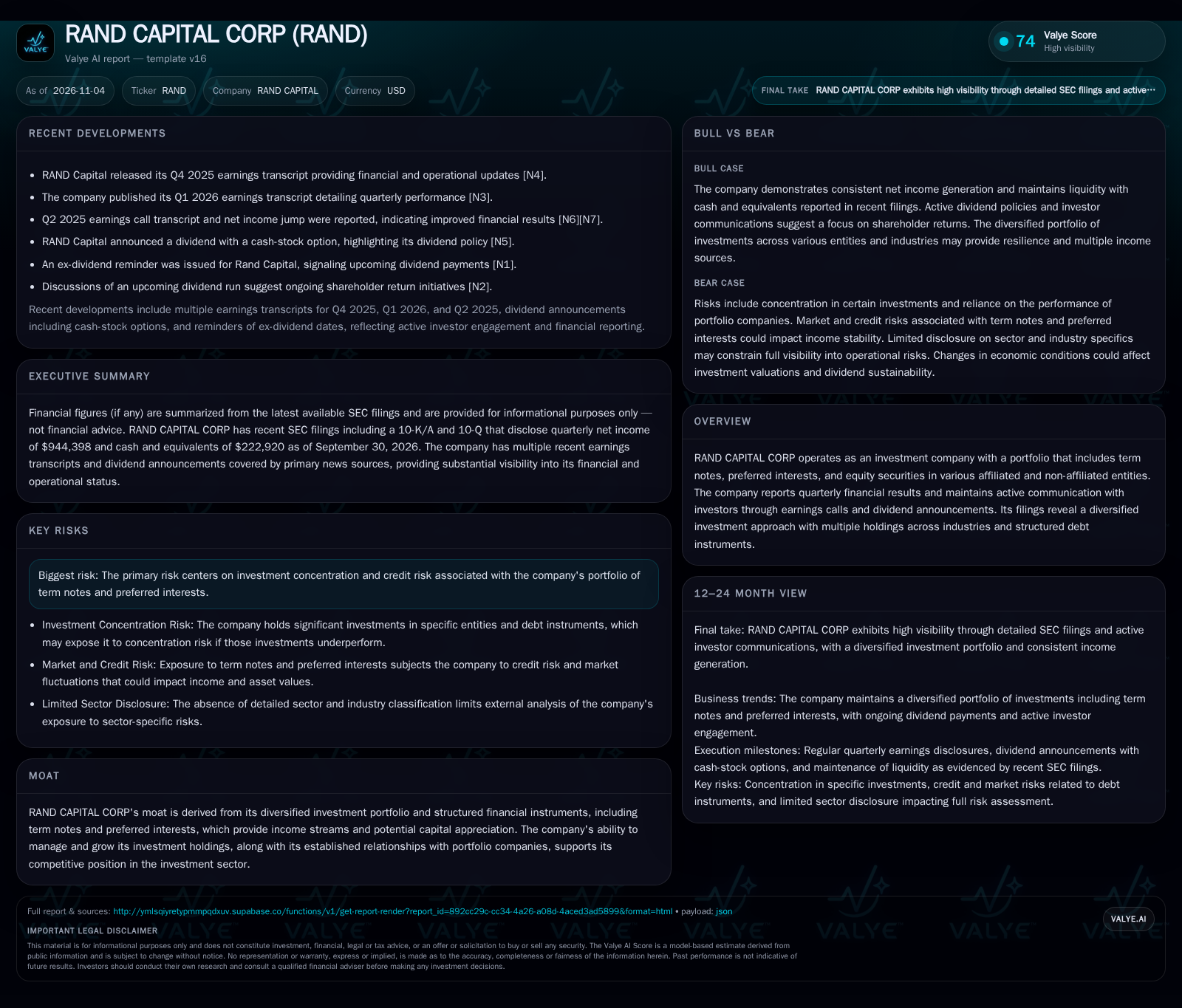
RAND Capital reported $944,398 in net income and $222,920 in cash as of September 30, 2026, reflecting steady income generation from a diversified portfolio of term notes, preferred interests, and equity securities. The cited source reports dividend-related activity; that disclosure alone does not establish dividend-policy continuity, management confidence, or a material constraint on capital flexibility. [S2]
RAND Capital Corp’s latest filings and earnings transcripts underscore its identity as a diversified investment company focused on generating returns through structured financial instruments—namely term notes, preferred interests, and equity stakes. The cited source reports dividend-related activity; that disclosure alone does not establish dividend-policy continuity, management confidence, or a material constraint on capital flexibility. The interplay between income generation, portfolio composition, and credit risk will determine whether RAND can continue to deliver attractive shareholder outcomes in the coming years.
Recent Results Reflect Consistent Profitability, But Portfolio Risks Remain
As of September 30, 2026, RAND Capital reported net income of $944,398 for the quarter, with basic and diluted earnings per share of $0.32. The company’s cash and cash equivalents amounted to $222,920 at period-end [S2]. These results confirm that RAND continues to generate positive income from its investment activities. The company’s portfolio remains diversified across term notes, preferred interests, and equity securities, as detailed in its filings [S1]. The cited source reports dividend-related activity; that disclosure alone does not establish dividend-policy continuity, management confidence, or a material constraint on capital flexibility. [N5] However, risks relating to investment concentration and exposure to credit risk in its underlying holdings are persistent themes, underscoring the importance of portfolio performance to long-term stability.
How RAND Capital Earns: Structured Instruments and Investment Income Dynamics
RAND Capital’s revenue model is rooted in the generation of investment income from term notes (debt instruments), preferred interests, and equity securities. Term notes and preferred interests provide regular interest or dividend income, typically with fixed or floating rates and varying maturities. Equity stakes offer the potential for capital appreciation and, in some cases, equity dividends. The mix between these asset types influences both the predictability and volatility of income—debt instruments tend to offer more stable cash flows, while equity positions introduce greater upside potential but higher risk.
Operating leverage in this model is limited, as investment companies primarily scale through asset growth rather than operational expansion. Management fees, administrative expenses, and the cost of capital (if leverage is used) are the main fixed and variable costs. [S2]
RAND’s capital needs are driven by portfolio maintenance (reinvesting proceeds from maturities or exits), potential follow-on investments, and the funding of dividend distributions.
Portfolio Structure and Counterforces: Where RAND Could Stand Out or Falter
RAND Capital’s competitive position is defined by its ability to source, structure, and manage a diversified set of investments that generate attractive risk-adjusted returns. The company’s moat, if any, derives from its established relationships with portfolio companies, experience structuring term notes and preferred interests, and discipline in capital allocation. However, in the broader landscape of investment companies—including business development companies (BDCs), closed-end funds, and private credit funds—RAND faces competition for deal flow, pricing, and access to quality assets.
Switching frictions are present at the portfolio company level—entities benefitting from RAND’s capital may face costs or restrictions in refinancing or replacing structured debt. However, from the investor perspective, switching costs are low, as public market investors can readily reallocate capital to alternative vehicles with different risk-return profiles.
A key counterforce is the risk of overconcentration: if a small number of investments account for a disproportionate share of income or asset value, underperformance in those holdings could materially impact RAND’s results. Without explicit disclosure of sector or geographic diversification, the company’s ability to weather industry-specific shocks remains an open question.
Portfolio Outperformance and Prudent Risk Management Drive Superior Returns
In a favorable scenario, RAND’s current portfolio generates stable or rising income, with term notes and preferred interests performing as expected and equity positions appreciating in value. Effective risk management—through diversification, active monitoring, and disciplined underwriting—limits credit losses and insulates the company from isolated defaults or market swings.
This scenario would be confirmed by several quarters of rising net income, stable or increasing cash balances, and growing dividend distributions. Additional evidence would include disclosures of new investments in diverse sectors and successful exits or repayments from existing holdings. A broadening of the portfolio, both by asset type and industry, would help demonstrate that RAND is not overly reliant on a handful of investments.
Falsification would occur if income streams declined, credit losses rose, or the company was forced to curtail dividends due to portfolio underperformance.
Sustained Income, Modest Growth, and Ongoing Portfolio Management Define the Status Quo
The most plausible outcome is that RAND continues to generate steady income from its existing portfolio, with periodic fluctuations depending on investment maturities, credit events, and market conditions. Dividend distributions are maintained at current levels, but growth is incremental rather than transformative. The company actively manages maturities and redeploys capital as assets roll off, but faces ongoing challenges in sourcing new investments with comparable risk-adjusted returns.
Confirmation of this scenario would include stable quarterly net income, periodic but not dramatic changes in cash levels, and the continuation of dividend announcements with similar structures. If disclosed, updates on portfolio turnover, reinvestment rates, and loss provisions would provide further evidence.
Falsification would be signaled by either a sudden drop in income (suggesting credit events or asset impairments) or outsized growth in investment income (indicating a shift in risk appetite or the addition of high-yield, high-risk assets).
Credit Losses or Concentration Risks Trigger Dividend Cuts and Income Erosion
The adverse scenario for RAND involves one or more significant credit events in its portfolio—defaults or restructurings on term notes or preferred interests—that erode investment income and potentially force asset impairments. If portfolio concentration is high, a single underperforming holding could materially reduce net income and liquidity, pressuring the company to reduce or suspend dividends.
This scenario could be confirmed by a sharp decline in quarterly net income, a reduction or omission of dividend announcements, and disclosures of realized losses or non-performing investments. A notable drop in cash and equivalents may also signal stress if not explained by planned portfolio activity.
Falsification would require evidence of stable or growing income despite isolated credit events, demonstrating that diversification and risk controls are effective.
What Will Determine the Resilience of RAND Capital’s Model?
Quarterly net income stability or growth, as reported in SEC filings, will provide the clearest signal of ongoing portfolio performance.
The level and trend of cash and cash equivalents, particularly relative to dividend payments and new investments, would help test liquidity resilience.
If disclosed, the degree of portfolio concentration (e.g., top five holdings as a percentage of total assets) would clarify exposure to idiosyncratic risk.
Credit loss disclosures or non-performing asset updates, if provided, would be crucial in assessing risk management effectiveness.
Evidence of new investments across diverse sectors or geographies would indicate progress toward broader portfolio diversification.
Reinvestment rates and portfolio turnover, if disclosed, would help assess the sustainability of income and the company’s access to new opportunities.
Disclaimer: This is research-only, informational analysis and not investment advice. It may include AI-generated interpretation and general industry context. Always verify important details using primary sources.

Comments