
Brownie’s Marine Group: Technology Transition, Diversification, and the Stakes of Financial Resilience
Brownie’s Marine Group is pivoting from legacy gasoline-powered systems to battery-powered, software-enabled solutions across a suite of marine safety and underwater breathing brands. While the company demonstrates product diversification and holds valuable intellectual property, persistent financial challenges and execution risks threaten the long-term payoff of its innovation and market expansion efforts.
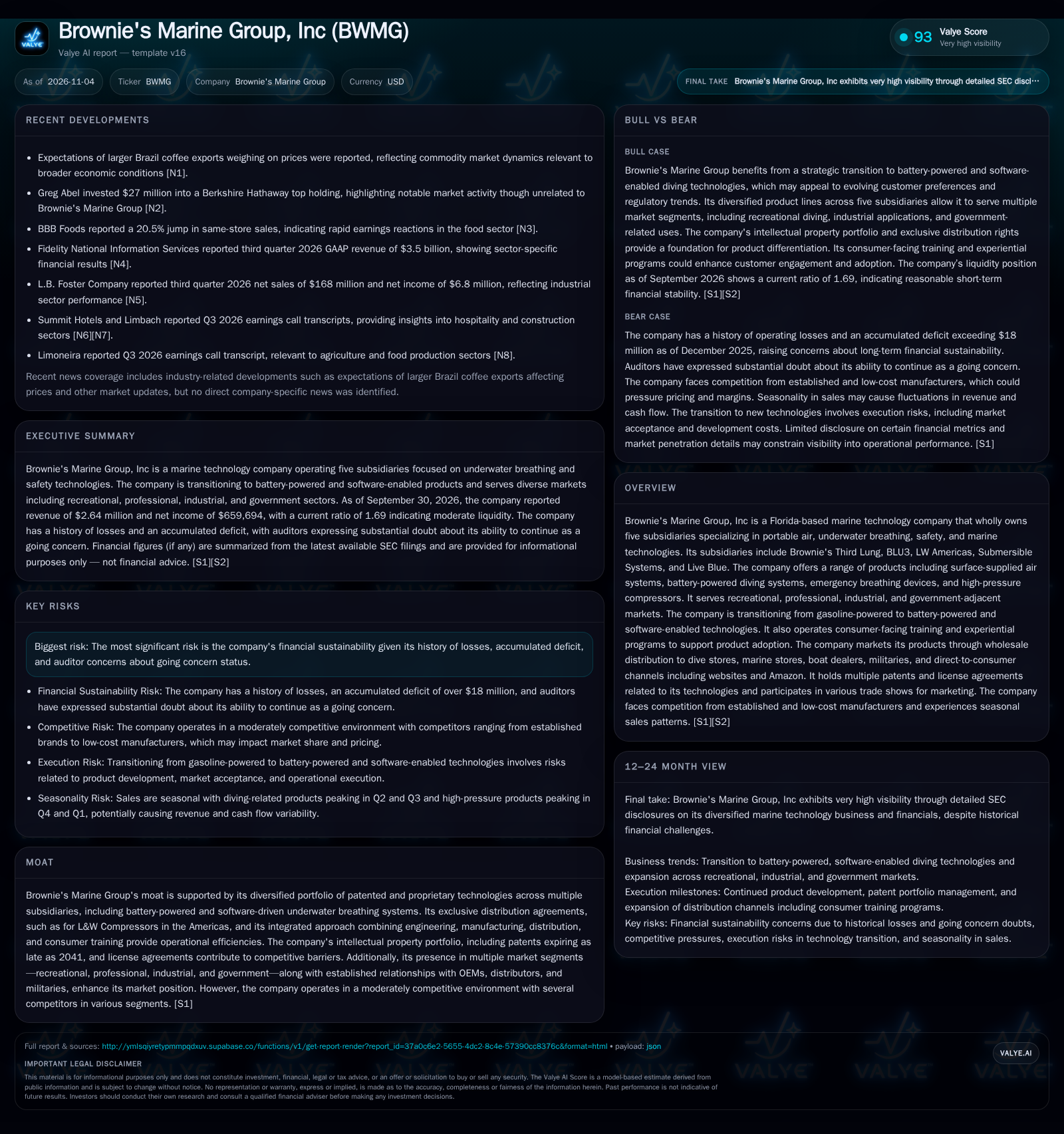
Brownie’s Marine Group is a diversified marine technology company with five subsidiaries spanning surface-supplied air, battery diving systems, high-pressure compressors, and emergency breathing devices. The company is transitioning to battery-powered, software-driven products and reported positive net income for the September 2026 quarter, but faces heavy accumulated deficits and auditor doubts about going concern status. Its multi-segment approach and intellectual property portfolio give it potential for product differentiation, but execution and financial sustainability remain critical uncertainties. [S1] [S2]
Brownie’s Marine Group, Inc. stands at a strategic crossroads: the company is aggressively transitioning its suite of marine safety and breathing technologies from traditional gasoline-powered systems to battery-powered, software-enabled solutions. This shift, coupled with a portfolio of patented products across five subsidiaries, positions Brownie’s to address evolving recreational, industrial, and government needs. Despite reporting a profitable quarter in late 2026, the company’s long-term viability is shadowed by a history of losses, a substantial accumulated deficit, and auditor doubts about its ability to continue as a going concern. The next phase will test whether innovation and diversification can overcome persistent financial headwinds and competitive pressures. [S1] [S2]
Recent Financial and Strategic Developments Reshape Near-Term Outlook
As of September 30, 2026, Brownie’s Marine Group reported quarterly revenue of $2,642,325 and net income of $659,694, a notable positive bottom-line result after a multi-year history of losses. Basic EPS for the quarter was $0.00119. The company’s balance sheet showed cash and equivalents of $238,754, current assets of $4,552,209, and current liabilities of $2,690,775, yielding a current ratio of 1.69 and a cash ratio of 0.09. [S2]
Despite the recent profitable quarter, the company had an accumulated deficit of $18,031,358 as of December 31, 2025, and auditors have expressed substantial doubt about its ability to continue as a going concern—casting a shadow on the sustainability of recent financial improvements. [S1]
Strategically, Brownie’s continues to transition from legacy gasoline-powered systems to battery-powered, software-enabled technologies, with all five subsidiaries contributing to a broad product portfolio. This technology shift is central to its growth ambitions and product differentiation efforts. [S1]
How Brownie’s Makes—and Could Scale—Its Money
Brownie’s Marine Group generates revenue from a diversified mix of products: surface-supplied air systems (Brownie’s Third Lung), battery-powered portable diving systems (BLU3), high-pressure compressor distribution and service (LW Americas), miniature/emergency breathing devices (Submersible Systems), and consumer training/experiential programs (Live Blue). The company sells through wholesale distribution (dive stores, marine retailers, OEMs, boat dealers, militaries) and direct-to-consumer channels (websites, Amazon). [S1]
The transition to battery-powered, software-enabled devices introduces the potential for higher-margin, value-added products, especially if software features can support premium pricing, recurring updates, or accessories. However, the upfront R&D and regulatory compliance costs for new technologies are likely significant, and the pace of adoption will determine how quickly these investments pay off.
Seasonality is pronounced: diving-related products peak in Q2/Q3, while high-pressure products are stronger in Q4/Q1. This cyclicality introduces cash flow management challenges and could pressure inventory and working capital needs.
Operating leverage could improve if sales volumes of new battery-powered systems ramp, as fixed product development and shared engineering infrastructure are spread over a larger sales base. However, legacy gasoline-powered inventory, ongoing patent/license royalty costs (such as those owed to Setaysha Technical Solutions through 2025), and competitive pricing could constrain gross margin expansion. [S1]
Diversification vs. Competition: Where Brownie’s Stands in the Marine Technology Arena
Brownie’s competitive landscape is fragmented, with established brands (such as Aqua Lung America and Bauer Compressors), specialized competitors (like Airline by JSink and Coltri America), and low-cost Chinese manufacturers all targeting segments of the recreational, professional, and safety diving markets. [S1]
The company’s portfolio of patents (expiring between 2033 and 2041), exclusive distribution agreements (notably for L&W Compressors in the Americas), and integrated engineering, manufacturing, and training provide some barriers to entry and operational efficiencies. These factors could help defend market share, especially if regulatory trends favor battery-powered and software-driven safety devices.
However, Brownie’s faces counterforces: established competitors have scale, brand recognition, and global distribution, while low-cost entrants can undercut prices. Product differentiation through technology and customer experience (e.g., software-enabled features, training programs) could help, but only if customers value these innovations and are willing or able to switch from legacy solutions.
The company’s access to multiple customer segments—including recreational divers, industrial safety users, and government-adjacent buyers—offers some insulation from demand swings in any single vertical, but also requires tailored sales, support, and compliance strategies.
If Innovation and Adoption Outpace Headwinds: A Path to Sustainable Growth
A favorable scenario for Brownie’s would see rapid adoption of its battery-powered, software-enabled diving systems, driven by consumer demand for safer, more convenient alternatives to gasoline-powered gear and by regulatory shifts favoring cleaner technologies. The company could leverage its patents and first-mover advantage in portable, software-controlled air systems (such as those developed by BLU3) to command premium pricing and expand into new geographic or professional markets.
If the company’s experiential and training programs (Live Blue) effectively reduce customer adoption friction and drive repeat purchases or upgrades, Brownie’s could improve customer lifetime value and build brand loyalty. Expansion of exclusive distribution agreements, or new OEM/military contracts, would further support volume growth and margin improvement.
Evidence that would confirm this scenario includes: sustained revenue growth from new battery-powered and software-driven products, improved gross margins, expanded patent licensing or distribution deals, increased direct-to-consumer sales, and disclosure of meaningful repeat business or recurring software/service revenues.
Balancing Diversification and Cash Constraints in a Competitive Market
The most plausible outcome is that Brownie’s achieves modest year-over-year revenue growth as its new technology offerings gain incremental traction, but faces ongoing margin and working capital pressures due to competition and the costs of supporting both legacy and next-generation product lines.
The company’s diversification across recreational, industrial, and government-adjacent markets may help offset seasonal swings and competitive price pressure in any one segment. However, without a clear breakout product or a major contract win, profitability is likely to remain erratic, and the risk of cash shortfalls or the need for additional financing will persist.
Confirmation of this scenario would come from steady but unspectacular revenue growth, continued positive but thin quarterly net income, and periodic disclosure of new or renewed distribution agreements—without evidence of a decisive step-change in market share, margin structure, or product adoption.
When Innovation Isn’t Enough: The Threat of Financial Exhaustion
In a more adverse scenario, Brownie’s faces slow adoption of its battery-powered and software-enabled solutions, perhaps due to customer inertia, competitive pricing from low-cost manufacturers, or regulatory delays. If revenue growth stalls or reverses while ongoing R&D, inventory, and royalty/license costs remain high, the company could experience renewed operating losses and liquidity strain.
Auditor warnings about going concern status highlight the risk that Brownie’s may not be able to secure additional funding or restructure obligations if cash burn resumes, especially if seasonality leads to inventory build-ups or delayed receivables.
Warning signs would include declining or stagnant revenue, a return to net losses, delays or shortfalls in launching new products, increased reliance on short-term financing, or disclosures of covenant breaches or restructuring discussions.
Testing the Brownie’s Thesis: What Will Determine the Next Chapter
Quarterly revenue and gross margin trends by product category—especially for battery-powered and software-enabled systems—would help clarify the pace and profitability of the technology transition.
Updates on patent licensing income, new patent applications, or expirations could indicate the sustainability of Brownie’s intellectual property moat.
Direct-to-consumer sales growth and customer adoption metrics for new products (e.g., BLU3 systems) would demonstrate success in reaching new market segments and reducing reliance on wholesale channels.
Evidence of new, renewed, or expanded distribution agreements, especially with OEMs, militaries, or global retailers, would support the case for scaling the business.
Disclosure of recurring revenue from software/service features, training programs, or aftermarket accessories would signal progress toward higher-margin, resilient business models.
Any further auditor commentary on going concern status, or new financing arrangements, would materially affect the risk profile and thesis durability.
Seasonal revenue and inventory swings—particularly if exacerbated by industry or macroeconomic shocks—should be monitored for potential liquidity crunches.
Disclaimer: This is research-only, informational analysis and not investment advice. It may include AI-generated interpretation and general industry context. Always verify important details using primary sources.

Comments