
UroGen Pharma in Late 2026: Commercial Expansion, RTGel Leverage, and the Stakes of Sustained Oncology Innovation
UroGen Pharma advances its RTGel-based cancer therapies with growing commercial traction and a replenished balance sheet, but faces the looming expiration of Jelmyto’s exclusivities and the high bar of biotech execution. The next phase will test whether platform differentiation and pipeline progress can offset competition and capital needs.
UroGen Pharma continues to expand its presence in urothelial cancer treatment with proprietary RTGel technology underpinning Jelmyto and Zusduri. The FDA’s acceptance of the UGN-103 NDA signals pipeline momentum, while strategic partnerships may broaden the company’s sustained-release oncology portfolio.
UroGen Pharma enters the final quarter of 2026 with commercial momentum for its RTGel-enabled therapies, an improving liquidity position, and pipeline advances that could reshape its medium-term trajectory. With Jelmyto and Zusduri addressing unmet needs in urothelial cancers, the company is leveraging its proprietary drug delivery platform and a specialized commercial infrastructure to drive adoption. However, the expiration of key exclusivities, ongoing operating losses, and the inherent uncertainties of biotech innovation present significant hurdles. The next 18–24 months will test whether UroGen can translate scientific differentiation and pipeline progress into durable commercial success.
Recent Performance: Revenue Growth, Pipeline Progress, and Financial Position
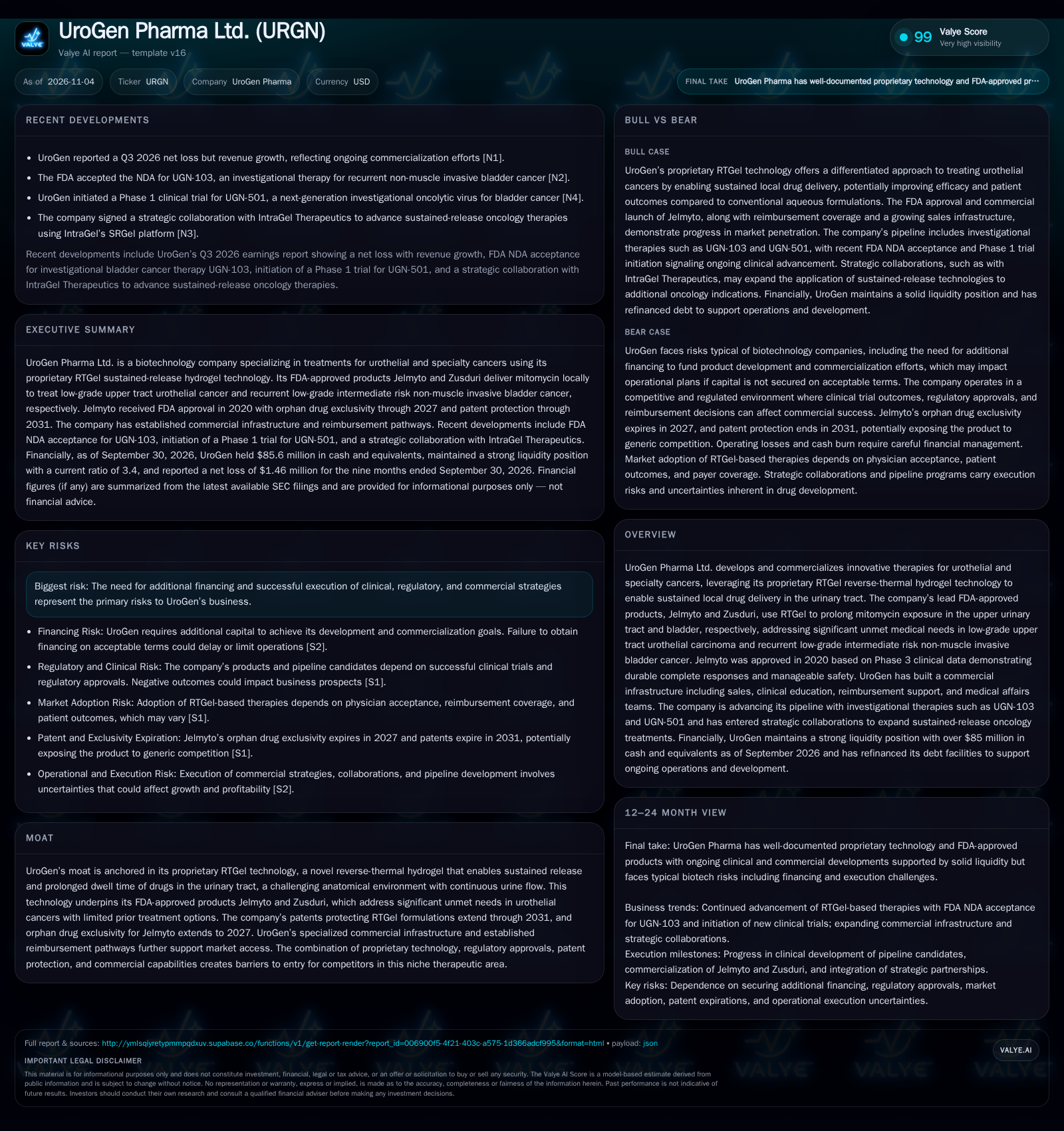
UroGen Pharma reported revenue growth in Q3 2026, reflecting continued commercial traction for its RTGel-based products Jelmyto and Zusduri, despite posting a net loss for the period [N1]. As of September 30, 2026, the company reported $85.6 million in cash and equivalents, $6.35 million in short-term investments, and a current ratio of 3.4 [S2]. Operating cash outflow for the nine months was $93.5 million, a reduction versus the prior year, suggesting some improvement in operational efficiency or cost discipline [S2]. In February 2026, UroGen refinanced its debt with a $200 million senior secured term loan, which may provide additional resources for ongoing investments and operational needs [S2].
On the pipeline front, the FDA accepted the NDA for UGN-103, an investigational therapy for recurrent non-muscle invasive bladder cancer, marking a milestone in advancing new indications [N2]. These developments position UroGen at a critical juncture: commercial expansion is underway, pipeline assets are progressing, and the company has reported financial resources to support its ambitions. However, the reported liquidity and credit facilities do not, by themselves, establish the company’s future operating runway or investment capacity, which will depend on future cash flows, financing conditions, and business execution.
Platform Economics: RTGel’s Role in Value Capture and Cost Structure
UroGen’s business model is centered on leveraging its proprietary RTGel reverse-thermal hydrogel for sustained drug delivery within the urinary tract. This platform enables differentiated product profiles for Jelmyto and Zusduri—potentially allowing premium pricing and facilitating payer coverage by improving patient outcomes in indications with few alternatives [S1]. The economics of these specialty oncology markets are characterized by relatively high gross margins on approved therapies, but require substantial upfront and ongoing investment in R&D, clinical trials, regulatory submissions, and commercialization infrastructure.
The company’s cost structure includes a specialized salesforce, clinical nurse educators, and reimbursement support teams—about 150 employees—supporting the commercial effort [S1]. Fixed costs are significant, but potential operating leverage exists if product adoption accelerates, as incremental revenue from new patients or expanded indications could outpace growth in commercial overhead. The RTGel platform offers scalability across multiple urologic indications, but each new product or label expansion must clear the high regulatory and clinical efficacy bar, with associated development costs.
Capital needs are material: in addition to supporting ongoing losses and pipeline development, UroGen must fund clinical programs and commercial launches well ahead of revenue realization. The recent $200 million term loan may provide near-term flexibility, but longer-term sustainability will depend on achieving positive operating cash flow, expanding the approved product portfolio, or securing additional capital. The company’s reported cash and liquidity metrics reflect its current financial position, but do not alone determine its ability to fund future operations without further financing.
Defending Share in a Niche Oncology Market: RTGel’s Barriers and the Threat of Generics
UroGen’s competitive position is anchored by the RTGel technology, which enables longer drug dwell time and potentially superior efficacy compared to conventional aqueous mitomycin formulations [S1]. This creates a technical and regulatory barrier, as replicating the hydrogel’s properties and demonstrating equivalent clinical outcomes would be challenging for would-be competitors. The company’s patent portfolio—protecting Jelmyto until 2031—and orphan drug exclusivity (expiring 2027) provide additional, though time-limited, protection [S1].
However, the field of urothelial oncology is attracting increased interest, and generic manufacturers may target Jelmyto once exclusivity lapses. Larger pharmaceutical firms or specialty biotech peers with bladder cancer programs represent the main competitive threat, particularly if they can match or exceed UroGen’s clinical results or offer more convenient regimens. Reimbursement and physician adoption are critical: established payer coverage and a trained salesforce provide a current edge, but switching costs for providers could diminish if generics or better alternatives enter the market. The strategic collaboration with IntraGel Therapeutics may help broaden the platform’s applicability and preempt competition in other sustained-release oncology niches [N3].
Platform Scaling and Pipeline Success Could Drive a Step-Change in Value
A favorable outcome for UroGen hinges on three reinforcing dynamics. First, continued commercial adoption of Jelmyto and Zusduri, supported by strong payer reimbursement and positive physician and patient experiences, could drive revenue growth and margin expansion. Second, the successful approval and launch of pipeline candidates—most immediately UGN-103—would expand the company’s addressable market and demonstrate the scalability of the RTGel platform. Third, strategic partnerships or licensing deals, such as the recent IntraGel collaboration, could accelerate development timelines and diversify revenue sources.
Evidence that would confirm this upside includes sustained double-digit revenue growth, positive regulatory decisions for UGN-103 and other pipeline assets, and new licensing or co-development agreements. Additionally, a shift to positive operating cash flow would signal that operating leverage is being realized. If UroGen can extend RTGel’s utility into additional oncology indications and defend its market position post-exclusivity, the company could achieve durable, platform-driven growth.
Balancing Commercial Momentum with Cost Discipline and Execution Risks
The most plausible medium-term path for UroGen is continued revenue growth from Jelmyto and Zusduri, with incremental expansion as additional physicians adopt RTGel-based therapies and payer coverage remains stable. However, operating losses are likely to persist as the company invests in pipeline development and commercial infrastructure. The acceptance of the UGN-103 NDA suggests potential for new product launches, but regulatory or commercial setbacks remain possible.
Confirmation of this scenario would include steady, but not explosive, revenue growth; continued, though narrowing, operating losses; and progress in advancing one or more pipeline assets toward approval. This scenario assumes no major competitive threats materialize before Jelmyto’s patent expiration, and that the company can manage capital needs through a mix of careful cost control and opportunistic financing.
Generic Entry, Clinical Setbacks, or Financing Constraints Could Derail the Growth Story
The primary adverse scenario involves a confluence of threats: generic competition emerging soon after Jelmyto’s orphan exclusivity expires in 2027, regulatory setbacks or lackluster clinical results from pipeline assets such as UGN-103, and/or deteriorating reimbursement or physician adoption. In this situation, UroGen’s revenue base could erode faster than cost reductions can be implemented, while the company’s fixed commercial infrastructure amplifies operating losses.
Downside confirmation would include regulatory delays, clinical trial failures, slowing or declining revenue, rapid loss of market share to generics or new entrants, and a rising cash burn rate. If financial markets tighten or UroGen is forced to raise capital on unfavorable terms, dilution or strategic retrenchment could follow. The risk is accentuated by the biotech sector’s typical binary outcomes and the company’s need to continually invest ahead of revenue realization.
Milestones That Will Test UroGen’s Platform Value and Commercial Durability
The pace and magnitude of revenue growth for Jelmyto and Zusduri relative to previous quarters, especially as exclusivity expiration approaches [N1] [S2].
Regulatory outcomes and timing for UGN-103 and other pipeline assets, including FDA approval decisions and any clinical data disclosures [N2].
Trends in operating cash flow and cash burn—whether operating losses narrow further or reverse direction [S2].
Updates on new or expanded reimbursement agreements, payer coverage, or changes in Medicare/J-code status (if disclosed).
Any evidence of generic or competing product launches, patent challenges, or litigation that could undermine exclusivity [S1].
Progress or setbacks in strategic collaborations, notably with IntraGel Therapeutics, and announcements of new licensing or co-development deals [N3].
Physician adoption rates and patient outcomes for RTGel-based therapies—a useful metric would be prescriber or patient growth (if disclosed).
Capital raises, debt refinancing, or changes in credit terms that indicate shifting financing conditions or runway pressure (if disclosed).
Disclaimer: This is research-only, informational analysis and not investment advice. It may include AI-generated interpretation and general industry context. Always verify important details using primary sources.

Comments