
Otter Tail in Late 2026: Regulated Utility Stability Meets Manufacturing and Plastics Margin Volatility
Otter Tail’s latest quarter highlights the contrasting fortunes of its core regulated utility and its more cyclical, cost-exposed manufacturing and plastics businesses. While the Electric segment provides stability through regulated returns and renewable investments, the Manufacturing and Plastics divisions face margin headwinds from commodity volatility, legal liabilities, and shifting demand—raising pivotal questions about future earnings resilience and capital allocation.
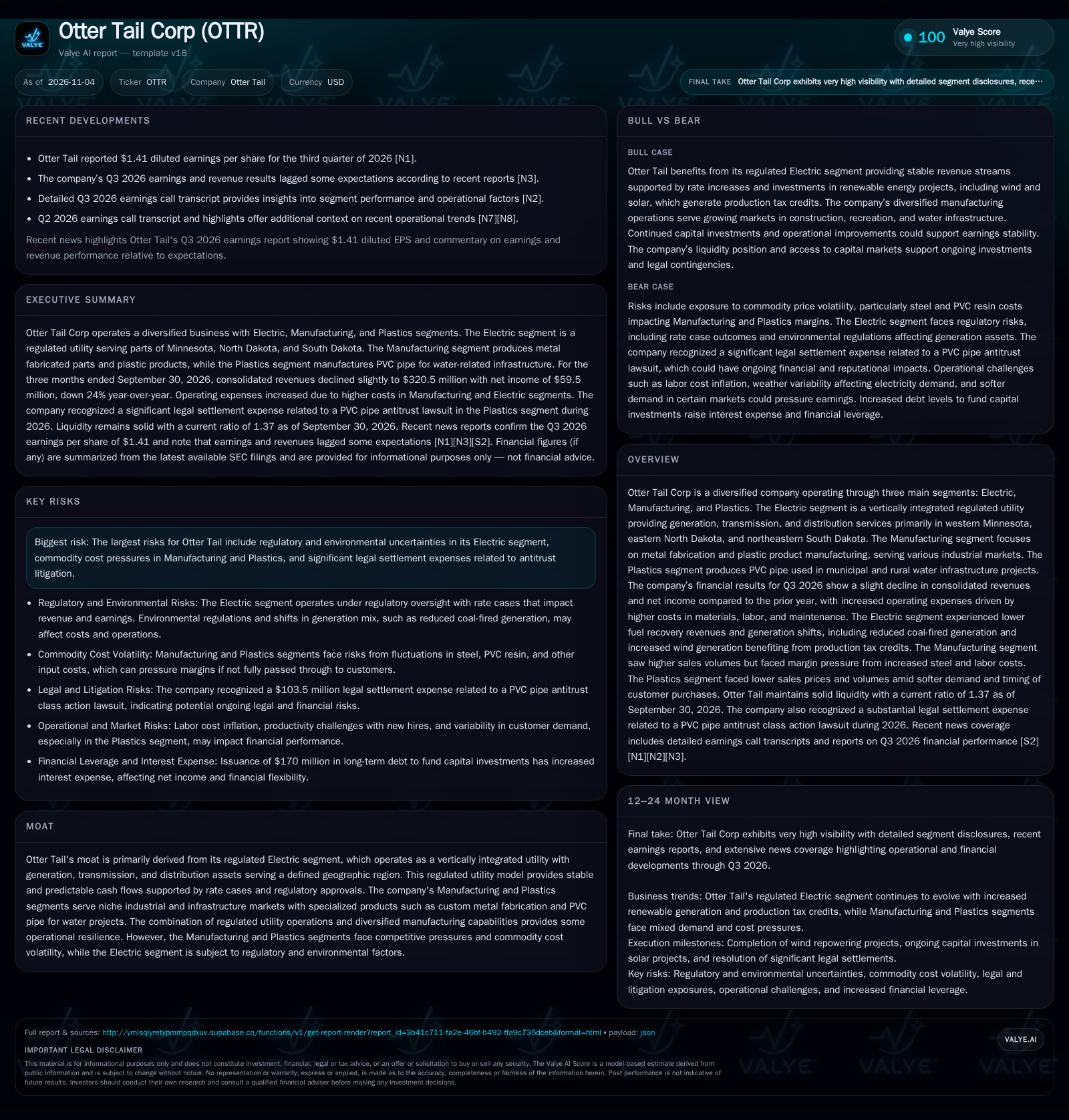
Otter Tail’s Q3 2026 results underscore a stable but flat-regulated utility business and pressured manufacturing and plastics segments. Margins in Manufacturing and Plastics are squeezed by higher costs, lower volumes, and a major legal settlement, while Electric benefits from renewables and production tax credits but faces higher expenses. The company’s diversified structure offers some resilience, but future performance hinges on cost control, regulatory outcomes, and demand recovery in cyclical markets. [S2] [N1] [N3]
Otter Tail Corp’s latest quarter illustrates the divergent realities of its business model: regulated utility operations provide a base of predictable earnings, while manufacturing and plastics units expose the company to cyclical volatility, cost inflation, and legal risk. Despite a stable performance from its Electric segment—underpinned by regulatory frameworks and renewable investments—the company’s overall profitability is under pressure due to higher expenses, adverse cost dynamics, and the impact of a major legal settlement in the Plastics segment.
Recent Results Reveal Diverging Segment Performance and Margin Compression
For Q3 2026, Otter Tail reported consolidated operating revenues of $320.5 million, a 1.6% decrease year-over-year, and net income of $59.5 million, down 24%. The Electric segment’s revenues declined 2.6% to $135.0 million, but net income was essentially flat at $27.4 million, as increased expenses offset benefits from renewables and production tax credits. The Manufacturing segment grew revenue by 16.6% to $89.7 million but saw net income drop 34.4% to $2.6 million, with higher labor and material costs eroding margins. Plastics revenues fell 12.9% to $95.8 million, and net income was down 33.4% to $29.0 million, reflecting lower sales prices, softer demand, and the impact of a $103.5 million legal settlement related to a PVC pipe antitrust class action. Interest expense increased due to a $170 million long-term debt issuance aimed at funding capital expenditures. [S2]
The company’s current ratio stood at 1.37 and cash at $205.8 million as of September 30, 2026. However, higher operating expenses, legal liabilities, and increased debt are driving a more complex risk/reward profile for the next several quarters. [S2]
How Otter Tail’s Mixed Model Drives Cash Flows—and Where It Breaks Down
Otter Tail’s economics are shaped by its hybrid structure: a regulated utility core (Electric) and two industrial businesses (Manufacturing and Plastics) exposed to cyclical demand and commodity price swings. The Electric segment benefits from a vertically integrated, rate-regulated model, providing predictable cash flows, cost recovery, and the ability to earn a regulated return on capital. Investments in renewables drive production tax credits, which reduce operating revenues but benefit customers and support regulatory relationships. The shift to wind and solar also lowers long-term fuel and maintenance costs, but upfront capital intensity is high and regulatory lag or disallowances could impact returns.
Manufacturing and Plastics segments operate in more competitive, price-sensitive markets. Manufacturing’s fixed-cost leverage means higher volumes can boost margins, but cost spikes in steel or labor compress profits rapidly if not offset by pricing power. Plastics relies on PVC resin, with input costs and demand for infrastructure projects driving volatility. The recent legal settlement in Plastics is a reminder that past conduct can have sudden, material cash flow consequences, and future litigation or regulatory actions could recur.
Otter Tail’s capital needs are significant, especially for Electric’s renewables and grid upgrades. The $170 million long-term debt issuance in 2026 increased leverage and interest expense, narrowing potential financial flexibility. The company reported cash and liquidity metrics for the period; these figures do not by themselves establish operating runway, investment capacity, financial flexibility, or financing capacity.
Regulated Monopoly Versus Commodity-Exposed Manufacturing: Otter Tail’s Competitive Landscape
Otter Tail’s Electric segment enjoys structural advantages as a regulated monopoly utility with defined service territories in Minnesota, North Dakota, and South Dakota. Regulatory frameworks provide earnings visibility and a degree of protection from direct competition, though the segment remains exposed to regulatory risk, environmental mandates, and potential shifts in allowed returns or cost recovery mechanisms. The move toward renewables may enhance long-term cost competitiveness but also exposes the company to policy uncertainty and the economics of intermittent generation.
Manufacturing and Plastics face a very different dynamic. Here, Otter Tail competes with regional and national players in metal fabrication and PVC pipe, where pricing is often dictated by commodity costs and customer purchasing cycles. Barriers to entry are modest, and product differentiation is limited. Margins can be protected through operational efficiency, scale, or niche specialization, but sustained cost inflation or demand softness will pressure weaker players. The antitrust litigation in Plastics underscores the reputational and financial risks in commodity product markets.
The company’s diversified model provides some buffer against shocks to any one segment, but it also dilutes focus and exposes Otter Tail to a wider array of operational and regulatory risks than a pure-play utility or industrial would face.
Unlocking Value Through Cost Discipline, Regulatory Wins, and Demand Recovery
A favorable scenario for Otter Tail hinges on several reinforcing developments. First, the Electric segment successfully executes on renewables investments, secures constructive rate case outcomes, and benefits from higher production tax credits, supporting stable or rising earnings. If regulatory lag is minimized and capital projects are included in rate base on schedule, the utility’s returns could improve, offsetting inflation in operating expenses.
Simultaneously, Manufacturing and Plastics could see input costs stabilize or decline, with steel and PVC resin prices normalizing. If demand for infrastructure projects rebounds—particularly in water and wastewater—Plastics volumes and pricing could recover, restoring margins. Manufacturing could benefit from productivity gains or automation, reducing unit labor costs.
Confirmation would come from sequential margin expansion in Manufacturing and Plastics, regulatory approval for new capital projects in Electric, and a return to year-over-year earnings growth. Disconfirmation would include persistent margin compression, regulatory setbacks, or continued legal liabilities.
Stable Utility Anchors, but Industrial Volatility Continues to Challenge Earnings
The most likely scenario is a continuation of current trends: the Electric segment provides a stable earnings base, supported by regulatory cost recovery and production tax credits from renewables, but faces incremental pressure from rising operating expenses and the transition away from coal. Manufacturing and Plastics remain volatile—Manufacturing may grow revenue but struggle to translate this into higher net income if cost inflation is not offset by pricing or efficiency gains. Plastics faces ongoing demand uncertainty and could see below-average margins as the market digests both the legal settlement and weaker infrastructure spending.
Management focuses on cost control, operational efficiency, and regulatory engagement to maintain dividends and fund critical investments. Confirmation would be stable or modestly growing utility earnings, with flat to slightly down industrial margins. Falsification would be a material negative swing in any segment—such as another legal hit, a failed rate case, or a sharp downturn in industrial demand.
Legal, Regulatory, and Commodity Shocks Expose Otter Tail’s Vulnerabilities
In a downside scenario, several risks materialize in tandem. Another significant legal or regulatory action—such as follow-on litigation or further antitrust scrutiny in Plastics—could trigger additional settlement expenses or operational restrictions. Regulatory outcomes in the Electric segment could turn negative, with delayed or disallowed cost recovery for renewables, lower allowed returns, or new environmental compliance costs increasing capital requirements without compensation.
Commodity price spikes—whether in steel, labor, or PVC resin—could persist or worsen, compressing margins in Manufacturing and Plastics regardless of revenue growth. If macroeconomic or construction market weakness continues, demand for Plastics products could erode further, leading to underutilization and potential asset impairment.
Evidence of this scenario would include further legal reserves or charges, negative regulatory rulings, a step-down in segment earnings, or liquidity pressure requiring asset sales or dividend cuts.
Milestones That Will Shape Otter Tail’s Earnings Resilience and Strategic Flexibility
Trends in segment margins, especially Manufacturing and Plastics, as a signal of cost control and pricing power—sequential improvement or further compression would be highly informative.
Resolution of any outstanding or new legal or regulatory actions, particularly in the Plastics segment, including disclosure of reserves, settlements, or compliance undertakings.
Regulatory developments in the Electric segment—including outcomes of pending or upcoming rate cases, cost recovery for renewables, and any changes in allowed returns.
Updates on capital expenditure plans and funding mix, especially for Electric’s renewables and grid modernization projects—look for disclosure of project cost, regulatory approval, and in-service dates.
Movements in input costs (steel, labor, PVC resin) and the company’s ability to pass these through to customers in Manufacturing and Plastics—a useful metric would be gross margin by segment, if disclosed.
Volume and pricing trends in Plastics, particularly tied to municipal infrastructure spending—watch for commentary on customer order patterns and backlog, if disclosed.
Disclaimer: This is research-only, informational analysis and not investment advice. It may include AI-generated interpretation and general industry context. Always verify important details using primary sources.

Comments