
Stanley Black & Decker in Late 2026: Strategic Execution, Capital Return, and the Stakes of Operational Excellence
Stanley Black & Decker’s raised outlook, renewed share repurchase authorization, and recent leadership changes signal a company in active strategic transition. The interplay between operational gains, legal risk, and the implications of the pending CAM business divestiture will shape its capacity for margin expansion and sustained shareholder returns.
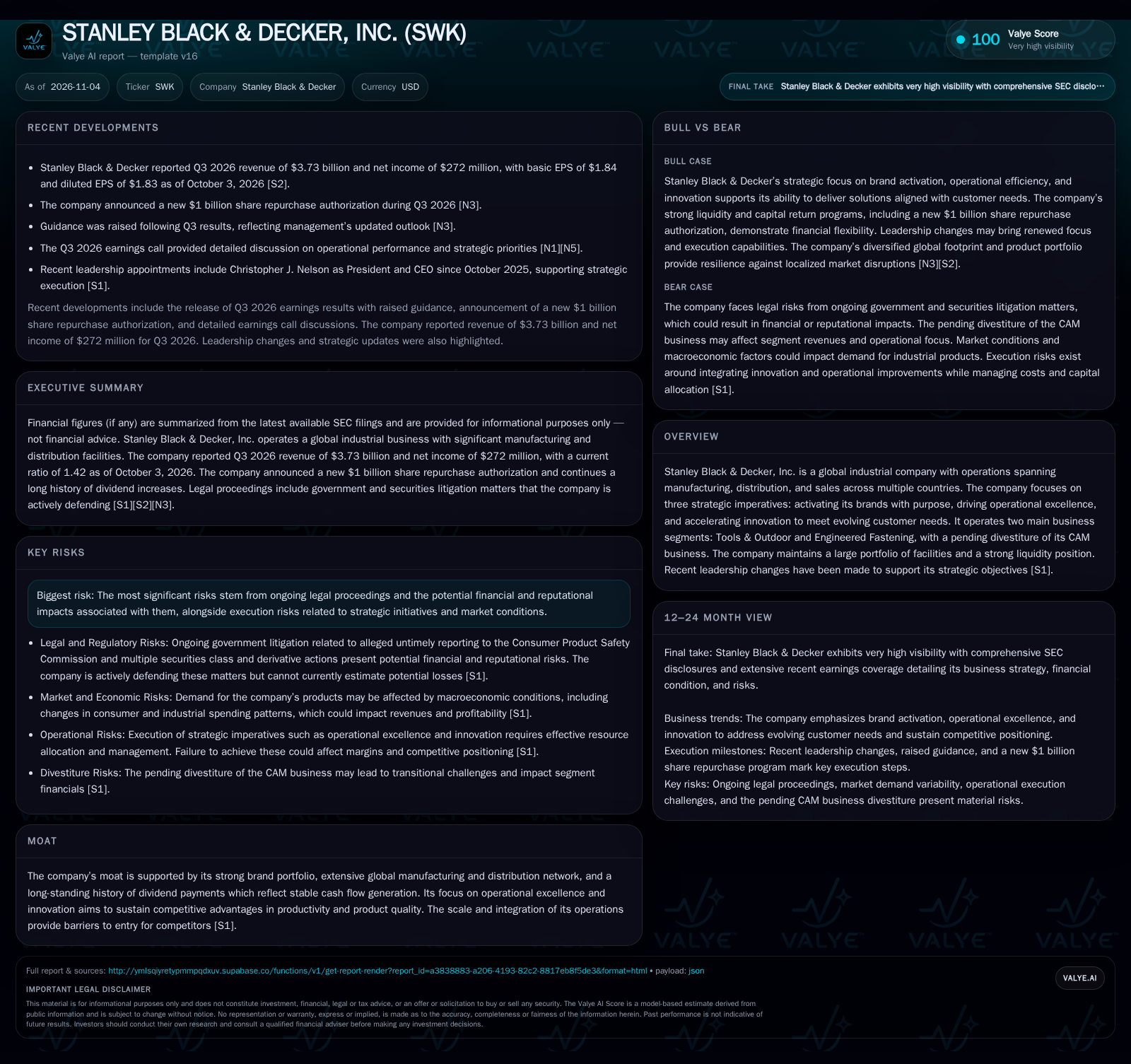
Stanley Black & Decker reported Q3 2026 revenue of $3.73 billion and net income of $272 million, announced a $1 billion share repurchase program, and raised guidance, all amid ongoing legal proceedings and a pending CAM business divestiture. The company’s focus on operational excellence and innovation, under new CEO Christopher J. Nelson, aims to drive margin gains, but execution and market risks remain material [S2] [N3].
Stanley Black & Decker enters late 2026 at a strategic crossroads: operational performance is improving, as reflected in raised guidance and solid Q3 earnings, but the company also faces significant legal and structural uncertainties. A new CEO and a $1 billion share repurchase program underscore management’s commitment to shareholder value and execution of its three-pronged strategy—brand activation, operational excellence, and innovation. Yet, with major litigation pending and the CAM business in the process of divestiture, the company’s ability to sustain margin expansion and defend its competitive position will depend on disciplined execution and adaptability to shifting market and regulatory dynamics.
Recent Results and Strategic Moves Reshape the Investment Picture
Stanley Black & Decker reported Q3 2026 revenue of $3.7316 billion and net income of $272.1 million, with basic EPS of $1.84 and diluted EPS of $1.83, as of October 3, 2026 [S2]. This performance led management to raise forward guidance, signaling confidence in operational improvements and demand trends [N3]. The company also announced a new $1 billion share repurchase authorization, underscoring a renewed commitment to capital returns [N3]. Recent leadership changes, including the appointment of Christopher J. Nelson as President and CEO in October 2025, reflect an intent to drive the company’s strategic imperatives more aggressively [S1]. Meanwhile, the pending divestiture of the CAM business is set to alter the segment mix and may create both execution risk and opportunity for portfolio focus [S1]. Legal proceedings—including government litigation related to product safety reporting and several class and derivative actions—remain unresolved, introducing potential financial and reputational uncertainty [S1].
How Stanley Black & Decker’s Global Footprint and Portfolio Shape Its Earnings Power
Stanley Black & Decker’s earnings model is anchored in its two primary segments: Tools & Outdoor, and Engineered Fastening. The company operates 108 large facilities across 18 states and 21 countries, which provides global reach but also embeds significant fixed costs and supply chain complexity [S1]. Historically, the Tools & Outdoor segment has been cyclical, with sensitivity to consumer and industrial spending, while Engineered Fastening offers more exposure to OEM and industrial markets, often with higher switching costs and longer customer relationships.
Gross margin expansion is a core lever: operational excellence initiatives—such as lean manufacturing, procurement savings, and supply chain optimization—could drive incremental margin gains if executed well. The company’s focus on innovation suggests a push toward higher-value, differentiated products, which may support pricing power and defend against commoditization risk. However, the capital intensity of manufacturing and distribution creates operating leverage: revenue growth can drive disproportionate bottom-line gains, but downturns can compress margins rapidly.
The pending CAM business divestiture, if completed, could sharpen segment focus and redeploy capital to higher-return initiatives, but may also reduce diversification and scale. The company reported cash and liquidity metrics for the period; these figures do not by themselves establish operating runway, investment capacity, financial flexibility, or financing capacity. [S2] The new share repurchase authorization points to confidence in near-term cash flow, though future debt or investment needs could constrain flexibility if end-market conditions deteriorate.
Assessing Brand Strength, Scale, and Innovation in a Crowded Tools Market
Stanley Black & Decker’s competitive positioning is underpinned by several durable factors: global scale, a broad brand portfolio (including legacy names in power tools and industrial fasteners), and established distribution relationships. The company’s emphasis on brand activation and innovation aims to differentiate its offerings in a market characterized by price competition and periodic influxes of low-cost imports.
Scale enables procurement advantages and supply chain resilience, but also exposes the company to global macroeconomic swings, regulatory regimes, and cost inflation. However, the commoditization risk in tools—where private-label and digital-native brands can erode pricing—remains ever-present.
In Engineered Fastening, switching costs and integration into customer workflows can provide greater stickiness, but this business is exposed to industrial cycles and customer consolidation. The competitive set spans large diversified industrials, specialty tool players, and increasingly, digitally enabled upstarts. The question is whether Stanley Black & Decker’s investments in operational excellence and new product development will be enough to sustain margin and share gains as the sector evolves.
If Operational Excellence and Innovation Translate to Margin Expansion
A favorable scenario for Stanley Black & Decker would see the company’s operational initiatives—lean manufacturing, supply chain optimization, and targeted innovation—delivering sustained gross margin expansion. If the company successfully activates its brands with purpose and launches differentiated products that command premium pricing, it could defend or grow share even in a competitive, price-sensitive environment.
The pending CAM business divestiture could further streamline the portfolio, freeing up capital for higher-growth or higher-return projects. The $1 billion share repurchase authorization, if executed at attractive valuations, could enhance EPS and signal management’s conviction in future cash generation [N3]. Confirmation of this scenario would come from sequential improvements in segment margins, above-market organic growth, and evidence that new products are gaining traction with key customers. If disclosed, metrics such as price/mix contribution to growth and new product revenue as a share of total sales would help validate this thesis.
Sustaining Progress Amid Execution Demands and Legal Clouds
The most plausible scenario is one of steady, but not spectacular, progress. Stanley Black & Decker could continue to realize modest margin gains from operational improvements and benefit from incremental innovation, while sustaining solid—if unspectacular—top-line growth. The raised guidance following Q3 2026 results suggests management sees tailwinds in the near term, but ongoing legal proceedings and the integration of new leadership introduce uncertainty [N3] [S1].
The CAM business divestiture may create some short-term disruption but could ultimately lead to a more focused company. Falsification would come from margin compression, unexpected legal liabilities, or operational missteps during the portfolio transition.
How Litigation, Macroeconomic Shocks, or Portfolio Disruption Could Derail Execution
Downside risk centers on three interconnected threats: adverse legal outcomes, a macroeconomic downturn, and disruption from the CAM business divestiture. A negative legal judgment or settlement could result in material financial costs or reputational damage, affecting both cash flow and customer relationships [S1]. Macroeconomic weakness—especially in housing, construction, or industrial end-markets—could pressure revenue, while the company’s fixed-cost base would amplify the margin impact.
If the CAM divestiture proves more complex than anticipated, the company could face stranded costs, loss of scale efficiencies, or operational distraction. Should these risks materialize, Stanley Black & Decker could be forced to curtail capital returns, slow investment in innovation, or even raise capital to shore up the balance sheet. Early warning signs would include rising legal reserves, negative surprises in segment results, or guidance cuts tied to market or portfolio challenges.
Testing the Stanley Black & Decker Thesis: Execution, Portfolio Realignment, and Legal Outcomes
Progress on gross and operating margin expansion in the Tools & Outdoor and Engineered Fastening segments—sequential improvement would support the operational excellence thesis.
Completion timing, terms, and financial impact of the CAM business divestiture—if disclosed, details on proceeds, stranded costs, and redeployment of capital would clarify future segment economics.
Updates on the status, cost, and potential resolution of ongoing legal and regulatory proceedings—a useful metric would be the size of legal reserves or qualitative commentary on risk exposure.
Pace and magnitude of share repurchases under the new $1 billion authorization—actual buyback activity versus program size would test management’s conviction and free cash flow strength.
Organic revenue growth versus peers and end-market trends—outperformance would suggest brand and innovation initiatives are gaining traction.
New product adoption rates and contribution to total sales—if disclosed, this would help assess the impact of innovation efforts.
Leadership commentary and strategic updates from CEO Christopher J. Nelson and his team, particularly around execution priorities and risk management.
Disclaimer: This is research-only, informational analysis and not investment advice. It may include AI-generated interpretation and general industry context. Always verify important details using primary sources.

Comments