
AtriCure’s Surgical Afib Platform: Clinical Leverage, Commercial Execution, and the Stakes of Market Expansion
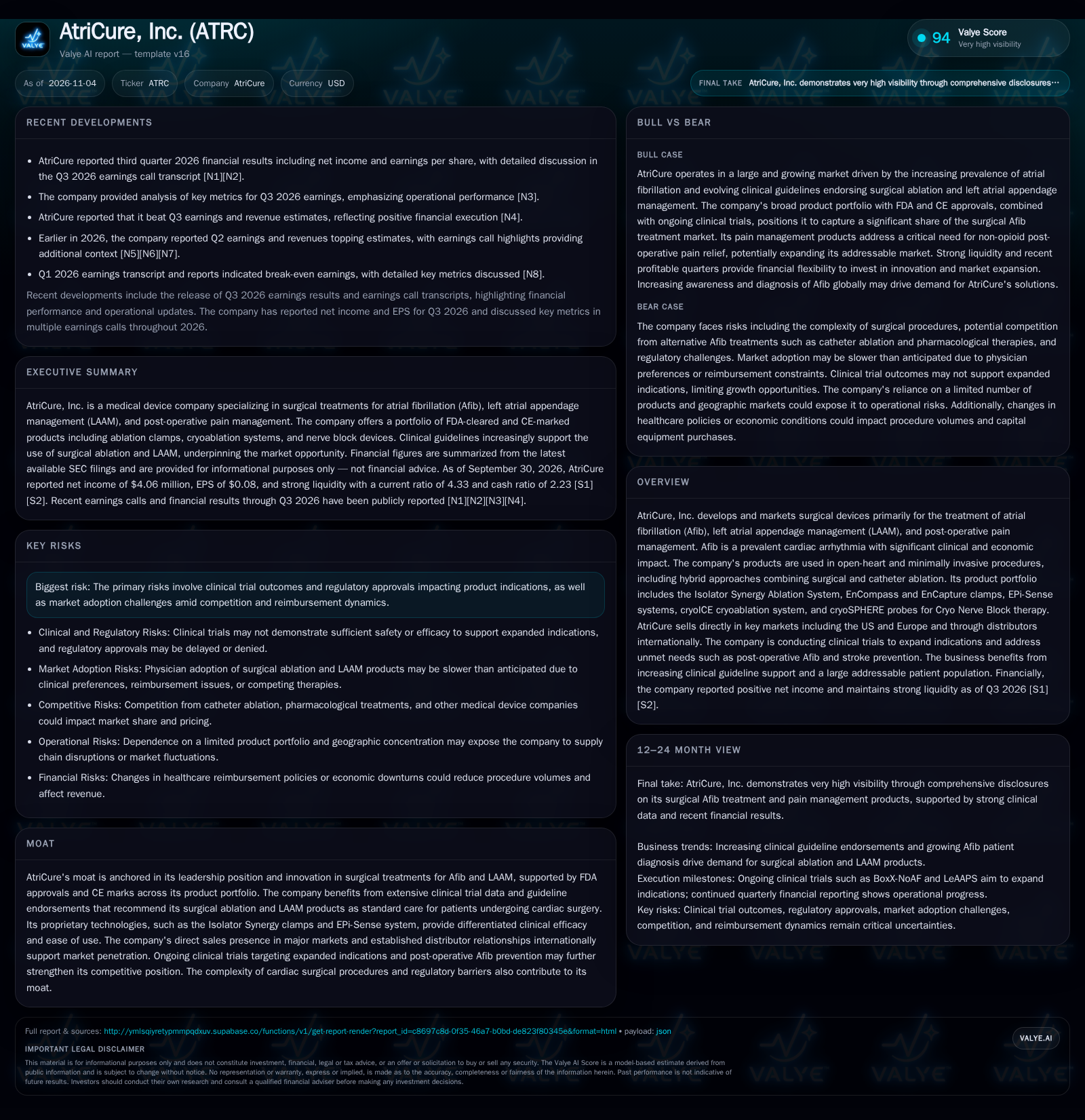
AtriCure reported net income of $4.06 million for Q3 2026, supported by a reported cash position and a product suite with FDA and CE approvals in Afib and pain management.
AtriCure reported net income of $4.06 million for Q3 2026, supported by a reported cash position and a product suite with FDA and CE approvals in Afib and pain management. The addressable Afib population remains largely undertreated by surgery, leaving substantial headroom if clinical data and guideline momentum continue. However, competitive pressure from catheter ablation, reimbursement dynamics, and the outcomes of ongoing trials are pivotal for future growth [S1] [S2].
AtriCure, Inc. stands at the intersection of innovation and execution in the treatment of atrial fibrillation and post-operative pain management. The company’s Q3 2026 results—marking both profitability and reported liquidity position—demonstrate that its surgical ablation and left atrial appendage management (LAAM) technologies are gaining traction amid a large, underpenetrated patient base. Yet, the real test lies ahead: Can AtriCure leverage clinical trial outcomes and evolving clinical guidelines to drive broader adoption, or will competitive and reimbursement headwinds cap its long-term upside?
Financial Results Signal Execution, but Clinical and Commercial Milestones Loom
AtriCure reported net income of $4.06 million and basic and diluted EPS of $0.08 for the quarter ended September 30, 2026, a notable achievement for a company operating in a complex, innovation-driven medical device market [S2]. The company’s liquidity position is reflected in $187 million in cash and equivalents, current assets of $363.4 million, and a current ratio of 4.33 [S2]. These reported figures indicate resources available for continued R&D and commercial investment, but do not by themselves establish the duration or sufficiency of future operating capacity.
These results arrive as AtriCure’s FDA-approved Isolator Synergy Ablation System, EnCompass clamp, and EPi-Sense system gain traction in both open-heart and minimally invasive procedures [S1]. Ongoing clinical trials (BoxX-NoAF, LeAAPS) could expand indications and further differentiate AtriCure’s portfolio if outcomes are positive [S1]. The combination of reported financial resources and pipeline momentum sets the stage for potential step-changes in adoption, but the pace and breadth of that adoption remain uncertain.
How AtriCure’s Revenue Model and Cost Structure Shape Scalability
AtriCure’s commercial model is centered on single-use, procedure-driven devices—such as ablation clamps and cryoablation probes—sold primarily through a direct sales force in major markets [S1]. This model creates a recurring revenue stream tied to surgical procedure volumes, though it is inherently sensitive to fluctuations in hospital budgets and cardiac surgery rates.
The gross margin structure is shaped by a mix of proprietary, differentiated disposables and capital equipment, with disposables typically commanding higher margins due to their recurring nature and regulatory barriers to entry. Fixed costs are driven by R&D and sales infrastructure, while variable costs scale with unit volumes. If guideline support and clinical trial outcomes broaden indications, AtriCure could see operating leverage as incremental revenue outpaces the growth in SG&A and R&D.
The company reported cash and liquidity metrics for the period; these figures do not by themselves establish operating runway, investment capacity, financial flexibility, or financing capacity.
Surgical Innovation Meets Catheter-Based Alternatives: Competitive Dynamics in Afib
AtriCure’s competitive edge rests on its FDA- and CE-cleared portfolio, clinical data, and growing clinical guideline support for concomitant surgical ablation and LAAM in cardiac surgery [S1]. These factors create high switching frictions for hospitals already invested in AtriCure’s platform, particularly where surgical workflow integration is established.
However, catheter ablation—a less invasive, electrophysiologist-driven alternative—remains a strong substitute, especially for patients not already undergoing cardiac surgery. Pharmacological therapies, while less durable, compete in lower-risk or early-stage patients. Device companies with strong electrophysiology franchises, as well as emerging minimally invasive ablation technologies, represent ongoing threats.
AtriCure’s direct sales footprint in the US and Europe and established distributor relationships internationally provide commercial reach, but local reimbursement dynamics and physician preferences can limit penetration. The company’s moat is supported by regulatory barriers and the complexity of procedure adoption, but it is not insurmountable if catheter-based or future non-surgical solutions achieve superior outcomes or cost-effectiveness.
Clinical Trial Wins and Guideline Expansion Could Unlock Accelerated Adoption
If AtriCure’s ongoing BoxX-NoAF and LeAAPS trials deliver positive results—demonstrating clear reductions in post-operative Afib and stroke risk—the company could see expanded product indications and stronger clinical guideline endorsements [S1]. This, in turn, could drive a meaningful increase in surgical ablation rates, tapping into the estimated global pool of over 500,000 annual candidates, of which less than 15% are currently treated surgically [S1].
A favorable scenario would also see growing uptake of pain management devices (cryoICE, cryoSPHERE) as hospitals seek non-opioid solutions post-surgery, expanding AtriCure’s addressable market beyond Afib. Operationally, stronger utilization would improve fixed-cost absorption, driving margin expansion.
Evidence confirming this scenario would include: significant increases in procedure volumes, new or revised guidelines explicitly recommending AtriCure’s technologies, and positive data readouts from pivotal trials. Accelerating revenue growth outpacing SG&A and R&D would further validate the operating leverage thesis.
Incremental Growth Anchored in Current Indications and Steady Guideline Support
The most plausible near-term path is one of steady, incremental growth: AtriCure continues to penetrate the existing surgical Afib and LAAM markets, supported by current guideline recommendations and gradual physician adoption. Revenue growth tracks with modest increases in cardiac surgery volumes and some expansion in pain management as opioid-sparing protocols gain traction.
Margins remain stable as the mix of high-margin disposables persists, but operating leverage is tempered by ongoing investment in clinical trials and geographic expansion.
This scenario would be confirmed by consistent, single-digit revenue growth, stable gross margins, and a clinical trial cadence that sustains (but does not dramatically accelerate) new product adoption. Neutral or modestly positive updates from ongoing trials would reinforce this trajectory.
Setbacks in Clinical Data or Shifts Toward Less Invasive Therapies Could Stall Growth
If AtriCure’s key clinical trials fail to show sufficient safety or efficacy, the company could face restricted product indications and diminished guideline support, curbing expansion opportunities [S1]. Simultaneously, if reimbursement becomes more restrictive or if catheter ablation continues to gain share—especially for persistent or long-standing persistent Afib—AtriCure’s addressable market could shrink.
A negative scenario may also play out if hospitals, facing cost pressures, defer capital purchases or shift toward lower-cost, less invasive therapies. Operationally, this would manifest as stagnant or declining procedure volumes, margin compression from underutilization of fixed infrastructure, and potential write-downs of inventory or capitalized R&D.
Evidence of this scenario would include: disappointing clinical trial readouts, negative or unchanged guidelines, stagnation or decline in procedure volumes, and heightened price competition or reimbursement headwinds.
Benchmarks for Assessing AtriCure’s Trajectory in Surgical Afib and Pain Management
Pivotal clinical trial outcomes (BoxX-NoAF, LeAAPS) and any resulting changes in FDA labeling or clinical guideline recommendations.
Trends in surgical ablation and LAAM procedure volumes—especially relative to overall cardiac surgeries and catheter ablation rates—if disclosed.
Adoption rates and revenue contribution from pain management devices (cryoICE, cryoSPHERE), particularly in non-cardiac surgical settings, if disclosed.
Gross margin trends, as an indicator of product mix, pricing power, and competitive pressure.
Geographic expansion progress, including new market entries and performance in existing international markets.
Any material changes in reimbursement policy or hospital purchasing behavior affecting procedure volumes or pricing.
Sales force expansion, physician training initiatives, and integration of new products into established surgical workflows.
Disclaimer: This is research-only, informational analysis and not investment advice. It may include AI-generated interpretation and general industry context. Always verify important details using primary sources.

Comments