
The New York Times in Late 2026: Subscription Growth, Profitability, and the Stakes of Digital Media Scale
Strong Q3 profitability and projected double-digit subscription revenue growth highlight the New York Times’ digital momentum, but the durability of its moat and subscriber retention will be tested by intensifying competition and evolving consumer habits.
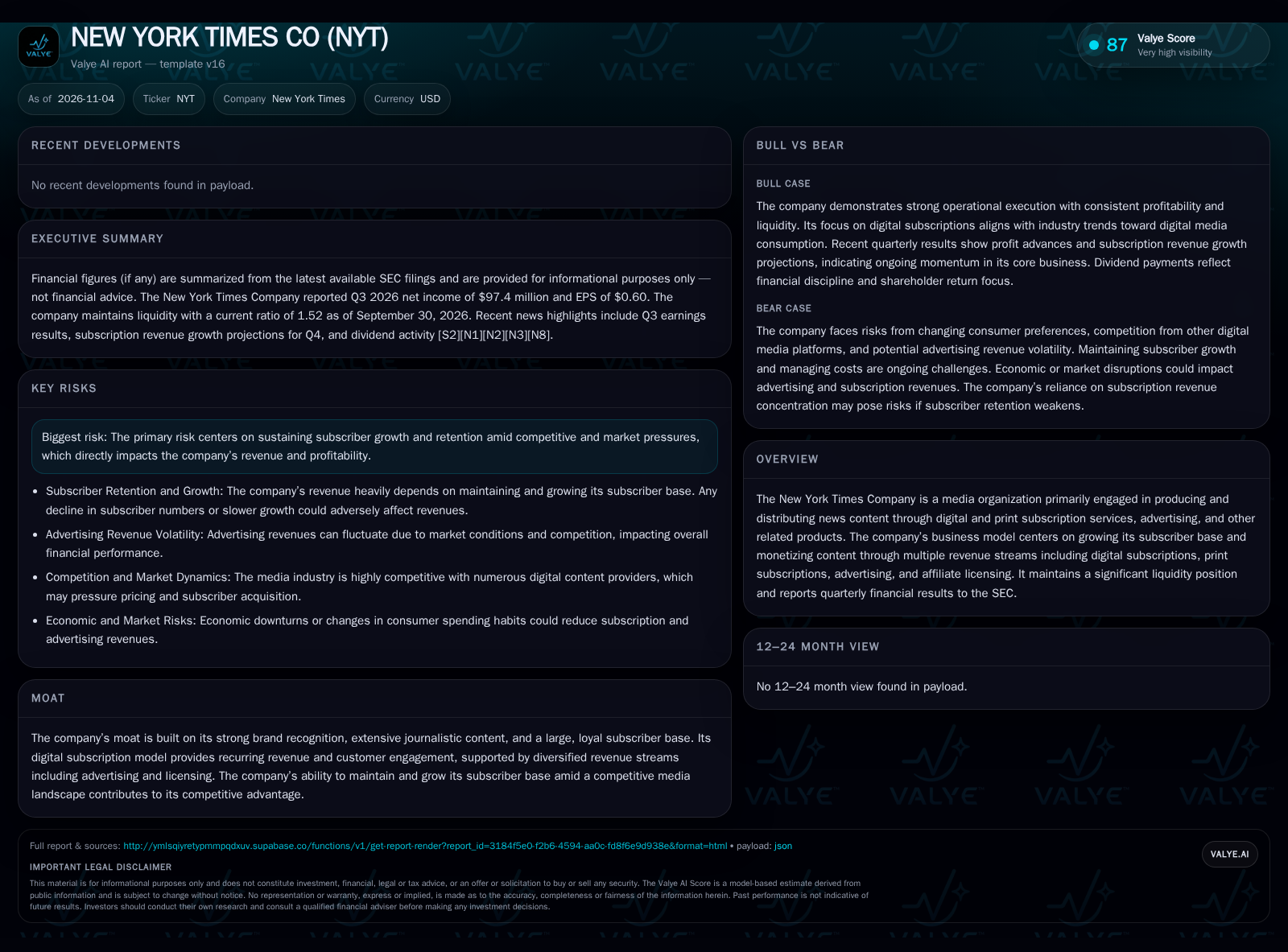
The New York Times posted $97.4 million in net income and EPS of $0.60 in Q3 2026, supported by a liquidity position of $221.3 million in cash and a current ratio of 1.52. Management projects Q4 2026 subscription revenue growth of 9–11%, indicating continued digital momentum. The company’s recurring-revenue model and brand strength underpin its current advantage, but long-term success will depend on subscriber retention, pricing power, and adaptability to competitive dynamics. Key watchpoints include churn, digital ARPU, ad revenue trends, and evidence of expanding subscriber engagement or new product monetization.[S2] [N1] [N2] [N3]
The New York Times Company enters Q4 2026 with strong financial momentum, posting robust profit figures and signaling confidence in continued subscription revenue expansion. Its digital-first strategy, anchored by a large and loyal subscriber base, has enabled consistent profitability and a reported liquidity position. However, as industry dynamics shift and competitive pressures mount, the company’s next phase will hinge on its ability to preserve subscriber growth, maintain pricing power, and innovate its monetization strategies in an increasingly crowded digital media landscape.
Q3 Profitability, Liquidity, and Subscription Growth Projections Shape Near-Term Outlook
The New York Times reported net income of $97.4 million and earnings per share of $0.60 for the third quarter of 2026, signaling another period of solid profitability. The company reported cash and liquidity metrics for the period; these figures do not by themselves establish operating runway, investment capacity, financial flexibility, or financing capacity. [S2][S2] Critically, management projects Q4 2026 subscription revenue growth between 9% and 11%, highlighting ongoing momentum in its core digital business.[N3] These facts matter because they demonstrate both operational execution and the continued centrality of the subscription revenue model, even as the media sector faces headwinds from advertising volatility and consumer shifts.
Subscription-Centric Model: Margins, Revenue Mix, and Scale Leverage
The New York Times’ economics increasingly revolve around its digital subscription base, which provides recurring, relatively predictable revenue with favorable gross margins compared to legacy print or volatile advertising streams. Digital subscriptions typically carry lower variable distribution costs, enabling higher incremental margins as subscriber count grows. Print subscriptions and advertising remain relevant but have lower growth and are more exposed to secular decline or market cycles.
Advertising revenue, though nontrivial, is inherently more cyclical and sensitive to macroeconomic shifts and industry competition. Affiliate licensing and other revenue sources offer diversification but are unlikely to match the scale or margin profile of core subscriptions. As fixed editorial and technology investments are leveraged over a growing subscriber base, operating leverage may drive further profit expansion if churn remains low and acquisition costs do not escalate disproportionately.
Capital needs are modest compared to capital-intensive industries; the main investments are in content, technology platforms, and marketing. [S2] [N8]
Brand Strength and Content Quality vs. Platform Competition and Consumer Choice
The New York Times’ competitive moat rests on its globally recognized brand, reputation for high-quality journalism, and a broad content portfolio that appeals to both general and niche audiences. This underpins subscriber loyalty and a willingness to pay for digital access. However, the digital news and information landscape is intensely competitive, with threats from other premium publishers, digital-native news platforms, aggregators, and even creator-driven newsletters and podcasts.
Switching frictions are moderate: while loyal subscribers value the Times’ content, alternatives are often available and price competition is real. The risk is that if consumer preferences shift toward free or lower-cost sources, or if competitors successfully replicate premium offerings, pricing power could erode. Network effects in news are weaker than in social media; differentiation must be sustained through exclusive content, user experience, and brand trust.
Advertising is exposed to substitution by social media and search platforms, while affiliate/licensing revenues are vulnerable to changes in partner economics or distribution models. The company’s ability to bundle content, introduce new verticals, or create value-added features may help defend its position but requires ongoing investment and execution.
Unlocking Higher Lifetime Value Through Retention, Pricing Power, and Product Expansion
A favorable scenario would see the New York Times translating its projected subscription revenue growth into sustained subscriber base expansion, higher average revenue per user (ARPU), and improved retention. If the company can successfully upsell bundled offerings (such as news, games, cooking, and audio), leverage data to personalize engagement, and experiment with dynamic pricing, it could raise lifetime value and reduce churn.
Confirmation of this scenario would come from sustained double-digit digital subscription revenue growth, reported declines in churn rates, and evidence of successful product cross-sell and ARPU expansion. Signs of effective cost discipline—where incremental margin expansion outpaces content and technology investment—would further validate the upside case.
Falsification would involve stalling subscriber growth, an uptick in churn, or evidence that price increases lead to material cancellations. Lack of adoption for new products or bundles, or margin compression due to rising customer acquisition or content costs, would also undermine the thesis.
Digital Growth Moderates as Competitive Pressures and Consumer Habits Evolve
The most plausible trajectory is one where the New York Times continues to grow its digital subscriptions at a mid-to-high single-digit pace, with ARPU gains partially offset by competitive discounting and occasional churn spikes. Advertising revenue remains a smaller but stabilizing contributor, with modest growth or cyclical fluctuations. Print continues to decline but does not materially destabilize the business in the near term.
This scenario would be confirmed by quarterly subscription revenue growth in the 5–10% range, stable or slowly improving operating margins, and continued profitability with limited need for external capital. News of new product launches, partnerships, or incremental monetization of the existing subscriber base would support the base case.
It would be falsified if digital subscription growth slows to low-single digits or turns negative, if ARPU declines due to discounting or increased churn, or if advertising revenue weakens materially without compensating growth elsewhere.
Subscriber Fatigue, Churn, and Content Substitution Threaten Recurring Revenue
A negative scenario could unfold if subscriber growth plateaus or reverses as consumers hit subscription fatigue, face economic stress, or are wooed by alternative news sources or aggregators. Rising churn or discount-driven retention could force the company to accept lower ARPU or spend more on customer acquisition, eroding margins.
Worsening advertising market conditions—driven by macroeconomic shocks or further shifts to walled-garden platforms—could amplify top-line pressures. If cost inflation in content creation or technology outpaces revenue growth, profitability could deteriorate. Prolonged negative trends might spark dividend cuts or curtail investment in new products.
Evidence supporting this scenario would include a sequential decline in digital subscribers, rising churn rates, falling ARPU, or missed subscription growth projections. Increased reliance on promotional pricing or a sharp drop in advertising revenue would further signal downside risk.
Milestones That Will Test the New York Times’ Digital Resilience and Growth Thesis
Quarterly digital subscriber growth and churn rates—if disclosed—will be essential for tracking the health of the subscription base and spotting early signs of fatigue or competitive leakage.
Digital ARPU (average revenue per user) trends: Sustained ARPU growth or successful cross-sell of bundled products would support the margin and retention thesis.
Subscription acquisition costs and payback periods—where disclosed—would help test whether growth remains efficient or is becoming more expensive.
Advertising revenue trends, both digital and print, as a share of total revenue, to gauge exposure to cyclical and structural shifts in the ad market.
Evidence of successful new product launches, bundled offerings, or expanded content verticals, which could drive incremental subscriber growth or engagement.
Disclosures around retention initiatives or subscriber engagement metrics would provide leading indicators of moat durability and customer loyalty.
Any management commentary or reporting on competitive dynamics—such as changes in pricing strategy, new entrants, or platform partnerships—will be crucial for assessing the sustainability of the current business model.
Disclaimer: This is research-only, informational analysis and not investment advice. It may include AI-generated interpretation and general industry context. Always verify important details using primary sources.

Comments