
JELD-WEN in Late 2026: Brand Strength, Margin Pressure, and the Stakes of Capital Structure Discipline
The strategic question is whether brand equity and operational scale can offset sector headwinds and capital structure constraints as the company navigates tariff risks and cyclical construction demand.
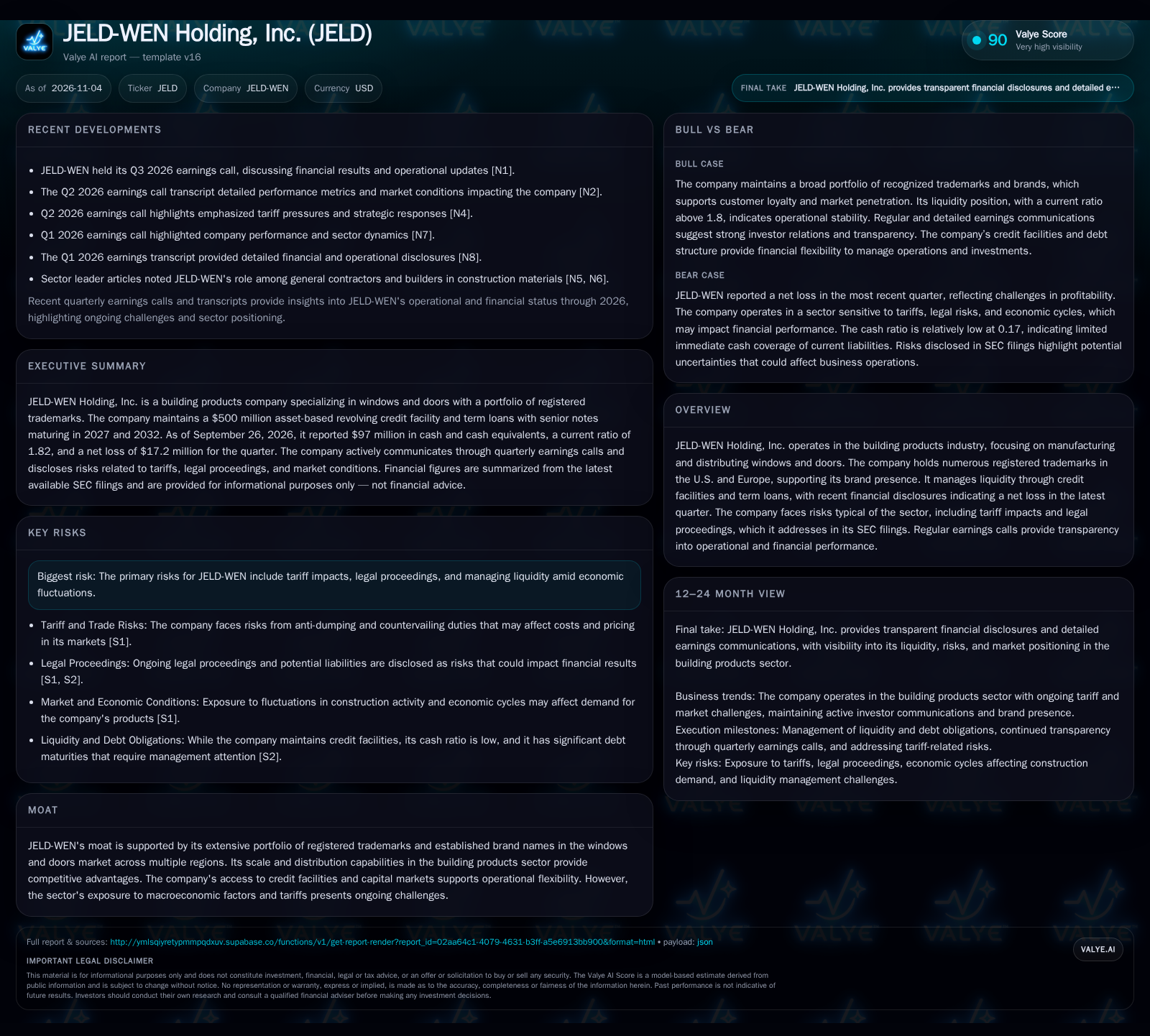
JELD-WEN posted a net loss of $17.2 million in Q3 2026, with a current ratio of 1.82 and a cash ratio of 0.17. The core thesis hinges on whether JELD-WEN’s brand portfolio and scale can drive margin recovery and sustainable cash flow before major debt maturities.
JELD-WEN Holding, Inc. finds itself at a crossroads as 2026 nears its close. Despite a robust portfolio of registered brands and a footprint spanning the U.S. and Europe, the company is contending with margin pressure and a net loss in its latest quarter. Liquidity is bolstered by substantial credit lines, but immediate cash coverage of liabilities is thin, spotlighting the importance of disciplined capital management. As construction activity remains sensitive to tariffs, legal disputes, and macroeconomic swings, the company’s ability to translate brand strength and operational scale into durable earnings and cash flow is now under scrutiny.
Recent Losses and Liquidity Metrics Shape Near-Term Outlook
JELD-WEN reported a net loss of $17.2 million and EPS of -$0.20 for the quarter ended September 26, 2026 [S2]. This loss underscores ongoing profitability challenges amid competitive and macroeconomic headwinds. [S2] Together, these facts frame a business with substantial brand and operational assets but exposed to short-term cash flow volatility and leverage management challenges.
How JELD-WEN’s Business Model Converts Brand and Scale into Earnings—Or Fails To
JELD-WEN’s core economics are driven by the manufacture and distribution of branded windows and doors for residential and commercial end markets. The company’s broad portfolio of registered trademarks enables it to command some pricing power in a fragmented industry, though the degree of premium pricing and retention is not disclosed. Revenue is likely a function of volume tied to construction activity, product mix (premium vs. entry-level lines), and periodic price increases to offset input cost inflation, including tariffs.
Fixed costs—including manufacturing plant overhead, sales and distribution infrastructure, and R&D for differentiated products—drive operating leverage; improvements in utilization and throughput can meaningfully affect margins. However, variable costs, especially raw materials (glass, wood, metals), labor, and logistics, are sensitive to commodity cycles and tariffs. Capital needs are moderate but persistent, given the asset intensity of manufacturing and the working capital requirements for inventory and receivables. The company’s access to a $500 million revolver and term loans is subject to the facility's disclosed availability and terms but introduces interest expense and refinancing risk if cash flow remains weak.
Profitability, therefore, depends on JELD-WEN’s ability to manage input costs, flex production, and leverage its brand portfolio for higher-margin sales. In periods of soft construction demand, the risk is that fixed costs and debt service outpace gross profit, eroding margins and pressuring cash flow.
Brand Equity, Distribution Reach, and the Limits of Differentiation in Building Products
JELD-WEN’s primary competitive advantages stem from its portfolio of established brands (such as JELD-WEN®, AuraLast®, LaCANTINA®) and its distribution scale across the U.S. and Europe [S1]. Brand recognition aids in specification by builders, architects, and contractors, potentially reducing price sensitivity and fostering repeat business. However, the building products sector is crowded, with national and regional manufacturers, private-label offerings from big-box retailers, and import competition all vying for share.
Tariffs on imported materials and finished goods can both help and hurt: they may raise costs for JELD-WEN’s inputs but also limit low-cost imports. Substitutes—including alternative window/door materials and offsite manufacturing—could erode share if JELD-WEN’s innovation or cost position lags. The company’s scale supports purchasing power and logistics efficiency, but this is not a unique advantage in an industry where several peers operate at similar scale.
Ultimately, JELD-WEN’s competitive position is durable so long as it can maintain brand relevance, manage costs, and adapt to product and channel shifts. The risk is that cyclical downturns or failure to pass through cost increases compress margins and cede share to more nimble or better-capitalized rivals.
Margin Recovery Catalyzed by Brand Pricing and Cost Discipline
A favorable scenario emerges if JELD-WEN leverages its brand equity to push through price increases and drive a higher-value product mix, offsetting input cost inflation and tariff impacts. If construction activity stabilizes or rebounds, volume growth would allow operating leverage to work in the company’s favor, expanding margins as fixed costs are absorbed across greater output.
Evidence supporting this scenario would include sequential margin improvement (gross and operating), positive free cash flow, and commentary on successful cost pass-throughs in earnings calls [N1] [N2]. Growth in branded premium lines or innovation-driven products would further signal competitive differentiation.
This scenario could be falsified by continued margin compression, inability to pass through costs, or stagnating premium product sales, especially if construction demand remains flat.
Navigating Cyclical Volatility While Managing Debt and Margin Headwinds
The most plausible near-term trajectory for JELD-WEN is one of modest revenue growth or stability, with ongoing margin pressure as tariff and input cost headwinds persist.
Under this scenario, JELD-WEN continues to defend share via its brands and distribution network but does not achieve significant margin expansion until sector demand improves or input cost inflation moderates. Debt service remains a priority, and refinancing or liability management becomes important as maturities approach in 2027 and 2032. Confirmation of this scenario would come from flat or slightly improving revenue, stable but unexceptional margins, and cautious forward guidance in earnings calls [N1] [N2].
This scenario would be falsified by either a sharp deterioration in demand (leading to outsized losses and liquidity stress) or an unexpected surge in profitability driven by cost reductions or market share gains.
Prolonged Margin Compression Triggers Liquidity Strain and Strategic Constraints
A negative outcome could unfold if construction activity contracts further, tariff and input cost pressures intensify, or legal liabilities materialize. In this environment, JELD-WEN’s fixed cost base and debt service requirements would squeeze profitability, potentially resulting in sustained net losses and negative operating cash flow.
Approaching debt maturities (notably in 2027) could heighten refinancing risk if credit markets tighten or if the company’s financial profile worsens.
Evidence of this downside would include accelerating net losses, negative free cash flow, revolver utilization trends, and management commentary on cost containment or restructuring efforts. Failure to stabilize margins or manage working capital would be a clear warning sign.
Milestones That Will Shape JELD-WEN’s Margin and Capital Trajectory
Sequential changes in gross and operating margins, especially evidence of margin recovery or further compression in upcoming quarterly reports.
Trends in net debt and revolver utilization, particularly if drawdowns accelerate or maturities are refinanced on less favorable terms.
Volume and mix shifts toward premium or branded products, if disclosed, as a sign of pricing power and competitive differentiation.
Cash flow from operations and free cash flow generation, with a focus on whether working capital is a net source or use of funds.
Commentary on tariff impacts and cost pass-through effectiveness during earnings calls or in SEC filings.
Any material legal settlements or new proceedings that could create unanticipated cash outflows or liabilities.
Guidance regarding capital expenditures, restructuring initiatives, or asset sales as management responds to margin and liquidity pressures.
Disclaimer: This is research-only, informational analysis and not investment advice. It may include AI-generated interpretation and general industry context. Always verify important details using primary sources.

Comments