
NRC Health: Balancing Data-Driven Opportunity with Cost Pressures and Liquidity Constraints
The company’s ability to retain clients and manage costs will define its next phase.
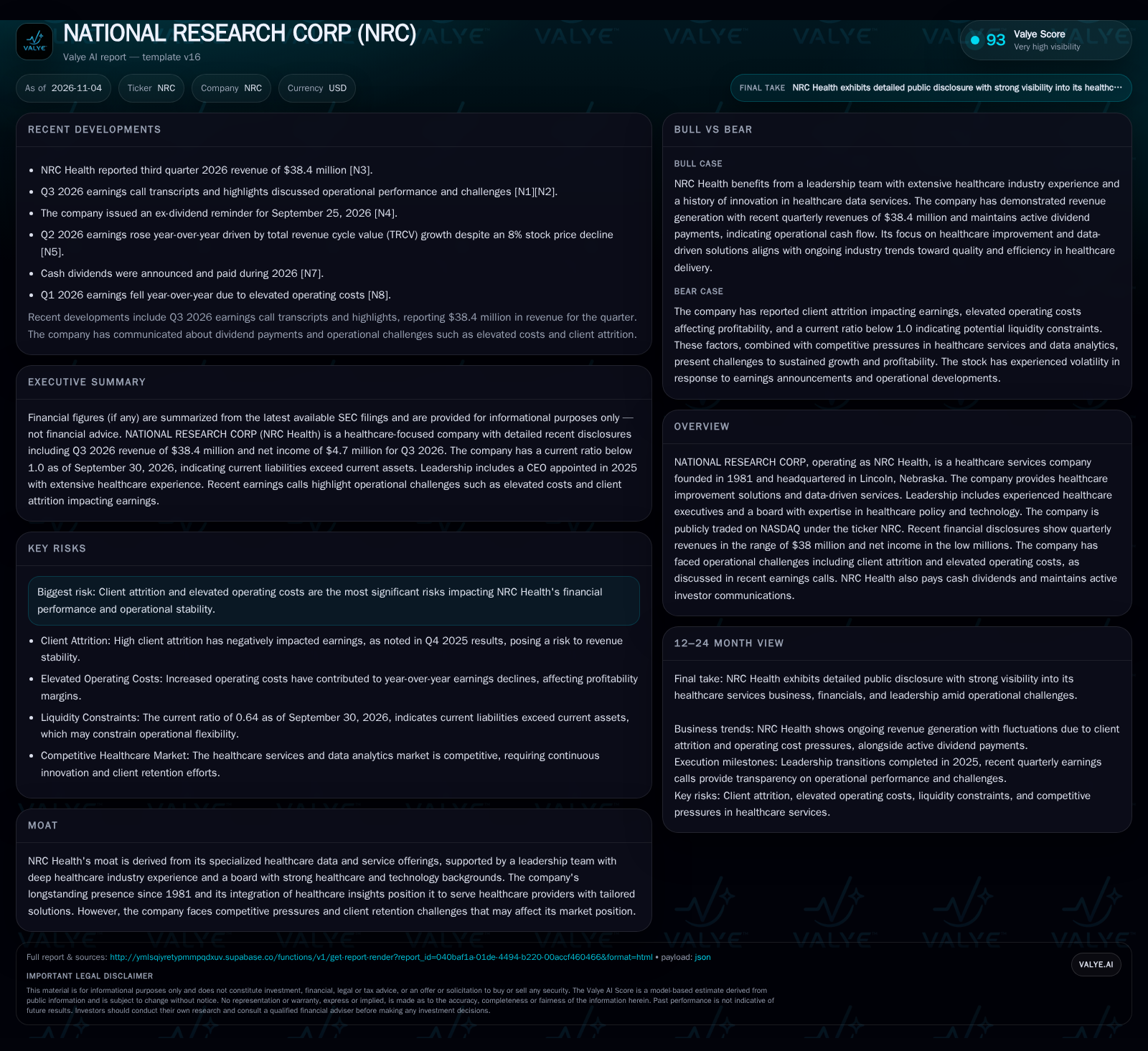
NRC Health reported $38.4 million in Q3 2026 revenue and $4.7 million in net income, but its current ratio of 0.64 signals that near-term liabilities outpace liquid assets. Leadership changes in 2025 underscore a strategic pivot, yet client attrition and rising costs challenge margin stability. The company’s long-term value will hinge on its ability to leverage data-driven solutions while navigating competitive and financial headwinds. [N3] [S2]
NRC Health stands at a turning point as it navigates the evolving demands of the healthcare data services market. With $38.4 million in Q3 2026 revenue and continued profitability, the company shows evidence of operational resilience. The cited source reports dividend-related activity; that disclosure alone does not establish dividend-policy continuity, management confidence, or a material constraint on capital flexibility. NRC’s future trajectory will largely depend on its ability to translate data-driven healthcare improvement into durable, defensible economics amid tightening financial conditions. [N3] [S2]
Recent Results Illuminate Growth and Financial Pressure
NRC Health reported $38.4 million in revenue and $4.7 million in net income for Q3 2026, confirming ongoing profitability despite industry headwinds. [N3] [S2] [S2] This indicates that near-term obligations outpace liquid resources, potentially constraining operational flexibility and investment capacity.
Leadership turnover—including the appointment of a new CEO in June 2025 and a CFO in September 2025—suggests a strategic pivot or response to changing market conditions. [S1] Meanwhile, the company has continued to pay cash dividends, even amid cost pressures and earnings fluctuations. [N4] [N7] Persistent challenges include client attrition and elevated operating costs, which have driven year-over-year earnings volatility through 2026. [N8]
How NRC Health’s Model Converts Data and Services into Profit
NRC Health operates in the healthcare improvement and data-driven services space, monetizing proprietary data, analytics, and consulting for provider organizations. Revenue is typically generated through contracts for survey solutions, patient experience measurement, and quality improvement tools. In a sector where recurring service contracts and data subscriptions can provide revenue visibility, NRC’s ability to lock in multi-year relationships would be a key driver of economic resilience—though current disclosures do not confirm the precise structure or duration of these arrangements.
Operating leverage is a plausible feature: once data infrastructure and analytics platforms are built, incremental customers can be served at relatively low marginal cost, potentially expanding margins as scale increases. However, NRC’s recent earnings volatility and cost pressures suggest that fixed costs (such as technology infrastructure and personnel) may be rising faster than revenue, or that variable costs are less controllable than assumed. Client attrition further complicates this dynamic, as replacing lost contracts may require higher sales and marketing expenditure.
Capital requirements are moderate for a data-driven services company, but the low current and cash ratios highlight a potential vulnerability to working capital shocks or delayed payments. The cited source reports dividend-related activity; that disclosure alone does not establish dividend-policy continuity, management confidence, or a material constraint on capital flexibility.
Specialization vs. Scale: NRC’s Place in the Healthcare Data Ecosystem
NRC Health’s competitive edge historically derives from its specialization in healthcare data, deep domain expertise, and long-standing relationships with provider organizations. The company’s board and leadership bring credibility and connections in the healthcare industry, which may help secure contracts with hospitals, health systems, and physician groups. However, the sector is crowded with both niche providers and larger data analytics firms, including diversified health IT vendors and consulting giants that offer integrated solutions.
Switching costs for healthcare providers can be meaningful if NRC’s data and insights are embedded in quality improvement processes, but evidence of explicit contract duration or renewal rates is not available. Competitive counterforces include increasing client sophistication, pressure to demonstrate ROI, and the risk of commoditization as analytics capabilities become more widespread. In addition, larger competitors may be able to cross-subsidize offerings or bundle services in ways that NRC cannot easily match.
Technology substitution is a credible threat: advances in AI-driven analytics and the proliferation of EHR-integrated solutions could erode NRC’s differentiation unless the company continues to innovate. The ability to deliver actionable insights, interoperability, and measurable improvement in patient outcomes will determine whether NRC can sustain premium pricing and client loyalty.
Unlocking Value Through Client Retention and Scalable Data Solutions
A favorable outcome for NRC Health would involve stabilizing and expanding its client base through improved retention and new wins, translating into sustained revenue growth and operating leverage. If the company can leverage its data assets and analytics capabilities to deliver demonstrable value—such as improved patient satisfaction scores, regulatory compliance, or cost savings—clients may be more willing to accept price increases or sign longer-term agreements.
Upside could also come from successful product innovation, such as new analytics modules or integration with emerging healthcare IT platforms, attracting additional provider segments. If NRC manages to control operating costs—either through automation or offshoring of non-core processes—margin expansion could follow.
Evidence that would confirm this scenario includes a rising client retention rate (if disclosed), sequential revenue growth above industry averages, improved gross or operating margins, and new product announcements that gain traction in the market. A reduction in dividend payout or a temporary halt could also signal a strategic focus on reinvestment for long-term growth.
Navigating Margin Pressure in a Competitive, Low-Liquidity Environment
The most plausible trajectory for NRC Health over the next 12-24 months is one of modest revenue growth offset by continued margin pressure. The company is likely to retain its core book of business but may struggle to accelerate top-line expansion in the face of client attrition and aggressive competition. Operating costs may remain elevated as NRC invests in technology and sales to defend its market position, while reported liquidity position constrains the pace of strategic initiatives.
The risk of a liquidity crunch increases if collections slow or if unexpected expenses arise. The scenario would be confirmed by stable but unremarkable revenue and earnings trends, persistent low current ratios, and relatively flat client or contract counts (if disclosed). Falsification would require a decisive improvement in margins or a step-change in client acquisition.
Margin Compression and Liquidity Stress Trigger Strategic Dilemmas
A negative scenario could develop if client attrition accelerates and NRC Health fails to replace lost revenue quickly enough, causing a sharper-than-expected decline in margins and operating cash flow. Elevated costs—whether from technology investments, wage inflation, or higher client acquisition expense—could further squeeze profitability. The company’s low current and cash ratios would then become acute, potentially forcing NRC to cut dividends, seek external financing on unfavorable terms, or even divest assets to meet obligations.
In this scenario, competitive pressures intensify as larger players or disruptive startups win share with more advanced or lower-cost solutions. If NRC cannot keep up with industry innovation or fails to demonstrate clear ROI to clients, contract renewals could drop and average deal sizes could shrink. Evidence supporting this scenario would include a sequential decline in revenue or net income, dividend reductions, further deterioration in liquidity metrics, and public disclosure of lost major clients or contracts.
Signals That Will Define NRC Health’s Next Chapter
Quarterly client retention and churn rates, if disclosed, would provide critical insight into NRC’s ability to defend its revenue base.
Trends in gross and operating margins over time—especially relative to peer benchmarks—will indicate whether cost pressures are being managed or worsening.
Changes in the current ratio and cash ratio in subsequent quarters will test the company’s ability to maintain operational flexibility.
Announcements of new product launches, partnerships, or major contract wins would suggest that NRC is innovating and gaining competitive traction.
Disclosures regarding the average duration and structure of customer contracts would help assess revenue visibility and switching friction.
Evidence of successful integration with emerging healthcare IT platforms or EHR systems would suggest NRC is adapting to technology shifts.
Disclaimer: This is research-only, informational analysis and not investment advice. It may include AI-generated interpretation and general industry context. Always verify important details using primary sources.

Comments