
Fastly’s AI Edge Ambitions: Can Liquidity and Cyber Discipline Drive a Turn to Profitability?
Fastly, Inc. is positioning itself as a leader in edge cloud infrastructure for AI-powered applications, leveraging a reported liquidity position and robust cybersecurity governance. The company’s persistent net losses and the competitive pressures of cloud and AI markets, however, underscore the challenge of translating innovation into sustainable profits.
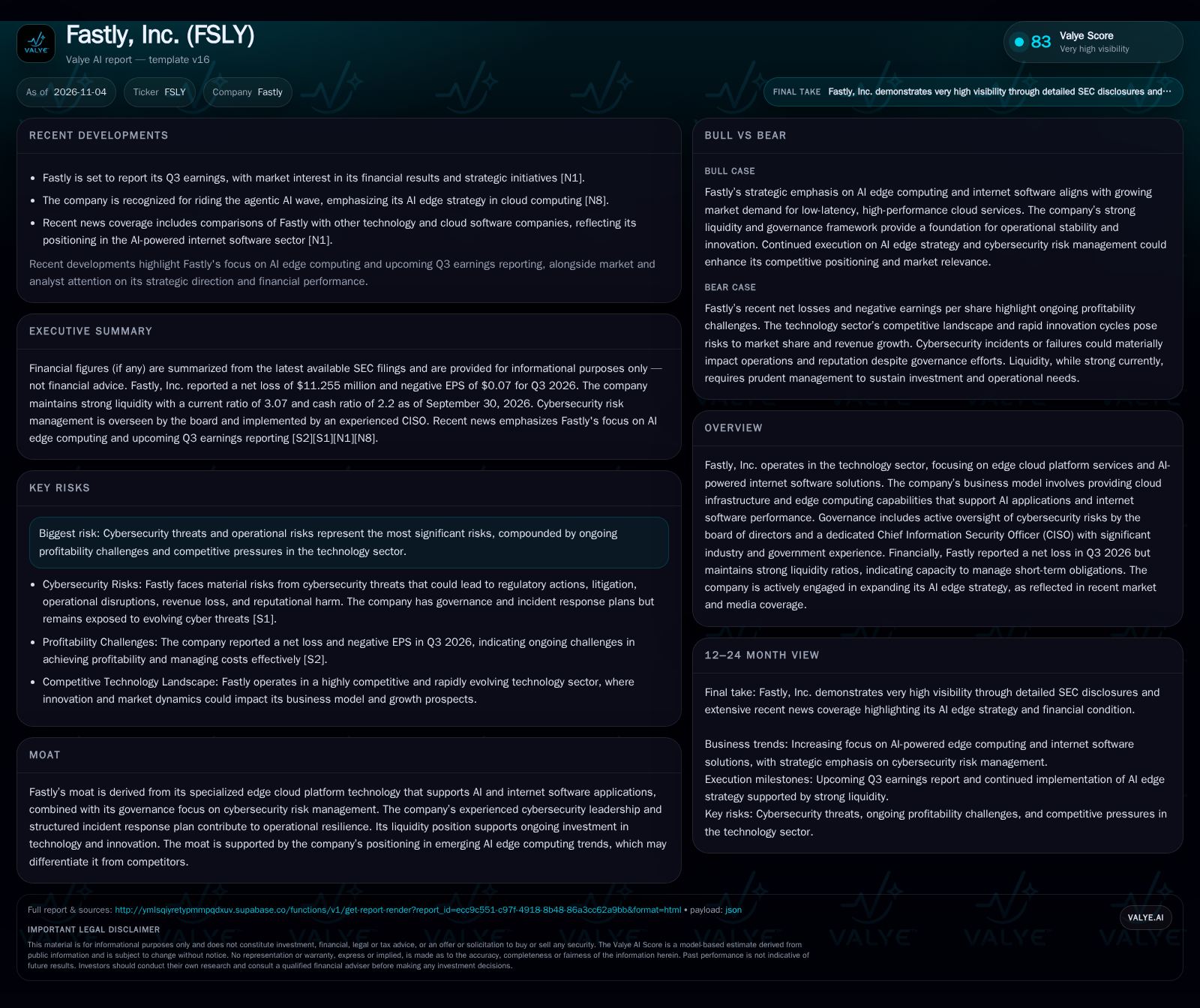
Fastly is expanding its AI edge strategy and maintains significant liquidity, but continues to report losses amid fierce competition in cloud infrastructure. The company’s cyber risk management is a governance strength, yet its path to profitability remains uncertain as the market awaits evidence of durable revenue growth and margin improvement. [S2] [N8]
Fastly, Inc. is doubling down on edge cloud platform services, aiming to capture a leading role in the deployment of AI-powered internet software. Yet, persistent net losses and the relentless pace of cloud and AI sector innovation raise the question of whether Fastly can convert its technological and strategic positioning into sustainable, scalable profits.
Liquidity Strength and AI Edge Focus Define Fastly’s Near-Term Position
Fastly reported a net loss of $11.255 million for Q3 2026, continuing a pattern of negative earnings per share (-$0.07) that highlights the company’s ongoing challenge to achieve profitability. Despite these losses, Fastly’s balance sheet shows $365.218 million in liquid assets—comprised of $113.506 million in cash and $251.712 million in short-term investments—against current liabilities of $165.659 million, yielding a current ratio of 3.07 and a cash ratio of 2.2. The company’s board and CISO maintain active oversight of cybersecurity risk, a governance attribute that may become increasingly important as the company expands its AI edge computing initiatives. Coverage in late 2026 emphasizes Fastly’s commitment to the agentic AI trend and upcoming earnings as key strategic signals. [S2] [N8] [N1]
The Economics of Edge Cloud: Margins, Scale, and Capital Allocation
Fastly’s business model is predicated on delivering edge cloud infrastructure and services that enable low-latency, high-performance AI and internet software applications. Revenue is likely driven by a mix of usage-based fees, enterprise contracts, and platform integrations, though precise commercial mechanics are not specified in the current disclosures. The edge cloud paradigm typically exhibits high fixed infrastructure costs—data centers, global network buildout, and R&D—offset by the possibility of strong operating leverage if customer volumes scale. Variable costs are driven by bandwidth, compute, and support. Gross margins in this space can be pressured by intense price competition and the need to subsidize new AI capabilities, but may improve as value-added services (such as security and AI inferencing at the edge) gain traction.
However, persistent net losses suggest that either top-line growth or cost discipline—or both—must improve to achieve sustainable profitability. A critical economic question is whether Fastly can build sufficient scale and differentiation in its AI edge offerings to command premium pricing or drive higher utilization, thereby unlocking the operating leverage inherent in the model.
Edge Computing Battleground: Differentiation Versus Deep-Pocketed Rivals
Fastly operates in a fiercely contested field that includes hyperscale cloud providers (such as the major public cloud platforms), specialized content delivery networks (CDNs), and emerging AI infrastructure players. Its edge cloud platform is differentiated by a focus on low-latency, programmable infrastructure and a growing suite of AI-enabled services. This positions Fastly to serve use cases that require real-time data processing close to end users—an increasingly important requirement for agentic AI applications and next-generation internet software.
However, the company faces formidable counterforces: hyperscalers can bundle edge and AI services with their broader cloud offerings, leveraging scale, integrated ecosystems, and aggressive pricing. Specialized CDNs and pure-play edge companies are also innovating rapidly. Fastly’s moat, if it develops, will likely depend on continued technical differentiation—such as developer-friendly APIs, seamless security integration, and superior performance for AI workloads—rather than scale alone. Retention and expansion metrics, if disclosed, would illuminate whether Fastly’s platform is sticky enough to defend against switching and price pressure.
If AI Edge Adoption Accelerates: Pathways to Operating Leverage and Strategic Relevance
The most favorable scenario for Fastly rests on accelerated adoption of AI-powered applications that require edge processing for latency, privacy, or bandwidth reasons. If Fastly’s platform is recognized as a critical enabler for these workloads, the company could see a step-change in customer acquisition and usage volumes. This, in turn, would drive higher utilization of its fixed infrastructure, improve gross margins, and potentially shift the company toward profitability as operating leverage kicks in.
Confirmation of this scenario would come from several fronts: sustained double-digit revenue growth tied to AI and edge use cases, disclosure of major enterprise wins in AI verticals, and margin expansion as platform utilization rises. Evidence that Fastly is able to cross-sell AI services to existing CDN customers, or that it is displacing competitors in high-value, latency-sensitive applications, would strengthen the case. Conversely, if revenue growth remains tepid or gross margins stagnate despite AI investments, the upside thesis would be undermined.
Likely Trajectory: Incremental Gains Amid Margin Pressure and Competitive Noise
The most plausible path for Fastly in the next 12–24 months is one of incremental revenue growth, continued investment in AI edge capabilities, and persistent but narrowing net losses. Fastly may achieve moderate share gains in selected AI-driven verticals or geographic regions, but hyperscale rivals and specialized competitors will cap the pace of market penetration.
Evidence for this scenario would include single-digit to low double-digit revenue growth, stable or slightly improving gross margins, and operating expenses that remain high relative to revenue as the company invests for future growth. If Fastly can demonstrate improved retention or wallet share among AI-focused customers, this would support a gradual path to breakeven. Conversely, if revenue decelerates or losses widen as AI investments fail to pay off, the base case would shift toward the downside.
When Innovation Isn’t Enough: Erosion from Scale, Churn, or Security Events
On the negative side, Fastly could be squeezed by larger cloud providers’ ability to bundle and discount edge and AI services, making it difficult to retain or acquire high-value customers. If competitors outpace Fastly in performance, features, or developer experience, switching costs could prove low, leading to elevated churn and stagnant or declining revenues. Persistent net losses could erode the company’s liquidity buffer, forcing cost cuts or dilutive capital raises.
A major cybersecurity incident—despite governance and incident response protocols—could also inflict reputational and financial damage, especially given the company’s positioning as an infrastructure provider for sensitive, AI-driven workloads. Confirmation of downside risk would come from declining revenue, contracting gross margins, customer or logo losses, or any material security event that triggers regulatory or customer backlash. Conversely, resilience in revenue and customer metrics, or containment of security events, would help refute this scenario.
What Will Determine Fastly’s Ability to Monetize the AI Edge Opportunity?
Revenue growth rates specifically attributable to AI and edge services, if disclosed, would clarify whether Fastly’s strategic pivot is yielding tangible business wins.
Gross margin trends quarter over quarter will reflect the company’s ability to drive operating leverage from its fixed infrastructure and value-added services.
Customer retention and expansion metrics, if disclosed, would test the stickiness and competitive strength of Fastly’s platform against hyperscale and specialized rivals.
The pace of new enterprise customer signings in AI-intensive verticals would serve as a proxy for the company’s relevance in the agentic AI wave.
Operating expense discipline—whether the company can slow expense growth while sustaining innovation—will be critical for the path to profitability.
Disclosure of significant cybersecurity events or regulatory actions would shape the risk profile for both customers and investors.
Liquidity drawdown rates (burn rate) and any additional capital raises or financing activity would test the sufficiency of Fastly’s current balance sheet to support its growth ambitions.
Disclaimer: This is research-only, informational analysis and not investment advice. It may include AI-generated interpretation and general industry context. Always verify important details using primary sources.

Comments