
Rayonier Advanced Materials: Cellulose Leadership Tested by Margin Pressure and Operational Realignment
A global specialist in high-purity cellulose products, RYAM faces the dual challenge of persistent net losses and a shifting asset base. With the Temiscaming plant shuttered and input costs volatile, the company leans on specialty cellulose and biomaterials for margin recovery—yet the path to sustainable profitability remains uncertain.
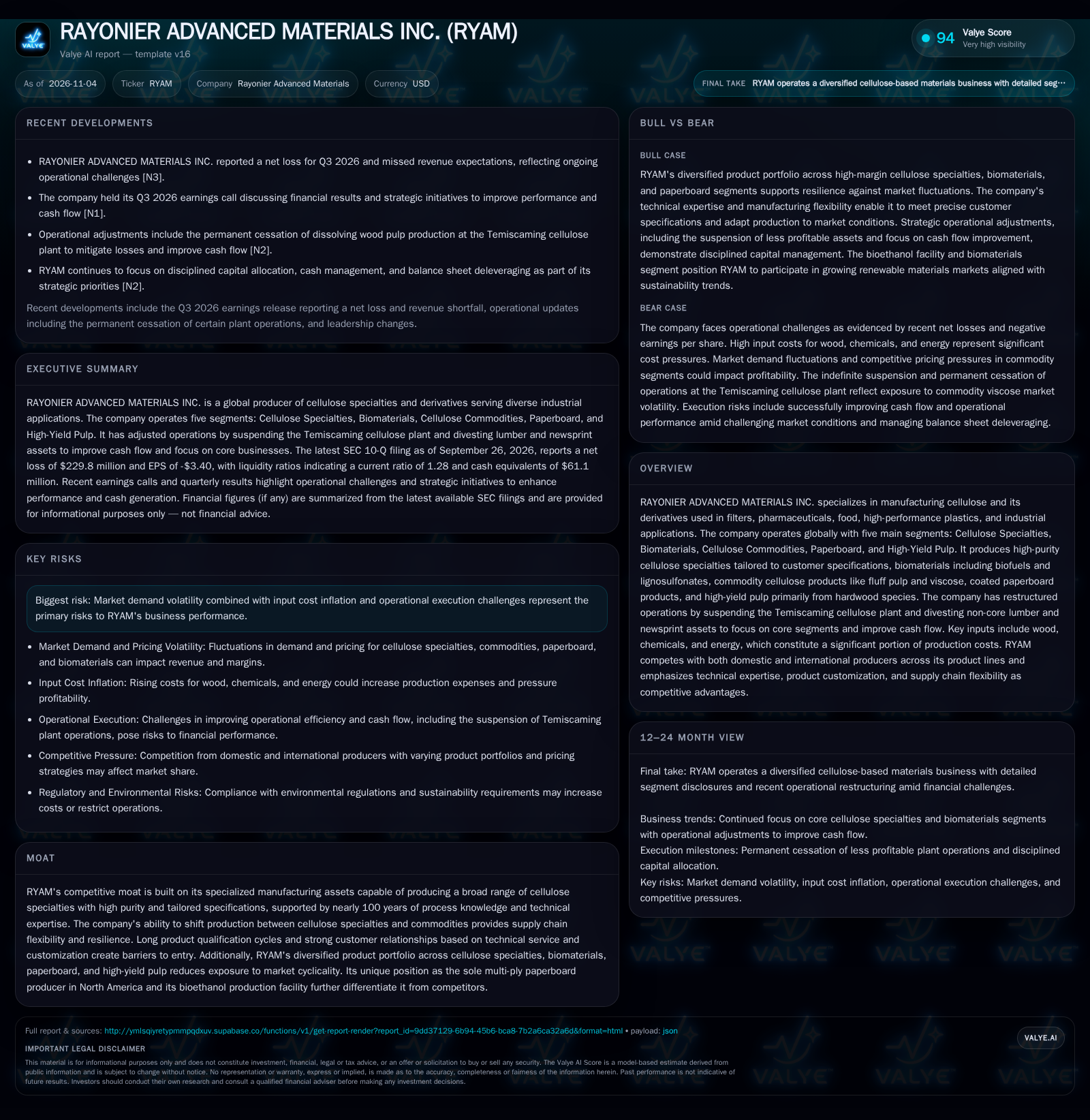
Rayonier Advanced Materials (RYAM) reported a Q3 2026 net loss of $229.8 million, reflecting ongoing margin pressure despite a strategic focus on high-purity cellulose specialties and biomaterials. The permanent closure of its Temiscaming plant marks a decisive shift away from volatile commodity segments. The company’s ability to improve cash flow and leverage technical differentiation in premium cellulose markets will be critical as it navigates input cost risks and intense global competition. Liquidity remains tight, with $61.1 million in cash and a current ratio of 1.28 at the end of Q3 2026. Execution on restructuring and capturing premium pricing in niche segments are the main levers for recovery.
Rayonier Advanced Materials, long recognized for its technical prowess in high-purity cellulose and derivatives, is undergoing a period of acute financial and operational stress. The company’s Q3 2026 net loss and the strategic closure of its Temiscaming facility underscore the risks inherent in commodity exposure and input cost volatility. As RYAM pivots toward higher-margin specialties and bio-based products, the central question becomes whether its advanced manufacturing capabilities and customer-centric model can restore sustainable profitability amid stiff global competition and cost inflation.
Recent Losses and Strategic Plant Shutdown Redefine RYAM’s Operating Baseline
Rayonier Advanced Materials reported a net loss of $229.8 million for the quarter ended September 26, 2026, translating to basic and diluted EPS of -$3.40. As of quarter-end, the company’s cash and equivalents stood at $61.1 million, and its current ratio was 1.28 [S2]. These figures highlight ongoing financial strain and reported liquidity position, placing a premium on cash generation and operational discipline.
The permanent closure of the Temiscaming plant, which followed an indefinite suspension in July 2024, marks a significant operational pivot. By exiting dissolving wood pulp production at this site, RYAM aims to stem losses associated with volatile commodity segments and concentrate resources on higher-margin businesses [S1] [N2].
Recent earnings calls and results underscore management’s focus on disciplined capital allocation, deleveraging, and a shift toward core segments such as cellulose specialties and biomaterials [N1] [N3]. This realignment is intended to improve cash flow and shield the company from the cyclicality and margin compression endemic to commodity pulp markets.
How Product Mix and Input Costs Drive Margin Volatility
RYAM’s revenue model is anchored in the sale of cellulose specialties, biomaterials, commodity cellulose, paperboard, and high-yield pulp. The company’s ability to command premium pricing is most pronounced in the cellulose specialties segment, where products are tailored for high-purity applications in pharmaceuticals, food, and advanced materials. These contracts often involve rigorous qualification processes and technical collaboration, potentially supporting longer-term customer relationships and price stability.
By contrast, the commodity cellulose and high-yield pulp segments are exposed to global market pricing, resulting in earnings volatility and lower margins. The company’s biomaterials segment, which includes 2G bioethanol and lignosulfonates, offers diversification and taps into renewable chemicals and fuels markets, though the scale and margin contribution from these products may be less predictable.
A critical economic lever is the cost structure: wood, chemicals, and energy together account for 35-50% of cost of sales, with volatility in these inputs able to quickly erode margins [S1]. Fixed costs remain high due to the capital-intensive nature of specialty cellulose production. This creates a scenario where operating leverage can amplify both upswings and downturns, particularly when plants are run below optimal capacity.
The company’s recent plant closures and asset sales reflect an attempt to realign the fixed-cost base with realistic volume expectations. However, the success of this strategy depends on sustained premium pricing in specialties and the ability to keep variable costs in check. The path to deleveraging and restoring profitability may require further capital discipline, possible restructuring charges, and ongoing investment in process innovation.
Technical Differentiation Versus Global Commodity Pressures
RYAM’s competitive positioning relies on its technical expertise in high-purity cellulose, flexible manufacturing assets, and the ability to customize products to exacting customer specifications. These attributes could increase switching costs and long qualification cycles, which can insulate the business from pure price-based competition in specialty segments.
However, the company faces formidable competition from both domestic and international producers, including Bracell, Borregaard, Sappi, and others [S1]. Many of these competitors have global scale, diversified product portfolios, and access to low-cost feedstocks. In commodity cellulose and pulp, price is often the primary differentiator, limiting the ability of any single producer to sustain above-market margins.
A further challenge is the threat of substitution—synthetic fibers, alternative packaging materials, and bio-based chemicals from new entrants could erode demand for traditional cellulose derivatives. RYAM’s participation in biomaterials and bioethanol production is an attempt to address this risk and capture growth from sustainability-driven market shifts.
The company’s position as the sole multi-ply paperboard producer in North America and its technical service orientation provide some insulation from commoditization, but continued investment in process innovation and customer relationships is required to maintain this edge.
Margin Expansion If Specialty Cellulose and Biomaterials Gain Traction
A favorable trajectory for RYAM would see the company leveraging its technical strengths to grow share and pricing power in cellulose specialties and biomaterials. If the company can secure new multi-year contracts in high-purity applications—such as advanced filtration, pharmaceuticals, or specialty plastics—this could drive volume growth at premium margins, offsetting declines in commodity segments.
The biomaterials segment, specifically 2G bioethanol and lignosulfonates, could become a more meaningful contributor if regulatory and customer demand for sustainable inputs accelerates. Successful commercialization of new bio-based products or the ability to pass through input cost inflation to customers would further enhance margins.
Evidence that would confirm this scenario includes: sustained or rising average selling prices in the specialties segment, new contract awards with long-term visibility, expanding gross margins, and revenue growth outpacing commodity pulp peers. Reduction in net debt and positive free cash flow would also support the upside thesis.
Stabilization Through Cost Discipline and Niche Focus
The most plausible near-term scenario is one of operational stabilization: RYAM continues to rationalize its asset base, containing fixed costs and focusing on core, higher-value segments. Revenue growth remains modest, with cellulose specialties and biomaterials offsetting ongoing softness in commodity pulp and paperboard.
Profitability may remain under pressure, but the company could gradually improve cash generation through tighter working capital management, selective price increases, and incremental process improvements.
Confirmation of this base outcome would be: narrowing net losses, stable or modestly improving gross margins, evidence of working capital efficiency, and no further major asset impairments or plant closures. A gradual reduction in leverage and steady progress on deleveraging targets would also support the base scenario.
Prolonged Losses If Input Costs and Commodity Weakness Persist
The adverse case for RYAM centers on continued input cost inflation, weak demand in commodity segments, and the inability to capture sufficient premium in specialties to offset these headwinds. If wood, chemical, or energy prices spike, or if global commodity pulp prices fall further, the company’s high fixed-cost structure could drive deeper operating losses.
Further plant shutdowns or asset sales may be required to contain cash burn, potentially at the expense of future revenue streams. Delays or failures in commercializing new biomaterials or securing specialty contracts could exacerbate revenue and margin pressure.
Downside confirmation would include: widening net losses, further cash balance erosion, negative free cash flow, and additional restructuring charges. Weakening customer demand or loss of major contracts in the specialties segment would also signal a deteriorating outlook.
Milestones That Will Reveal RYAM’s Operational and Margin Recovery Trajectory
Sustained or rising average selling prices and gross margins in the cellulose specialties segment would help validate margin improvement efforts.
Execution on new, multi-year specialty cellulose or biomaterial contracts—if disclosed—would demonstrate the ability to secure premium, recurring business.
Quarterly trends in cash flow from operations, with positive free cash flow signaling stabilization.
Progress on net debt reduction and deleveraging targets, as reported in future filings.
Volume and capacity utilization metrics for core specialty and biomaterials facilities—if disclosed—would indicate whether fixed costs are being absorbed efficiently.
Any further plant closures, asset sales, or restructuring charges would suggest continued operational or financial distress.
Updates on input cost trends (wood, chemicals, energy) and the company’s ability to pass through cost increases to customers.
Disclaimer: This is research-only, informational analysis and not investment advice. It may include AI-generated interpretation and general industry context. Always verify important details using primary sources.

Comments