
Harley-Davidson in 2026: Strategic Reset, Segment Dynamics, and the Stakes of Brand Evolution
Harley-Davidson's Q3 2026 results reflect a company in transition: legacy internal combustion motorcycles anchor revenue, while electric ambitions and financial services reshape the long-term narrative. Execution of the new strategic plan, competitive responses, and evolving consumer preferences could determine whether the brand's century-old moat endures or erodes.
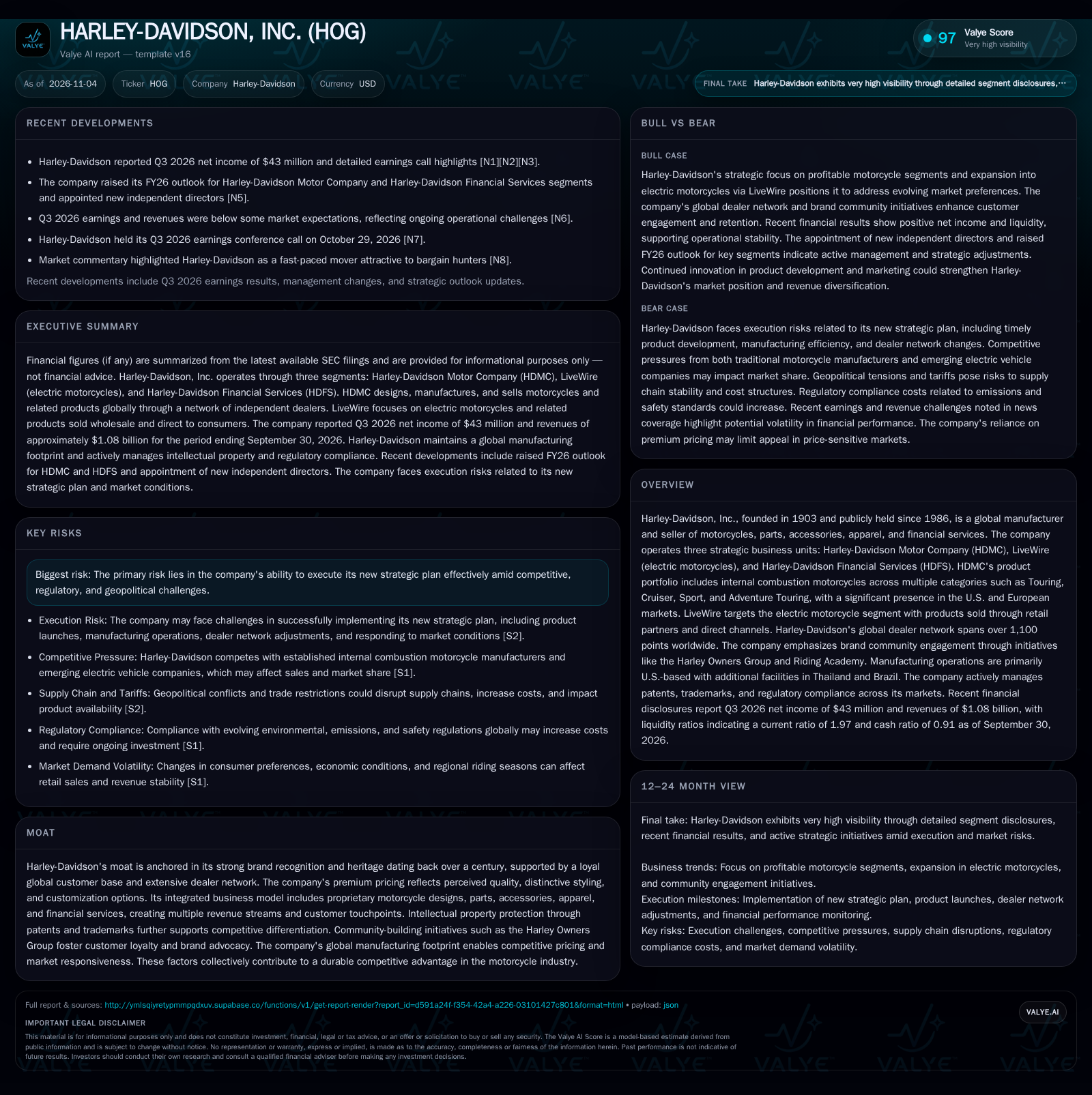
Harley-Davidson reported Q3 2026 net income of $43 million on $1.08 billion in revenue, as its core motorcycle business faces operational and market pressures. The company raised its FY26 outlook for motorcycles and financial services, reflecting confidence in selective segments. Execution risk around the new strategic plan—spanning product development, electrification, and dealer network evolution—remains the central variable for long-term value.
Harley-Davidson enters late 2026 at a strategic crossroads: its legacy business delivers consistent, if pressured, profitability, while the company bets on electrification and financial services for future growth. Recent financial results highlight both the resilience and vulnerabilities of the traditional motorcycle franchise. With a new strategic plan now in place—following the close of its 'Hardwire' program—the stakes are high for execution across product development, manufacturing, and dealer transformation. The question is whether Harley can reinvent its brand for the next generation of riders without sacrificing the core economics that have defined its moat.
Recent Results and Strategic Shifts Set the Stage
Harley-Davidson reported Q3 2026 net income of $43 million and revenue of $1.08 billion, reflecting ongoing profitability but also operational pressures as earnings missed some market expectations [S2] [N3] [N6]. The company raised its FY26 outlook for its core motorcycle (HDMC) and financial services (HDFS) segments, suggesting management’s confidence in these areas despite short-term challenges [N5]. Harley also repurchased 3.4 million shares in Q3, continuing its capital return strategy [S2]. Notably, the 2025 conclusion of 'The Hardwire' plan and the announcement of a new strategic plan in Q1 2026 signal a pivot point: the company must now execute on refreshed priorities, including electrification and global dealer evolution [S1]. These developments frame a period of heightened execution risk and strategic ambiguity.
How Harley-Davidson’s Multi-Segment Model Drives Profitability—and Complexity
Harley-Davidson’s revenue model is anchored by its internal combustion motorcycle business, with 74.3% of 2025 revenue from motorcycles, 17.2% from parts and accessories, 6.0% from apparel, and 0.6% from licensing [S1]. This mix illustrates a classic high-ticket durable-goods business with meaningful aftermarket and brand monetization. Gross margins in the core motorcycle segment are typically supported by premium pricing and brand loyalty, but face cyclical volume risk and high fixed costs in manufacturing, distribution, and R&D.
Parts, accessories, and apparel provide higher-margin, recurring revenue streams tied to the installed base, while licensing offers brand-leverage with minimal capital outlay. The rise of Harley-Davidson Financial Services (HDFS) adds a credit-based earnings stream, but introduces credit risk and capital requirements—especially in economic downturns.
LiveWire, the electric motorcycle unit, is currently a small contributor but represents a capital-intensive bet on future relevance. The economics here are uncertain: electric motorcycles may command premium pricing but face steep R&D, battery, and distribution costs, and their volume trajectory is unproven. The company’s global manufacturing footprint—spanning the U.S., Thailand, and Brazil—offers cost and trade flexibility, but also operational complexity and exposure to geopolitical risks [S1].
Brand, Community, and the Challenge from New Entrants
Harley-Davidson’s enduring advantage is its brand: a century-old symbol of Americana, individualism, and motorcycle culture, with a loyal global customer base reinforced by initiatives like the Harley Owners Group and Riding Academy [S1]. This brand equity underpins premium pricing, customer retention, and a robust aftermarket ecosystem.
However, competitive threats are intensifying. Traditional motorcycle manufacturers compete aggressively on price, features, and distribution, while emerging electric vehicle (EV) entrants—both legacy OEMs and startups—target the next generation of riders with new technology and design. LiveWire’s success will depend on whether Harley can bridge its heritage with the demands of EV consumers, who may value different brand attributes and buying experiences.
The global dealer network (1,174 points as of 2025) is both an asset and a liability: it enables reach and service, but can slow adaptation to new retail models and lock in fixed costs [S1]. Regulatory pressures—especially emissions and safety standards—favor those able to invest in compliance and innovation, but also raise costs and create execution risk [S1] [S2].
If Electrification Gains Traction and the New Plan Delivers
A favorable scenario sees Harley-Davidson’s new strategic plan succeeding on several fronts. First, the company could leverage its brand and dealer network to drive adoption of both premium internal combustion and electric motorcycles, using LiveWire to access new, younger, and urban demographics. If LiveWire’s product lineup finds market fit—especially in the U.S. and European cities with tightening emissions rules—Harley could build a second engine of growth with higher margin potential as scale improves.
Parts, accessories, and apparel could see renewed growth as new and existing riders engage with the brand’s expanded ecosystem. Financial services could benefit from stable credit performance and higher origination volumes if motorcycle sales recover or grow.
Evidence confirming this scenario would include: accelerating LiveWire sales, margin improvement in electric motorcycles, sustained or growing core motorcycle volumes, stable or expanding dealer count, and upward revisions to segment guidance.
Legacy Strengths Offset by Transition Challenges
The most plausible path is a blend of resilience and friction. Harley-Davidson’s core internal combustion business remains profitable but faces flat or modestly declining volumes in mature markets, offset in part by price discipline and strong aftermarket sales. Parts, accessories, and apparel help stabilize margins, while HDFS maintains steady, if cyclical, profitability.
LiveWire grows slowly, constrained by high costs and uncertain consumer uptake, but provides optionality as regulatory and consumer preferences shift. The new strategic plan delivers incremental improvements—operational efficiency, selective new product launches, and dealer rationalization—but does not fundamentally alter the growth trajectory in the near term.
Evidence for this scenario: Stable or modestly declining motorcycle unit sales, limited but positive LiveWire contribution, consistent aftermarket revenue, and management reiterating guidance without major upward or downward revisions.
What If Execution Falters and Market Preferences Shift Faster Than Anticipated?
The adverse scenario centers on execution risk: delayed or poorly received new products, manufacturing disruptions, or dealer attrition undermine the new strategic plan’s objectives. If LiveWire fails to gain traction and core motorcycle volumes erode faster than pricing or aftermarket can compensate, revenue and margin pressure could intensify.
Regulatory changes (e.g., stricter emissions rules) or tariff shocks could raise costs or limit market access, while increased competition from both legacy brands and aggressive EV entrants compresses share and pricing power. HDFS could face higher credit losses if macroeconomic conditions deteriorate.
Signals that would confirm this downside: accelerating declines in core motorcycle sales, persistent LiveWire losses with minimal sales growth, dealer network contraction, and repeated downward revisions to guidance or profitability.
What Will Determine Harley-Davidson’s Long-Term Value Proposition?
LiveWire sales volume and gross margin trajectory—if disclosed—will be critical to assess the scalability and profitability of Harley’s electric transition.
Year-over-year changes in global motorcycle unit sales, especially in the U.S. and Europe, would help test the resilience of the core business.
Dealer network size and composition: growth, rationalization, or attrition trends could indicate execution success or friction in the new plan.
Aftermarket (parts, accessories, apparel) revenue growth rates would demonstrate the health of Harley’s ecosystem and brand monetization.
HDFS asset quality metrics (e.g., delinquencies, charge-offs)—if disclosed—are essential for assessing financial services risk in a changing market.
Updates on regulatory compliance costs and capital expenditure guidance would clarify the burden and timing of emissions/safety investments.
Progress against stated milestones in the new strategic plan (e.g., product launches, market entries, cost targets) should be tracked to test execution.
Management guidance revisions—upward or downward—offer a real-time read on confidence and operational momentum.
Disclaimer: This is research-only, informational analysis and not investment advice. It may include AI-generated interpretation and general industry context. Always verify important details using primary sources.

Comments