
LiveWire’s Liquidity Crossroads: Electric Motorcycle Ambition Meets Funding Reality
LiveWire Group, Inc. leverages strategic partnerships and recent portfolio expansion to compete in the electric motorcycle market, but faces a critical inflection point as substantial doubt mounts over its ability to fund ongoing operations. The interplay of capital intensity, market adoption, and restructuring options will define the company’s next chapter.
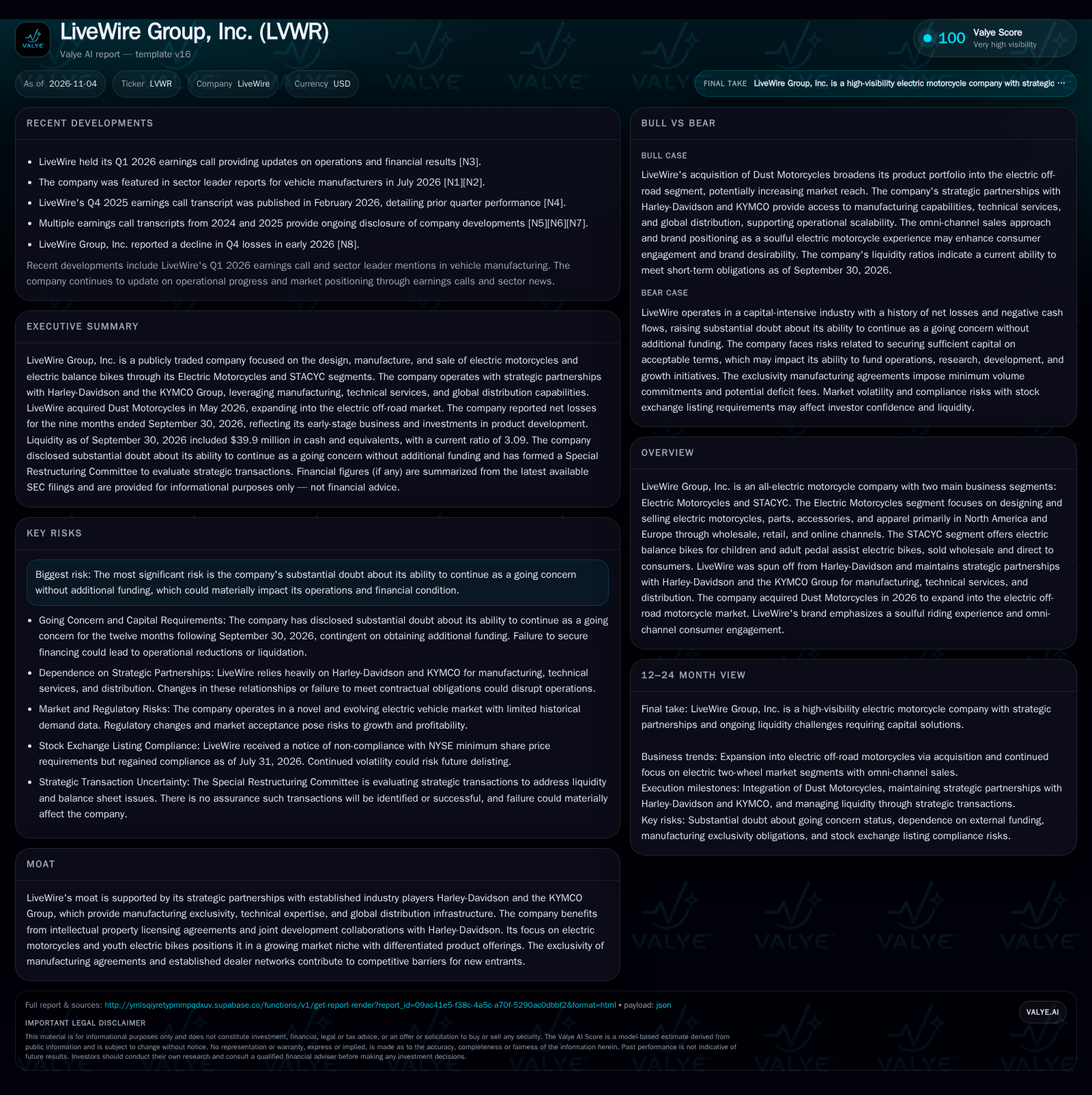
LiveWire Group, Inc. is a leading electric motorcycle company with strategic ties to Harley-Davidson and KYMCO, operating in both premium electric motorcycles and youth/adult e-bikes. Despite a broadened product lineup and improved segment losses, LiveWire faces a capital crunch, having disclosed substantial doubt about its ability to continue as a going concern without new funding. The company is actively exploring restructuring or financing solutions, and its ability to secure capital will be decisive for its future as it integrates new off-road offerings and strives to scale in a still-nascent market. [S2]
LiveWire Group, Inc. stands at a pivotal moment: it is a high-profile electric motorcycle company with deep ties to Harley-Davidson and a recently expanded product portfolio, yet faces acute funding uncertainty as losses persist and capital needs remain high. The company’s operational improvements and strategic moves—such as the Dust Motorcycles acquisition—are overshadowed by a public admission of substantial doubt about its ability to continue as a going concern. As LiveWire explores restructuring and financing options, its future will hinge on capital access, execution in a maturing but still unproven electric motorcycle market, and its ability to leverage partnerships without being constrained by exclusivity agreements.
Liquidity Concerns and Strategic Review Define the Near-Term Outlook
LiveWire’s most material current facts are its continued net losses, the acute disclosure of substantial doubt about its ability to continue as a going concern, and the initiation of a formal restructuring process. In Q3 2026, the company reported a net loss of $18.6 million, with a nine-month cumulative net loss of $55.0 million—slightly improved from prior periods, but still indicative of persistent negative cash flow [S2]. As of September 30, 2026, LiveWire’s liquidity comprised $39.9 million in cash and equivalents, a current ratio of 3.09, and a cash ratio of 1.97 [S2]. Despite these descriptive metrics, management has formally disclosed substantial doubt about the company’s ability to operate for the next twelve months without new capital. In response, a Special Restructuring Committee and Chief Restructuring Officer have been appointed to evaluate financing, sale, or recapitalization options [S2]. These developments position LiveWire at a critical juncture where capital access, not just operational progress, will determine its trajectory.
Capital Intensity, Margin Structure, and the Challenge of Scaling Electric Motorcycles
LiveWire’s business model is defined by two segments: premium electric motorcycles and the STACYC line of youth/adult e-bikes. The electric motorcycle segment is inherently capital intensive, requiring substantial investment in R&D, tooling, inventory, and dealer support. The addition of Dust Motorcycles adds off-road dirt bikes to the portfolio, potentially increasing fixed costs but broadening revenue opportunities [S2].
The company’s economics are likely characterized by high upfront development and production costs, with gross margins constrained by low-to-moderate volume, especially in a market where electric motorcycles remain a niche. Variable costs could decline with scale, but LiveWire’s operating leverage is not yet positive: segment losses persist, albeit with some improvement year-over-year [S2]. Pricing power in the premium segment is plausible given the brand’s positioning and Harley-Davidson legacy, but the elasticity of demand for electric motorcycles at current price points remains uncertain. STACYC, with a broader addressable market and lower price points, may offer better unit economics but is unlikely to offset the capital requirements of the flagship motorcycle business in the near term. The company’s ongoing losses and need for additional funding illustrate the long cash conversion cycle and the lag between investment and profitable scale.
Strategic Partnerships, Brand Legacy, and Barriers—But the Market Remains Fragmented
LiveWire’s competitive position is anchored by strategic partnerships with Harley-Davidson and KYMCO, which provide access to manufacturing, technical expertise, and global distribution [S2]. These relationships confer real advantages in credibility, supply chain efficiency, and go-to-market capability, but also introduce counterforces: Harley-Davidson is the exclusive manufacturer for a six-year period, with volume commitments that could become a liability if demand lags [S2].
The electric motorcycle market remains fragmented, with competition from established motorcycle brands investing in electrification, as well as newer entrants and Chinese manufacturers targeting lower price points. LiveWire’s focus on a ‘soulful’ riding experience and omni-channel journey seeks to differentiate its brand, but the company must contend with technology substitution risk, evolving consumer preferences, and the challenge of educating a market not yet at mass adoption. The STACYC segment faces less entrenched competition, but its contribution to overall corporate economics is limited by scale. The key question is whether LiveWire can convert its pedigree and partnerships into a defensible market share before incumbent brands and high-volume competitors erode the premium electric niche.
How a Capital Infusion and Off-Road Expansion Could Catalyze Profitable Scale
In a favorable scenario, LiveWire secures sufficient funding—potentially through equity issuance, strategic investment, or a successful restructuring—to address its near-term liquidity gap. This capital would allow continued investment in R&D, product launches, and dealer expansion, while the integration of Dust Motorcycles could open new revenue streams in the off-road segment. If electric motorcycle adoption accelerates and LiveWire leverages its partnerships to drive volume, operating leverage could improve, narrowing losses and setting a path toward break-even.
Confirmation of this scenario would include evidence of fresh capital raised or a strategic partner injecting funds, consistent revenue growth from both the core and Dust-acquired offerings, and narrowing operating losses despite ongoing investment. Early signs of market share gains or positive dealer feedback on new models would further support the bull case. Falsification would come from failure to secure funding, stalled product launches, or continued deep losses despite increased investment.
Restructuring Uncertainty and a Slow March Toward Market Validation
The most plausible path is one of continued operational improvement but with major strategic uncertainty. LiveWire may secure interim funding or partial asset sales that provide runway but not transformative scale. The company’s losses may continue to narrow as it integrates Dust Motorcycles and leverages its partnerships, but the overall market for electric motorcycles is likely to remain nascent, with adoption slower than hoped.
This scenario would be confirmed by evidence of incremental financing (such as modest ATM equity sales), continued but modest revenue growth, and further but unspectacular reductions in operating losses. The restructuring process may not result in a sale or major recapitalization, but could yield new cost controls or renegotiated supplier agreements. Falsification would be rapid acceleration—positive or negative—such as a major strategic transaction, abrupt loss of partnership support, or a severe liquidity event.
Funding Shortfall Forces Drastic Restructuring, Asset Sales, or Liquidation
In a negative outcome, LiveWire fails to secure new capital on acceptable terms, exhausting its cash reserves before achieving scale or profitability. In this scenario, the company could be forced to undertake drastic restructuring, including asset sales, layoffs, or even voluntary liquidation. The exclusivity and minimum volume obligations with Harley-Davidson could exacerbate financial strain if sales lag, while fixed costs tied to manufacturing and R&D become unsustainable.
Evidence for this scenario would include unsuccessful capital raises, missed payments to suppliers or creditors, rapid acceleration of cost-cutting, or public disclosure of bankruptcy-related processes. Further signals would be the loss of key partnerships, delisting risk re-emerging, or a breakdown in the restructuring process. Falsification would require clear evidence of a robust capital raise or a rapid shift in market demand driving positive cash flow.
Milestones That Will Determine LiveWire’s Viability and Market Position
Updates on the outcome of the Special Restructuring Committee’s review, including any announced financing, sale, or recapitalization.
Disclosure of new capital raised—via ATM issuance, private placement, strategic investment, or debt facility—including terms and dilution.
Quarterly trends in operating losses and cash burn, as narrowing losses or positive cash flow would validate improved economics.
Integration milestones and early sales data for Dust Motorcycles’ off-road products, indicating traction in the new segment.
Dealer network expansion or contraction, especially in Europe and North America, which would signal brand momentum or retrenchment.
Evidence of renegotiated volume commitments or exclusivity terms with Harley-Davidson, which could relieve or intensify financial pressure.
If disclosed, unit sales growth, average selling prices, and gross margin by segment to clarify adoption and pricing power.
Ongoing compliance with NYSE listing standards, as non-compliance could trigger further liquidity or reputational challenges.
Disclaimer: This is research-only, informational analysis and not investment advice. It may include AI-generated interpretation and general industry context. Always verify important details using primary sources.

Comments