
InPoint Commercial Real Estate Income: Navigating Income Stability Amid Sector Cyclicality
With steady profitability and a sizable cash reserve as of Q3 2026, InPoint Commercial Real Estate Income, Inc. demonstrates operational discipline in a sector known for volatility. The company’s current disclosures point to stable income generation, yet limited transparency on asset composition and tenant mix leaves open questions about resilience to sector downturns and future growth capacity.
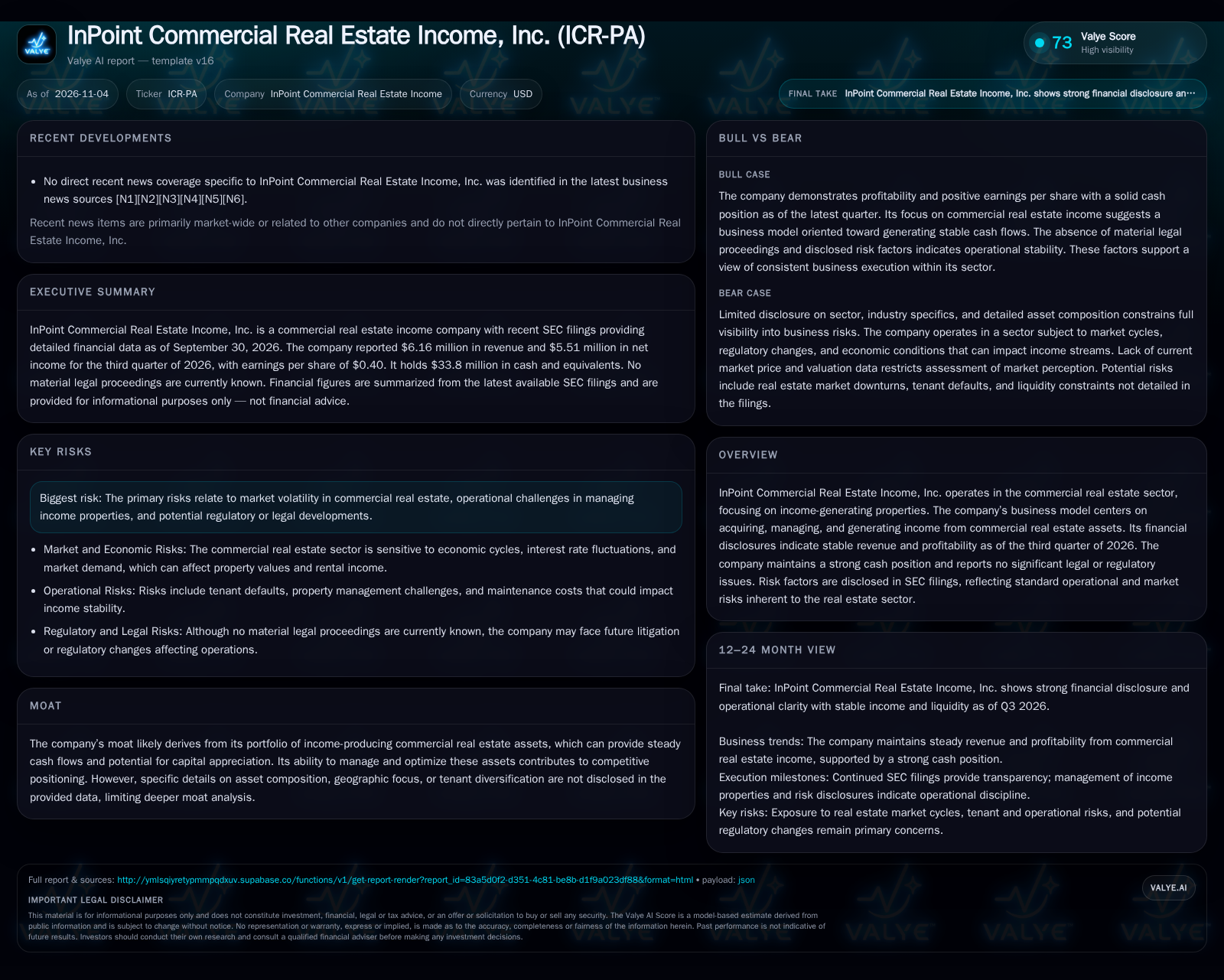
InPoint Commercial Real Estate Income, Inc. reported Q3 2026 revenues of $6.16 million and net income of $5.51 million, maintaining $33.8 million in cash and equivalents. The company’s outlook hinges on real estate market cycles and its ability to manage operational challenges such as tenant defaults and property maintenance. [S2]
InPoint Commercial Real Estate Income, Inc. stands out in the commercial real estate sector for its reported profitability and cash reserves as of the third quarter of 2026. With $6.16 million in revenue and $5.51 million in net income, the company’s recent results signal healthy margins and operational efficiency. However, the absence of detailed disclosures on property types, geographic focus, and tenant diversification limits visibility into the company’s risk profile and ability to withstand adverse sector developments. As market conditions for commercial real estate remain variable, InPoint’s continued performance will depend on its asset management discipline and adaptability to shifting economic tides. [S2]
Recent Financial Results Highlight Margin Strength and Liquidity
InPoint Commercial Real Estate Income, Inc. reported $6.16 million in revenue and $5.51 million in net income for the quarter ended September 30, 2026. This translates to an earnings per share of $0.40, indicating robust profitability for the period. The company held $33.8 million in cash and equivalents at quarter-end, which provides a notable liquidity position relative to disclosed quarterly performance. There were no material legal or regulatory proceedings reported in the most recent filings, suggesting an absence of immediate external legal threats. These facts collectively demonstrate operational stability and margin discipline, which are significant in a sector that often faces income volatility tied to market cycles. [S2]
How Income Properties Drive Earnings and the Limits of Visibility
InPoint’s core business model is predicated on acquiring and managing income-producing commercial real estate assets. Revenue is typically generated from rental income streams, which can be relatively stable if supported by long-term leases and creditworthy tenants. The company’s ability to convert a high percentage of revenue into net income for Q3 2026 suggests either favorable lease structures, low operating costs, or both. However, without disclosure of property type (office, retail, industrial, etc.), lease duration, or tenant concentration, it is difficult to assess the durability of these earnings.
Operating leverage is likely present: fixed costs such as property management and asset depreciation can drive margin expansion as occupancy and rental rates rise. Conversely, in downturns, vacancy increases and tenant defaults could rapidly erode profitability.
A deeper understanding of InPoint’s revenue stability would also benefit from an analysis of lease structures beyond duration, such as the presence of escalation clauses, percentage rents, or expense reimbursements. These features can significantly affect cash flow predictability and margin resilience. For example, leases with built-in rent escalations tied to inflation or market indices can provide a hedge against rising costs, whereas leases lacking such provisions may expose the company to margin compression during inflationary periods. Moreover, the extent to which operating expenses are passed through to tenants versus absorbed by the landlord influences net income volatility, especially in environments of rising maintenance or property tax costs.
Another important consideration is the company’s approach to capital expenditure and property maintenance. The timing and scale of capital reinvestment can materially impact short-term profitability and long-term asset value. If InPoint defers maintenance or upgrades to preserve near-term earnings, it may face higher vacancy or rent concessions in the future. Conversely, proactive asset management that includes periodic renovations or repositioning can enhance tenant retention and justify premium rents, thereby supporting income stability. Understanding the company’s capital allocation priorities and reserve policies would help assess how it balances immediate cash flow needs against sustaining asset competitiveness.
Assessing Competitive Differentiation in a Fragmented Market
InPoint’s potential competitive advantage may lie in its portfolio composition and asset management capabilities. In the fragmented commercial real estate sector, scale, geographic diversification, and tenant quality are key differentiators. If InPoint’s assets are concentrated in resilient markets or sectors (such as logistics or high-demand office space), it could sustain higher occupancy and rental rates than peers exposed to weaker segments. However, the lack of current data on asset mix and tenant profile precludes definitive conclusions about competitive positioning.
The company faces competition from both large institutional REITs and smaller private real estate operators. Substitution risk is significant: tenants can relocate, and investors can allocate capital elsewhere if returns wane.
Pathways to Enhanced Income Stability and Expansion
The most favorable outcome for InPoint would arise if its property portfolio is weighted toward sectors or locations demonstrating strong post-pandemic demand—such as logistics, data centers, or prime suburban offices. The company reported profitability for the period. The company’s cash reserve could be deployed for accretive acquisitions if distressed assets become available, providing further scale and diversification.
Confirmation of this upside would require disclosure of property types, geographic spread, and tenant credit quality, as well as evidence that rental collections remain high and lease renewals are robust. Falsification would occur if filings reveal concentration in struggling sectors (e.g., urban retail or office), rising vacancies, or declining rental rates.
Sustaining Current Performance Amid Sector Normalization
The most plausible trajectory is that InPoint continues to deliver steady, if unspectacular, income from its existing portfolio, with modest fluctuations tied to broader commercial real estate trends. Revenue and net income may ebb and flow with lease expirations, tenant turnover, and prevailing market rents, but the absence of major legal or regulatory distractions should allow management to focus on operational execution.
A shift in reported occupancy rates, a jump in bad debt expense, or new disclosures of tenant distress would challenge the base case.
Sector Downturn or Asset-Specific Issues Could Pressure Results
Should the commercial real estate market experience a downturn—driven by rising interest rates, economic contraction, or secular shifts away from certain property types—InPoint could face declining occupancy, rental rate pressure, and increased tenant defaults. These factors would directly impact revenue and could quickly compress margins given the fixed-cost nature of real estate operations.
The risk is amplified if the company’s assets are concentrated in vulnerable sectors or with a narrow tenant base. Deterioration in the company’s risk factor disclosures or the emergence of legal disputes could also indicate mounting stress.
Company-Specific Data Points That Will Shape the Investment Thesis
Disclosure of property type and geographic concentration—if provided—would clarify the durability of InPoint’s income streams and its exposure to market cycles.
Tenant concentration and credit quality metrics would help gauge risk of income disruption and potential for tenant defaults.
Occupancy and lease renewal rates, if disclosed, would offer early insight into the health of the underlying portfolio.
Debt level, maturity schedule, and interest coverage—currently undisclosed—would be critical for assessing financial resilience in a downturn.
Trends in rental rates and bad debt expense would signal underlying strength or stress in the portfolio.
Evidence of opportunistic acquisitions or asset sales could indicate management’s ability to capitalize on market dislocations.
Changes in risk factor language or new regulatory/legal disclosures in future filings would help identify emerging threats.
Disclaimer: This is research-only, informational analysis and not investment advice. It may include AI-generated interpretation and general industry context. Always verify important details using primary sources.

Comments