
Kailera Therapeutics: Clinical Ambition, Capital Strength, and the Hurdles to Commercialization
Kailera Therapeutics’ deep pipeline, highlighted by ribupatide in late-stage trials, is underpinned by reported liquidity position and recent IPO momentum. Yet the company’s lack of approved products and unproven ability to scale clinical and commercial operations leaves high execution risk, making clinical outcomes and capital access the decisive variables for its future.
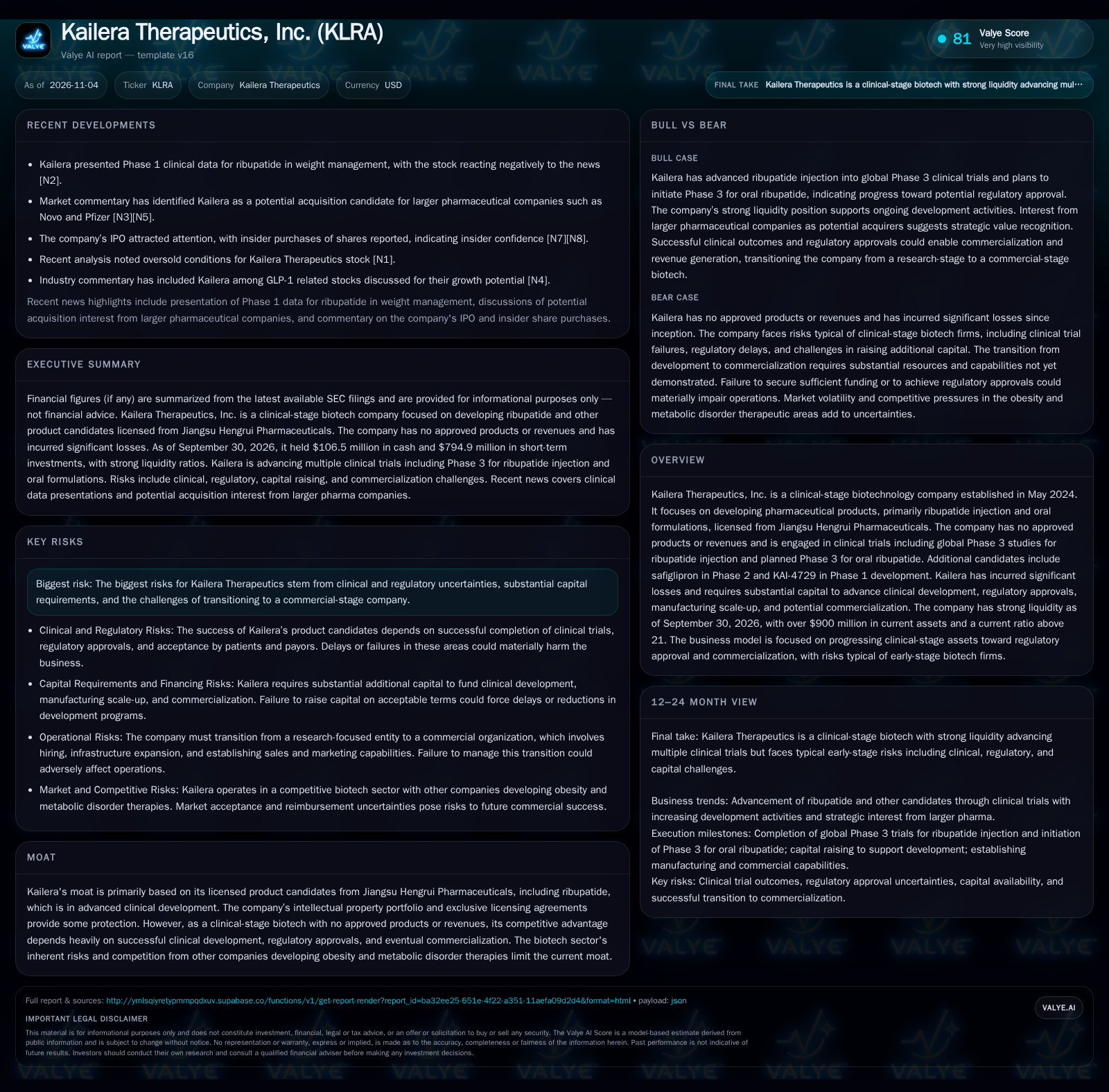
Kailera Therapeutics is a well-funded, clinical-stage biotech advancing late-stage assets in obesity and metabolic disorders, but faces the classic challenges of translating promising science into commercial reality. The company’s prospects hinge on successful Phase 3 trial results, regulatory approvals, and the ability to build out manufacturing and commercial infrastructure—or to attract a strategic acquirer before needing to raise substantial additional capital.
With no commercial products or revenue to date, Kailera’s future depends on the twin pillars of successful late-stage clinical trials and the ability to either build or partner for commercial infrastructure. The coming quarters will test whether its capital base and scientific promise can overcome the formidable hurdles of biotech execution risk.
Late-Stage Pipeline Progress and Capital Cushion Define Present Reality
Kailera Therapeutics, founded in May 2024, is a clinical-stage biotech with a portfolio centered on ribupatide injection and oral formulations, both licensed from Jiangsu Hengrui Pharmaceuticals. The company is running a global Phase 3 trial for ribupatide injection and has a planned Phase 3 for the oral version, while earlier-stage candidates include safiglipron (Phase 2) and KAI-4729 (planned Phase 1) [S1]. As of September 30, 2026, Kailera reported $106.5 million in cash and $794.9 million in short-term investments—over $900 million in current assets versus $42.1 million in current liabilities—resulting in a current ratio above 21 [S1]. Despite this liquidity, Kailera has incurred significant losses, with a net loss of $95.7 million for the most recent quarter and no product revenue [S1]. Recent events include insider share purchases around the IPO, negative stock response to Phase 1 ribupatide data, and public discussion of acquisition interest from larger pharma companies [N2] [N7] [N8]. These facts underscore Kailera’s capital strength and clinical ambition, but also its reliance on future trial success and the absence of commercial proof points.
How Kailera’s Model Could Translate Science Into Commercial Value
Kailera’s economic model is, at present, entirely pre-commercial and investment-intensive. The company’s cash burn reflects ongoing clinical development, regulatory preparation, and organizational build-out—common for clinical-stage biotechs. The core business lever for future value is the successful progression of ribupatide and other assets through late-stage clinical trials, regulatory approval, and ultimately to market launch. If ribupatide achieves approval, the addressable market in obesity and metabolic disorders is large, with precedent-setting therapies commanding premium pricing and rapid uptake. However, Kailera would then face the capital-intense challenge of scaling manufacturing, distribution, and a commercial sales force, or else licensing or partnering with an established pharma for these functions.
In terms of cost structure, fixed R&D and G&A costs currently dominate, with variable costs rising only upon commercial launch. Operating leverage could be significant if a product reaches market, but this is offset by the need for additional investment in supply chain, regulatory compliance, and post-marketing studies. The company reported cash and liquidity metrics for the period; these figures do not by themselves establish operating runway, investment capacity, financial flexibility, or financing capacity. [S1] If successful, revenue could be highly concentrated in the first approved product, with future pipeline assets providing optionality but also ongoing cash demands.
Pipeline Differentiation Versus Intensifying Competition in Obesity Therapeutics
Kailera’s competitive position rests on the clinical promise of ribupatide and the exclusivity provided by its licensing from Jiangsu Hengrui Pharmaceuticals. The obesity and metabolic disorder therapeutic space is intensely competitive, with multiple established and emerging players—many of whom have greater resources, broader pipelines, and commercial infrastructure. In this environment, differentiation depends on demonstrating superior efficacy, safety, tolerability, or dosing convenience in late-stage trials.
Intellectual property protection and exclusive licensing are necessary but insufficient for long-term advantage. The real moat will be determined by clinical outcomes, regulatory success, and—if approval is achieved—speed and effectiveness of commercialization. Potential substitutes include other GLP-1 analogs, peptide therapeutics, and next-generation metabolic drugs. If ribupatide can show best-in-class or first-in-class attributes in pivotal trials, Kailera could attract partnering or acquisition offers from larger pharma, especially given recent market consolidation in metabolic disease therapies. Conversely, if trial results are equivocal, the company may struggle to secure a lasting foothold.
What Success Could Look Like: Clinical Wins, Pharma Interest, and a Commercial Inflection
In a favorable scenario, Kailera delivers strong Phase 3 efficacy and safety data for ribupatide, resulting in regulatory approval in major markets. The company leverages its liquidity to advance manufacturing and commercial planning, either building its own infrastructure or securing a lucrative licensing or acquisition deal with a larger pharmaceutical partner. Ribupatide launches into a receptive obesity/metabolic market, achieving rapid adoption due to differentiated clinical data or patient convenience.
This scenario would be confirmed by positive late-stage trial readouts, regulatory filings, and announcements of commercial partnerships or M&A activity. A sharp reduction in quarterly cash burn post-approval, accompanied by initial product revenue, would further validate the transition to a commercial-stage company. Additional pipeline progress—such as positive data from safiglipron or KAI-4729—would add to the optionality and perceived valuation.
Most Likely Trajectory: Prolonged Clinical Timelines and Ongoing Capital Demand
The most plausible outcome is that Kailera continues advancing its trials, incurring substantial operating losses as it moves ribupatide through global Phase 3 and prepares for regulatory submissions. Clinical timelines may extend, as is typical in late-stage drug development, requiring careful cash management and likely further capital raises before revenue is realized. In this scenario, the company’s stock remains sensitive to clinical data releases and capital market conditions.
Confirmation would come from continued but measured pipeline progress, recurring net losses, and periodic financing announcements. Falsification would occur if trial results are unexpectedly positive (accelerating partnering or M&A) or negative (forcing pipeline reprioritization and cost cuts).
Execution Risks: Clinical Setbacks or Funding Gaps Derail the Pipeline
In an adverse scenario, ribupatide fails to deliver compelling Phase 3 results, or regulatory bodies require additional studies, delaying or blocking approval. With no revenue and high fixed costs, Kailera could face a liquidity crunch, especially if capital markets are unreceptive to further equity or debt offerings. The company may be forced to halt or delay pipeline programs, reduce workforce, or seek asset sales under unfavorable terms.
This scenario would be confirmed by negative or inconclusive clinical trial results, public disclosures of cost-cutting measures, or warnings regarding the ability to continue as a going concern. An absence of partnering or acquisition interest would further undermine the strategic case.
Milestones and Metrics That Will Determine Kailera’s Trajectory
Readouts of pivotal Phase 3 data for ribupatide injection and progress toward Phase 3 initiation for the oral formulation.
Updates on regulatory submission timing and interactions with FDA/EMA or other major agencies.
Disclosures of additional capital raises, runway estimates, or changes in projected cash burn rates.
Announcements regarding manufacturing scale-up, commercial infrastructure build, or partnering/licensing deals.
Evidence of acquisition or strategic partnership interest from major pharmaceutical companies.
Progress and data releases for earlier-stage assets, particularly safiglipron and KAI-4729, if disclosed.
Insider transaction activity was reported in the cited source; this activity does not by itself establish insider confidence.
Market and payor reactions to clinical data, including analyst commentary on competitive positioning and pricing potential.
Disclaimer: This is research-only, informational analysis and not investment advice. It may include AI-generated interpretation and general industry context. Always verify important details using primary sources.

Comments